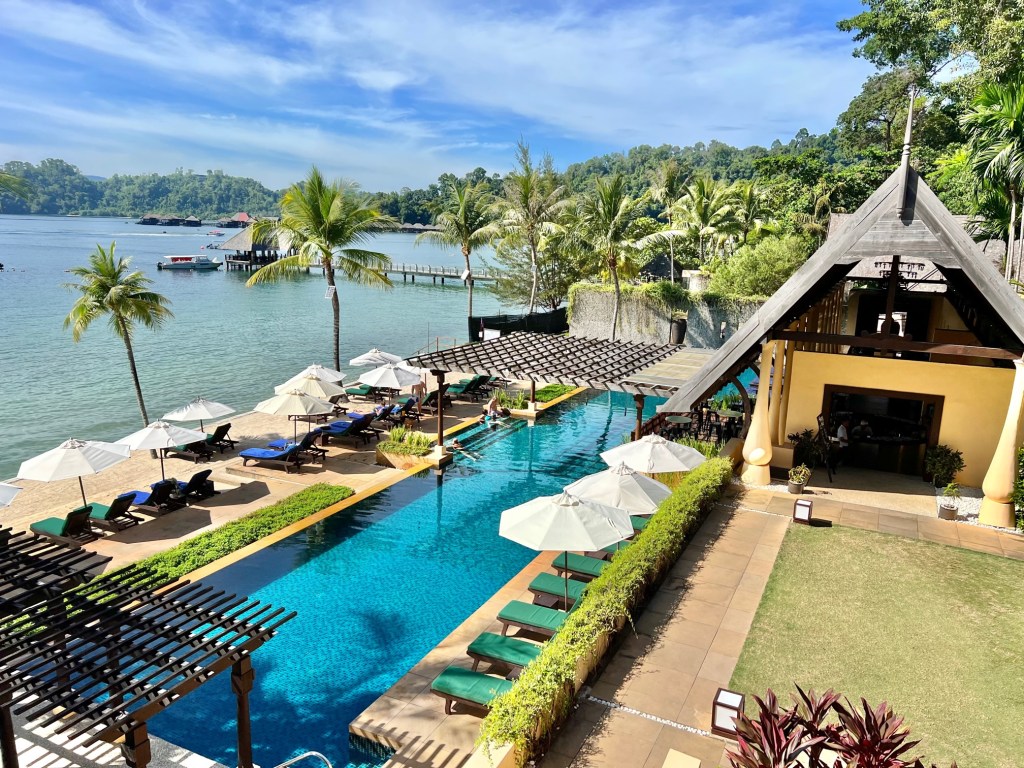
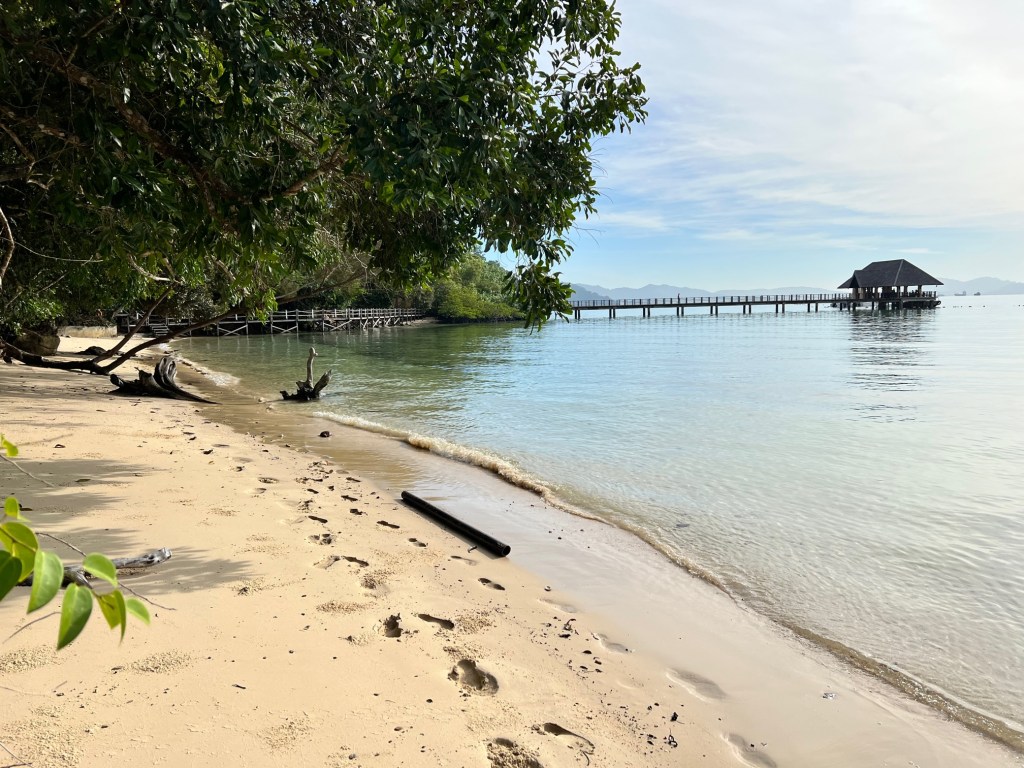
We spent our last three nights in Borneo at the Gaya Island Resort. We wanted to end with a beach resort, but it wasn’t really the kind of beach resort I prefer.
The view from our room at Gaya Island Resort.
We landed at the airport in Kota Kinabalu a short 45 minutes after takeoff from Lahad Datu. Another short trip in a taxi had us at the pier. A boat from the resort picked us up and we were at the resort in less than fifteen minutes. And that is what I didn’t like about it. When I go to a beach resort, I want to be further out, and harder to get to. And I really don’t want to see the mainland and the port from my room. But that is how it was.
The room was nice. The pool was nice. But it just didn’t really feel very beachy to me. We checked out the turtle rescue program, and saw the sun rise from our deck. The best part about the resort was the spa.
The dock at sunset.
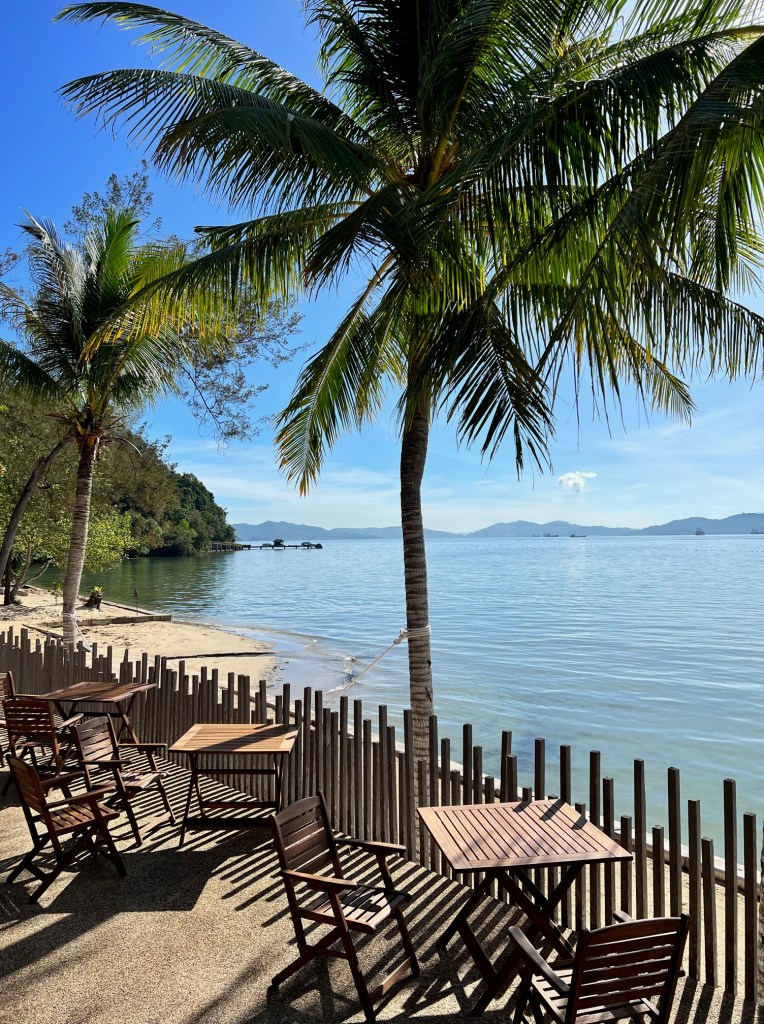
There wasn’t much beach, and there was quite a bit of floating debris (plastic) and warnings of jelly fish. We spent our days relaxing and saving up energy for the long trip home. I did swim in the South China Sea, something I’d not done before.
Sunrise from our deck at Gaya Island Resort.
I can’t say I’d recommend this resort, unless eating and swimming in a pool is your idea of a beach resort. My sister and I both had a very good massage though. Our favorite part of the trip was the Borneo Rainforest Lodge and seeing the orangutans in the wild, being very far into the forest. And that was what I didn’t like about the beach resort. It was too close in. But this trip was mainly about seeing the wildlife, so that was great. The Malaysian people were all very nice. We saw quite a few cats, and it seems to be a cat culture. We saw a few skinny dogs, but not that many. I would do things a bit differently if I had to do it over again, but that is the case on almost every trip.
Leaving the resort for the long trip home. We had to fly from Borneo to Kuala Lumpur, then Hong Kong, then Los Angeles. It was a long way to go, and air travel is not fun.
We started our day with a two hour drive from the Kinabatangan River to the town of Lahad Datu. Here we are taken to the office of the Borneo Rainforest Lodge. The Lodge is an additional three hour drive up into the rainforest. Guests are put into a pickup or a Toyota Landcruiser and we begin the journey. The paved road ends about 1/4 of the way into the drive. The remainder of the road looks and feels a lot like the logging roads at home in Oregon.
We even cross a few creeks on our way to the Lodge.
Buffet style eating at the Borneo Rainforest Lodge.
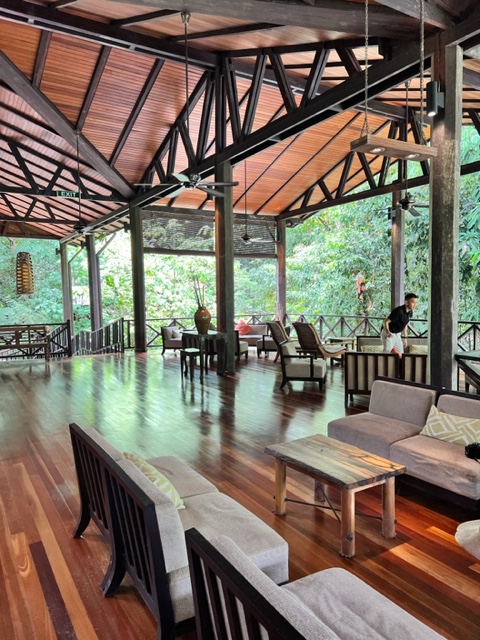
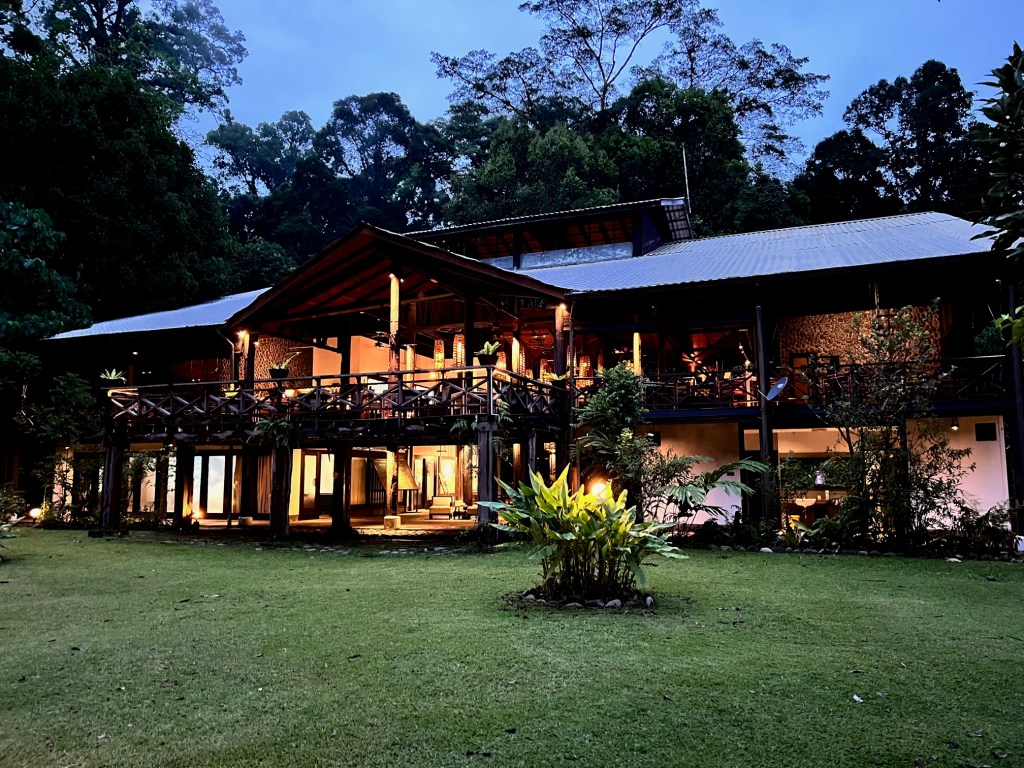
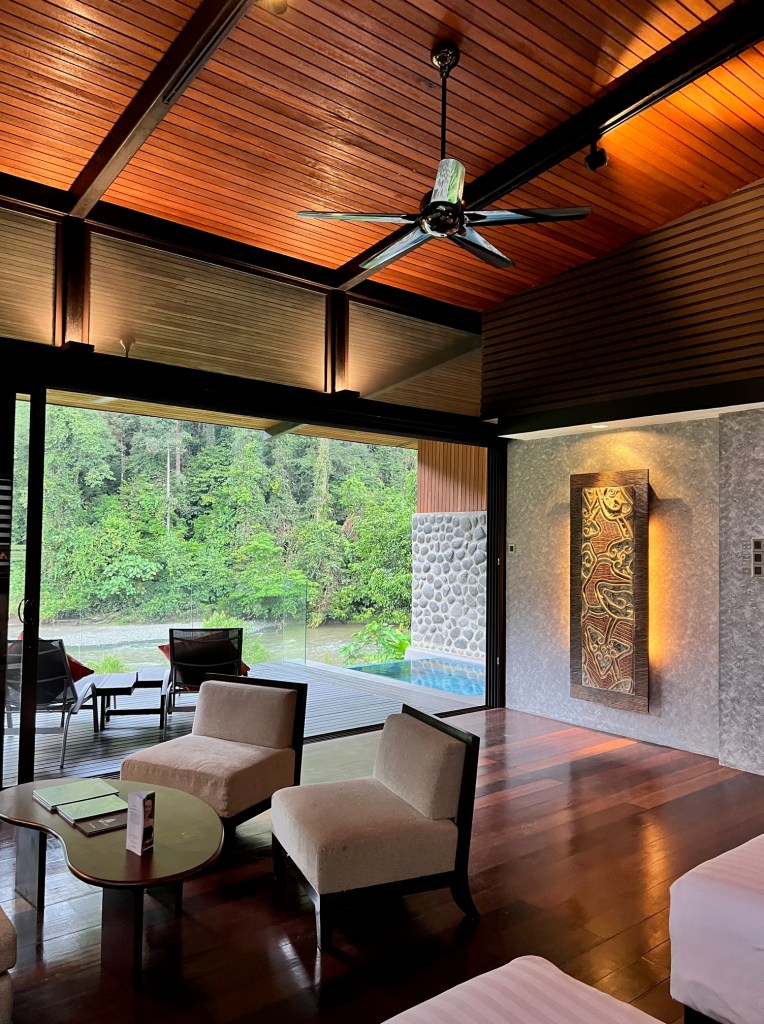
Once at the Lodge, we have lunch and are shown our room. This lodge has been described by the Lonely Planet Borneo guidebook as for “Indiana Jones types with healthy wallets.” Pretty accurate. The rooms are beautiful, the food is good, and the guides are knowledgeable. They also have a proper wine list and real coffee to my delight. No Indiana Jones movie would be complete without a suspension bridge, and there is even one of those.
We relax in our room, and watch a torrent of rain as a thunderstorm moves overhead. Our first hike is a short afternoon orientation walk. Leech socks are essential. Leeches sit on the leaves and reach out as you pass, trying to attach themselves as we walk by. Every now and then we stop for a leech check. The socks are pulled over your pant leg, and if a leech climbs up your shoe and lower leg, they can’t penetrate the sock. I picked up a leech on the first walk, but did not get bitten. By the end of our three day stay, both my sister and I were bitten by at least one leech, and we did wear leech socks.
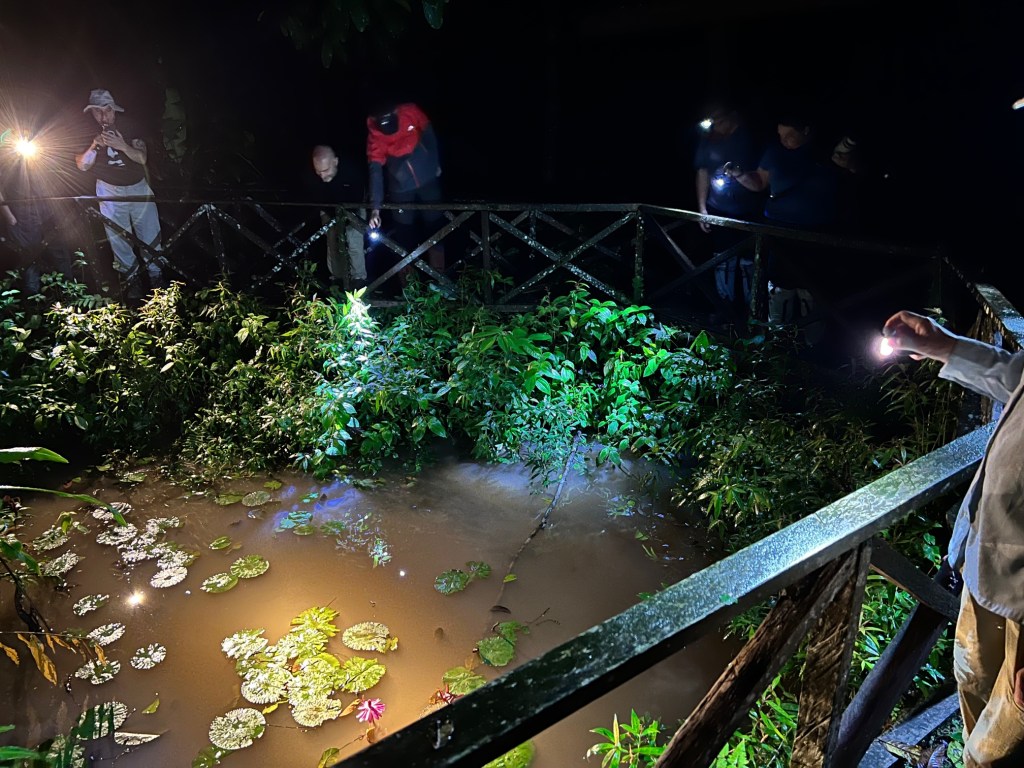
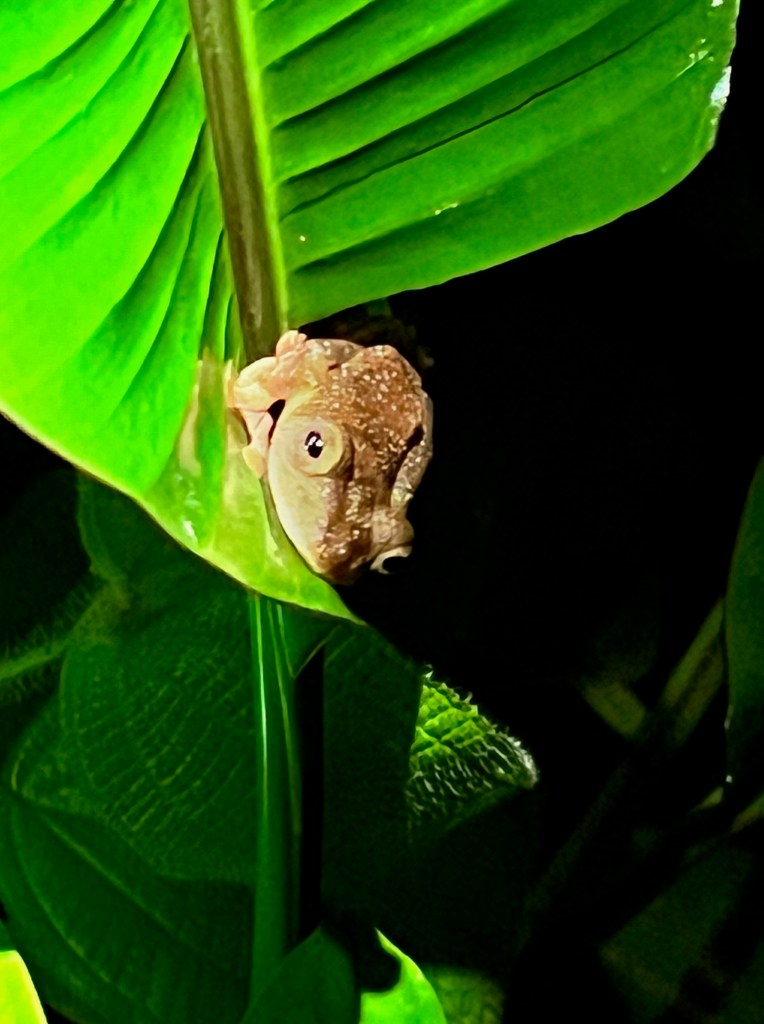
Our first evening at the lodge we walked the short distance to a frog pond looking for frogs. We found some. Maybe not as exciting as an orangutan, but it was fun.
On our second day at the BRL we started out at 8 am to walk up to the overlook. It is a four hour round trip hike. It was not a flat walk, and it was warm and humid. We crossed several suspension bridges, and saw at least three wild orangutans in the tree tops.
The trail at times was steep and muddy.
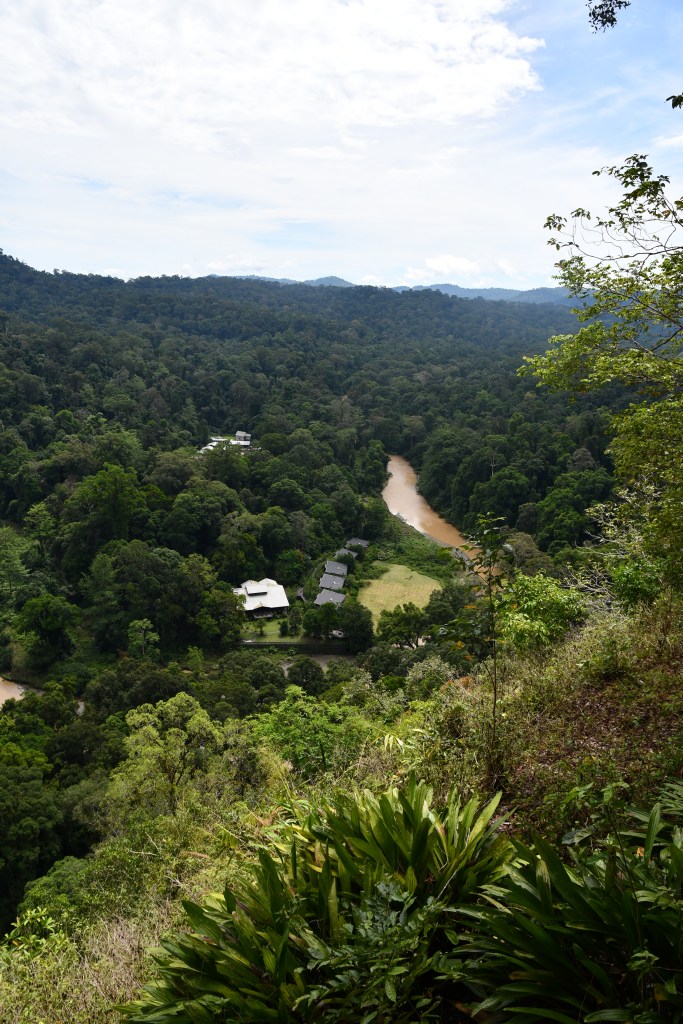
A view of the lodge below, from the top of the trail.
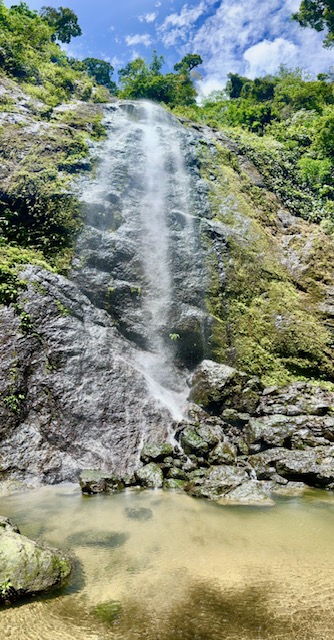
From the viewpoint, you can either return back down the same trail, or continue a bit further, on even steeper terrain, to Fairy Falls. We opted to continue. It was worth it.
Fairy Falls, a little walk past the viewpoint.
We were told to bring our swim suits along on the hike, and there would be a natural pool for swimming. As promised, hot and tired on our return hike to the lodge, we plunged into the cool natural pool. It was heaven.
We were back down to the lodge by 12:30. It was a good walk despite the heat, humidity and leeches, and I had a massage scheduled for 3 pm.
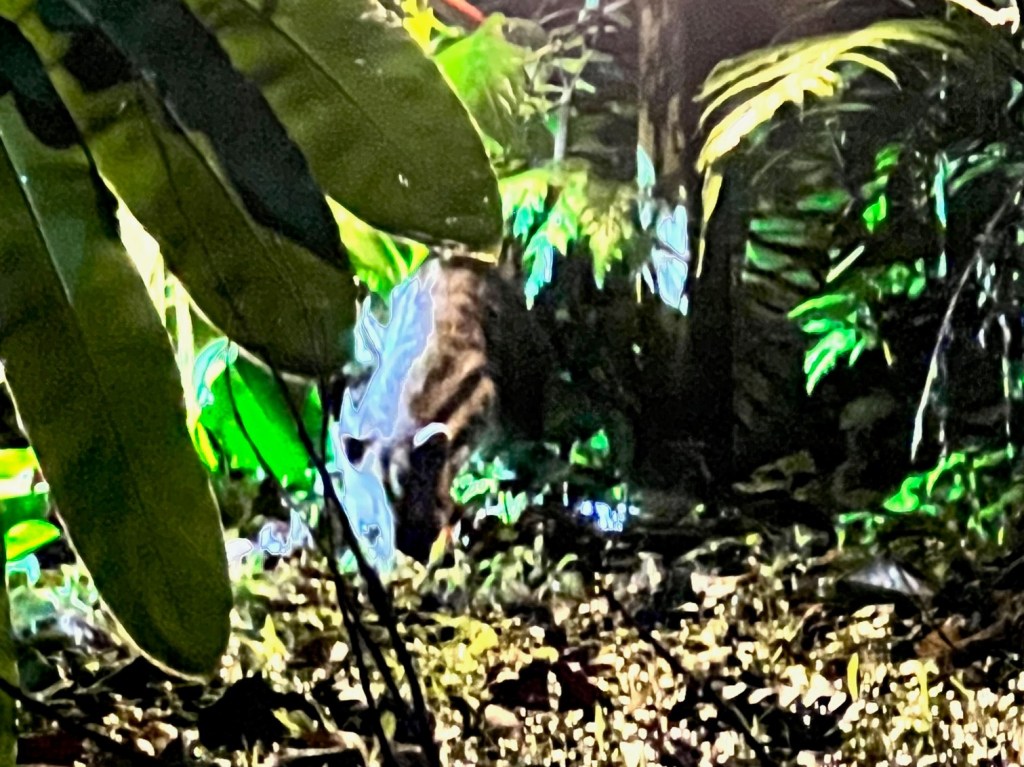
There is wildlife in the area surrounding the lodge, you really don’t have to go far. We saw a Malay Civet not far from the lodge entrance. The photo below is not good, but the best I could get, as it was at night, zoomed in with an iPhone. The civet cat was under a landscape light eating bugs.
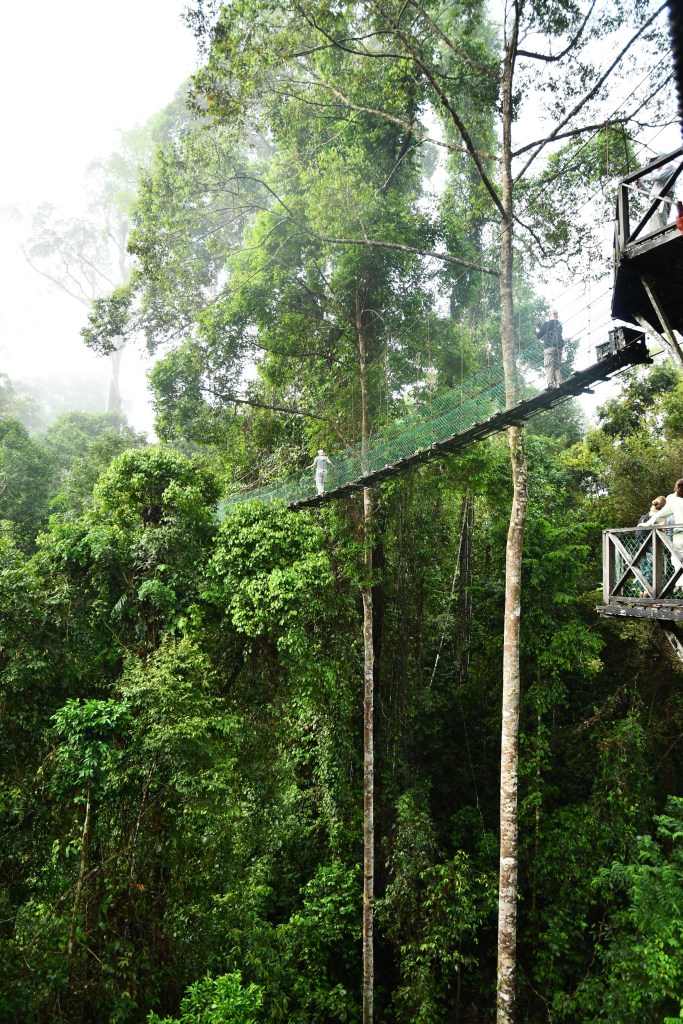
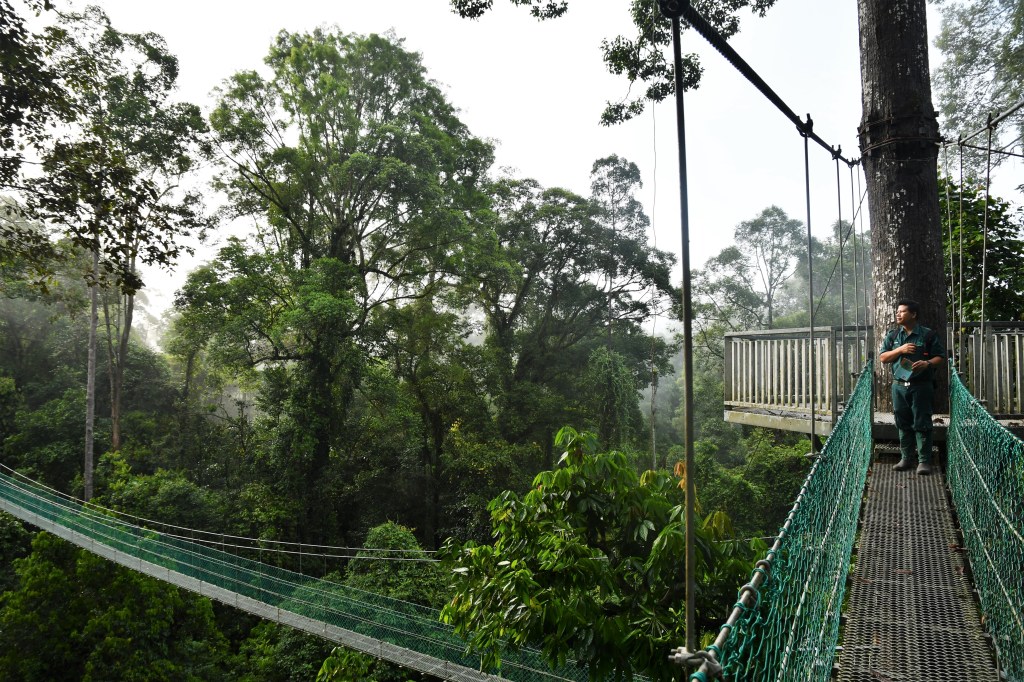
The next morning, before breakfast, we headed to the canopy walk. The mist hangs in the tree tops most mornings. We left the lodge near sunrise, and watched as the shadows faded and the colors turned from dark to green.
Sunrise on the canopy walk.
In the morning, as mist hangs over the tree tops. As the sun rises the colors change from grey and dark to a vibrant green.
In the afternoon of the same day, we got a very close look at a rather large orangutan. He had been in a tree close to the lodge and decided it was time to climb down. We watched as he made his way under the boardwalks that connect the rooms. Suddenly he grabbed a small tree and easily swung up onto the boardwalk. A guide called out “Back, back”, to us, not the great ape. The orangutan slipped between the rails and then down over the other side. It was wonderful to see him so close.
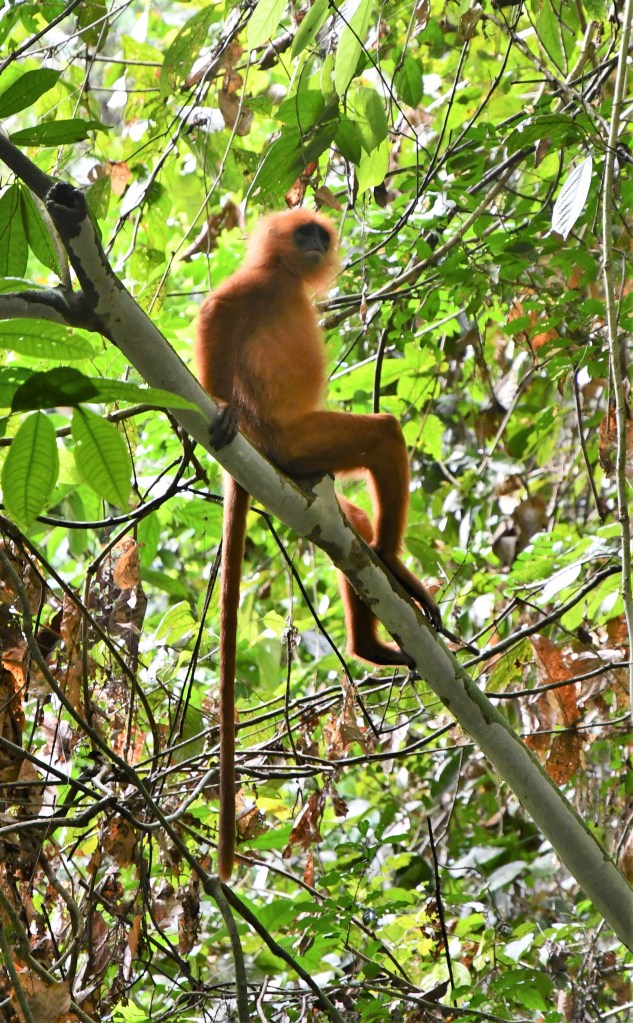
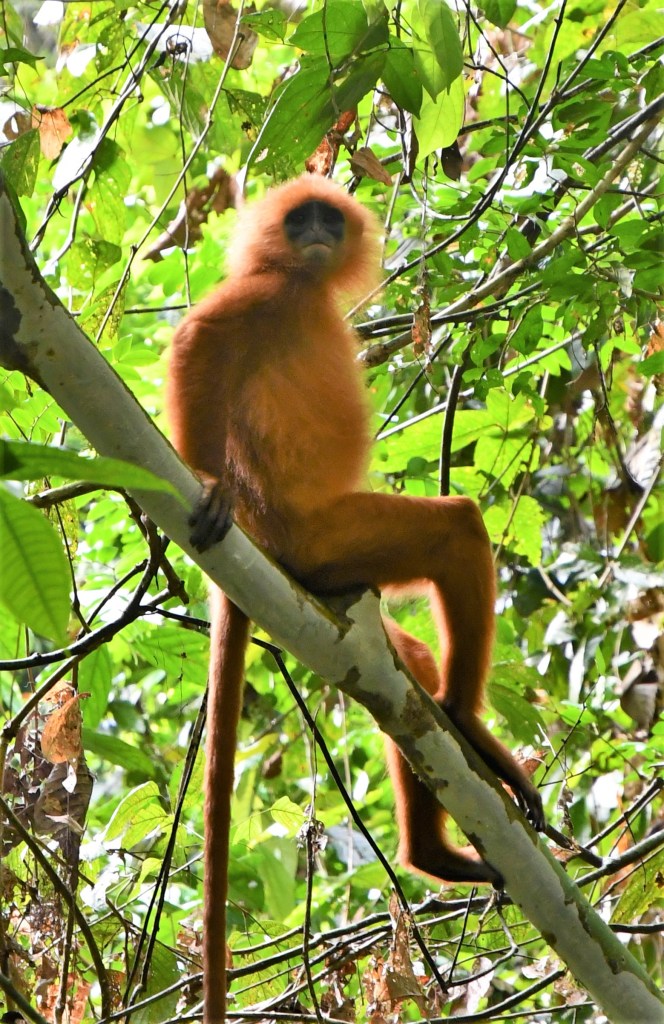
That afternoon, my sister and I joined the guide for a walk in search of the Red Leaf Langur. We set out to see that specific monkey, and darned if we didn’t. We found three, playing in the trees and watched them for a while. If was just the two of us and the guides, so we were able to be quietly watch them for as long as we wished.
Red Leaf Langur
On our last evening at the lodge, we did a night walk, hoping to see deer. We didn’t see the deer (we did see their tracks) but we did see a Tarsier, also called a ghost monkey. They are very small, about 4 to 5 inches tall, nocturnal creatures. We saw it hanging onto a reed stem. My photo was so blurry as to be unusable, so I am using a photo from the book in our room. I don’t like to use photos other than my own, but it was a relatively rare sighting and I don’t think many people would be able to picture what a Tarsier looks like, so I am using this. I am sorry that I didn’t take notes to be able to site the name of the book or the photographer.
We saw a Tarsier like this one on our night walk. This is a photo from a book in the room.
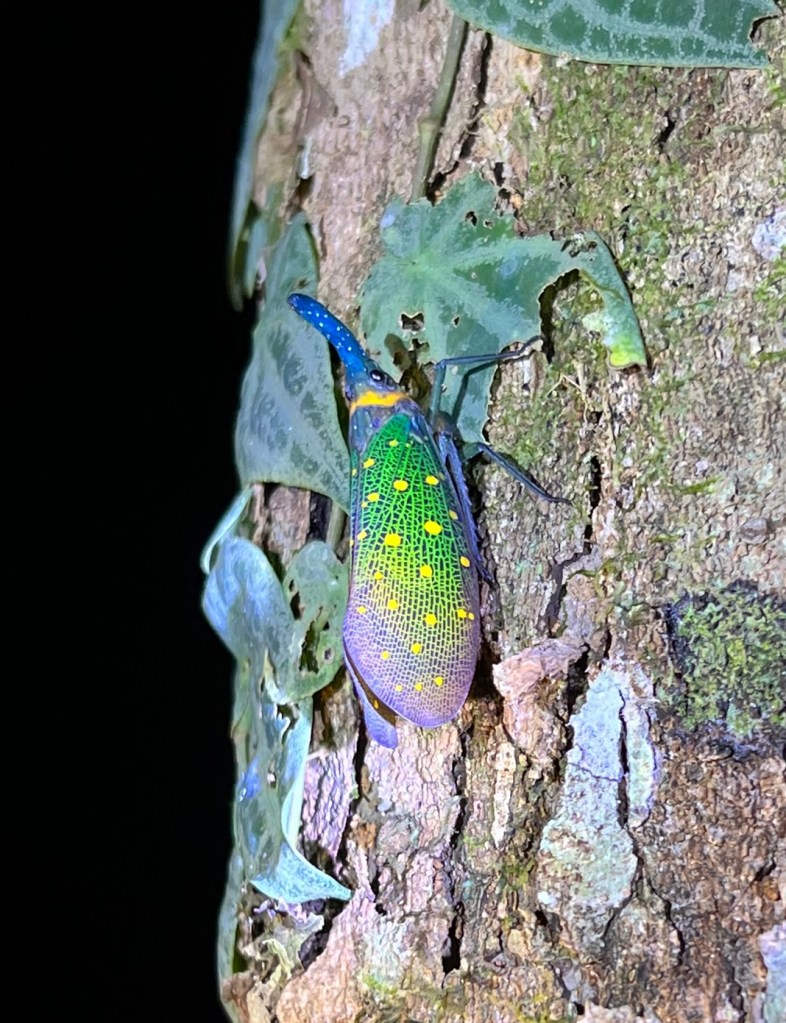
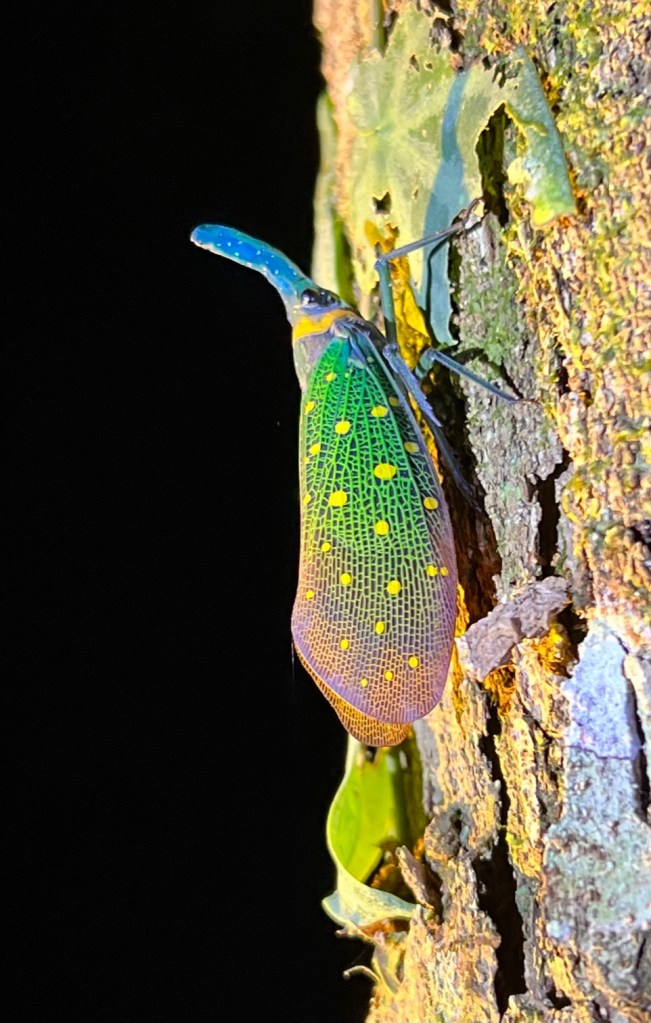
We also saw this Lantern Fly on our night walk.
Lantern Fly
On the morning of our departure, from our deck we saw eight otters scamper along the river. This was the second morning we saw them, playing and catching fish. They are Small Clawed Otters. I did one last nature walk in the morning and was rewarded with Gibbons. I saw two, high in a tree. It was the first sighting of Gibbons for us.
Our list of sightings here was pretty good. There were many more birds than I can name, but here is a short list of what we saw:
Malay Civet
Orangutan
Small Clawed Otter
Blue-throated Bee-eater
Rhinoceros Hornbill
Monitor Lizard
Tarsier, “ghost monkey”
Red Leaf Langur
Frogs
Gibbons
We did not see any elephants at the RFL, but a few guests saw them on the drive up. Our return drive to the airport in Lahad Datu was much faster than the drive up. It felt like we were participating in the East African Safari Classic. The driver took 30 minutes off the trip, but probably 3 years off my life. We staggered out of the vehicle at the airport, glad to be getting into a turboprop. The 45 minute ATR flight to Kota Kinabalu was much smoother.
A three hour Boeing 737 Malaysia Airlines flight from Kuala Lumpur had us to our final destination of Borneo.
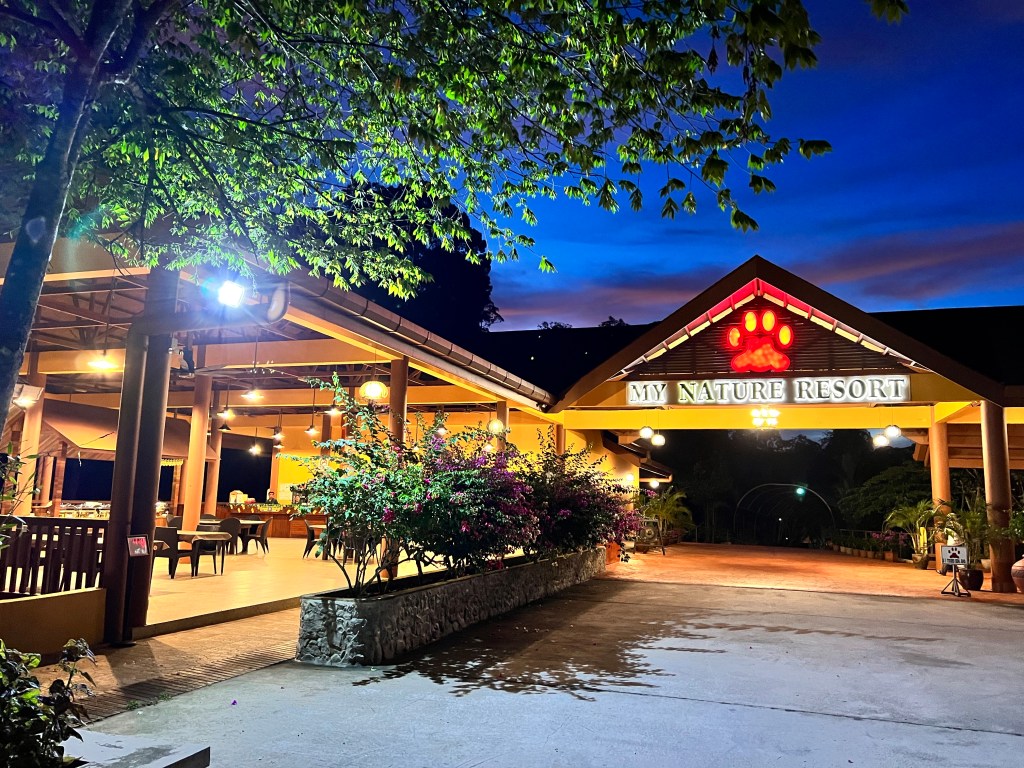
MY Nature Resort.
The island of Borneo (the world’s third largest) is shared with three countries; Malaysia, Indonesia, and Brunei. We are staying in the Malaysian portion. Our itinerary includes two nights at a lodge near the Orangutan Rehabilitation Center in Sepilok, two nights on the Kinabantangan River, and three nights at the Borneo Rainforest Lodge in the Danum Valley.
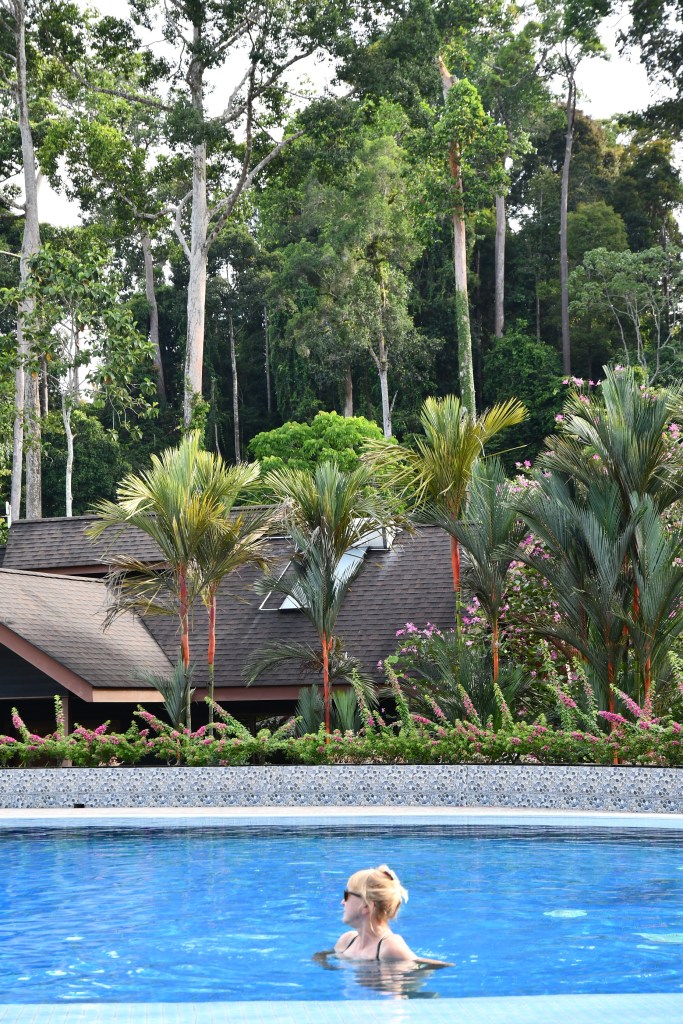
We are met at the Sandakan airport in the Sabah region on the northern tip of Borneo and driven to MY Nature Resort. It is, naturally, oppressively hot. They have a very nice pool and that is where we spend the afternoon. The rooms are nice, but the attraction here is the very close proximity to the Orangutan Sanctuary. At dinner they served a very tasty ginger fish and mango pudding for which I’d love the recipe.
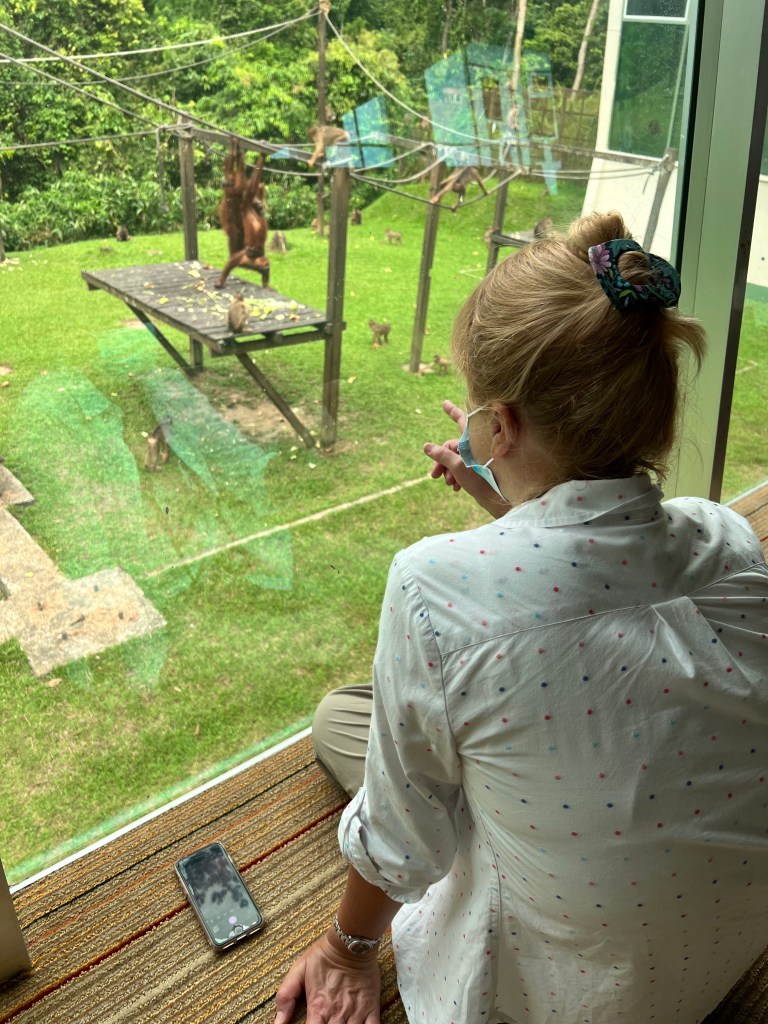
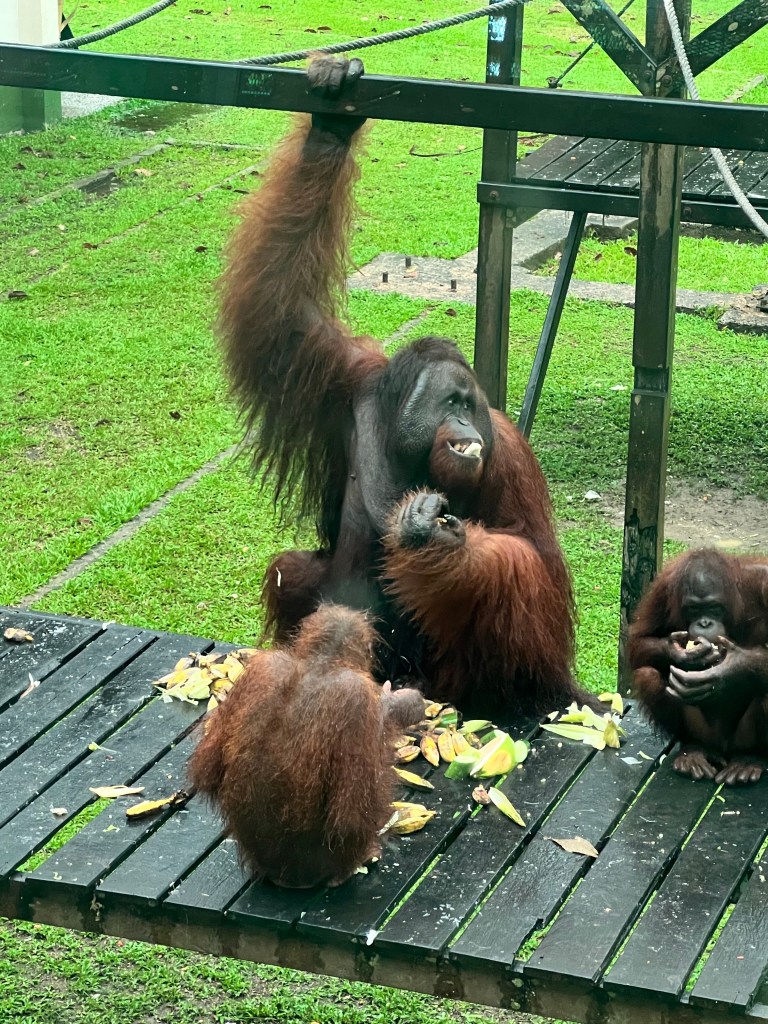
On our first full day in Borneo we luckily are able to modify our original itinerary, and we hopped on an early morning visit to the Sepilok Orang-utan Sanctuary. These Wild Men of Borneo (Orang-utan translates to man of the wild) are what we traveled so far to see in their own habitat. The entrance fee is inexpensive, 30 Malaysian Ringgit, or about $7 US, and an additional 10 MYR for my camera ($2.50). Masks are required. A boardwalk winds through the tropical jungle of the rehabilitation center, which occupies 17 square miles. We began our Orangutan encounter with a stop at the outdoor nursery. The center takes in orphaned and injured animals, and eventually releases them to the wild. The area around the sanctuary is open, unfenced, and the great apes can come and go. They come back to the center at feeding times, if they wish. Today we are lucky. One of the largest male Orangutans has come back to the center. Sometimes they do not see him for months at a time. We see him at the nursery and again at the feeding station. They are fun to watch, and the morning visit is fairly crowded. Tour buses line the curb outside.
In the outdoor nursery
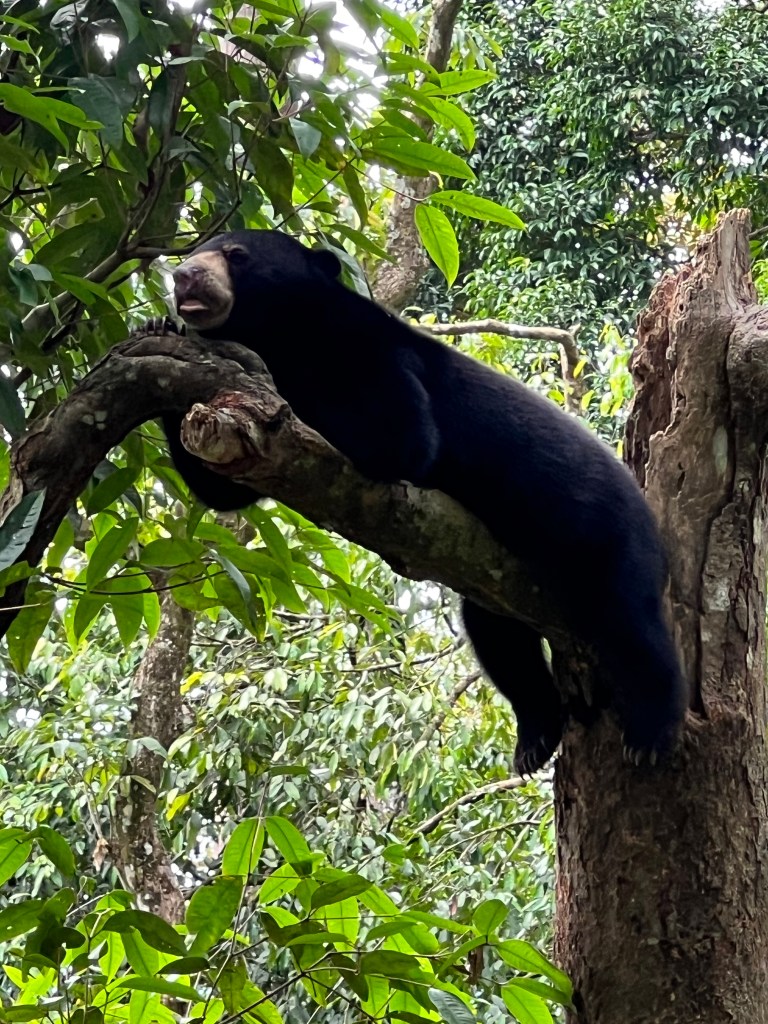
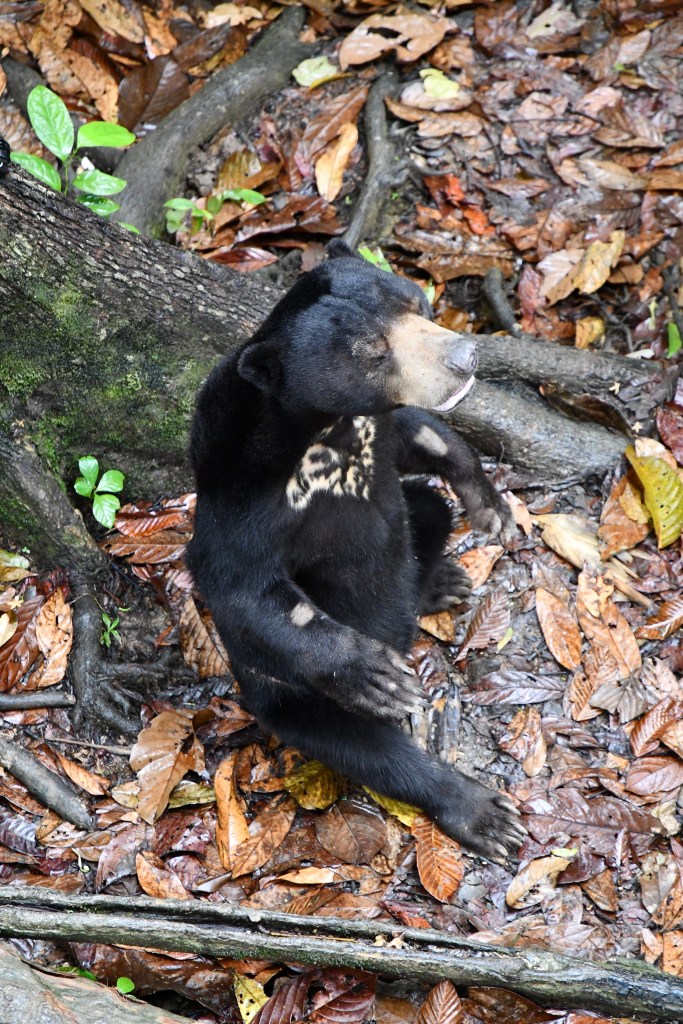
Right next door to the Orangutan center is the Sun Bear Conservation Center. These smallest of all bears are also fun to watch. All the bears at the center have been rescued. The aim is to release them back into the wild. Unfortunately for them, they are small and cute, which is why they are kept as pets. They are also kept in small cages and used for bile production, used in “traditional medicine”. It is horrible. Many have been rehabilitated and released. Our morning excursion lasted between 9 am and 11 am.
Sun bear.The outdoor feeding platform.
We returned to the resort in time for a quick plunge in the pool and lunch. We decided to tag along again on the afternoon tour. We returned at 2 pm to the same centers, using the same ticket. It was a different experience, and much less crowded. Our afternoon visit rewarded us with a private viewing of sun bears in the trees, as we were the only visitors. It was unbelievably hot and humid, and it was taking its toll. Our afternoon visit was shorter, 1 ½ hours.
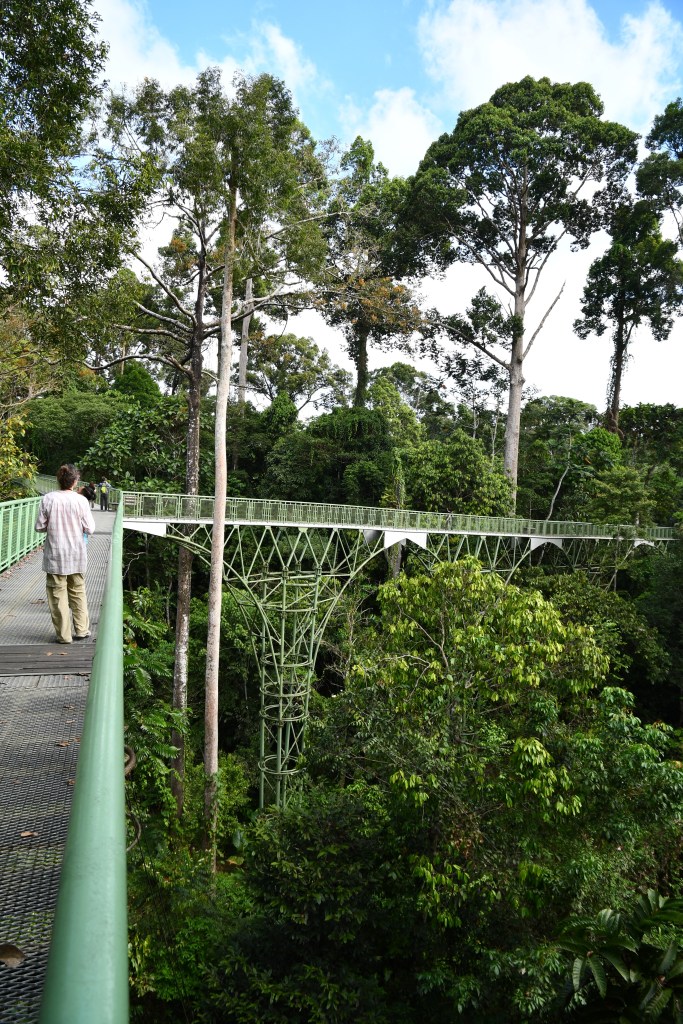
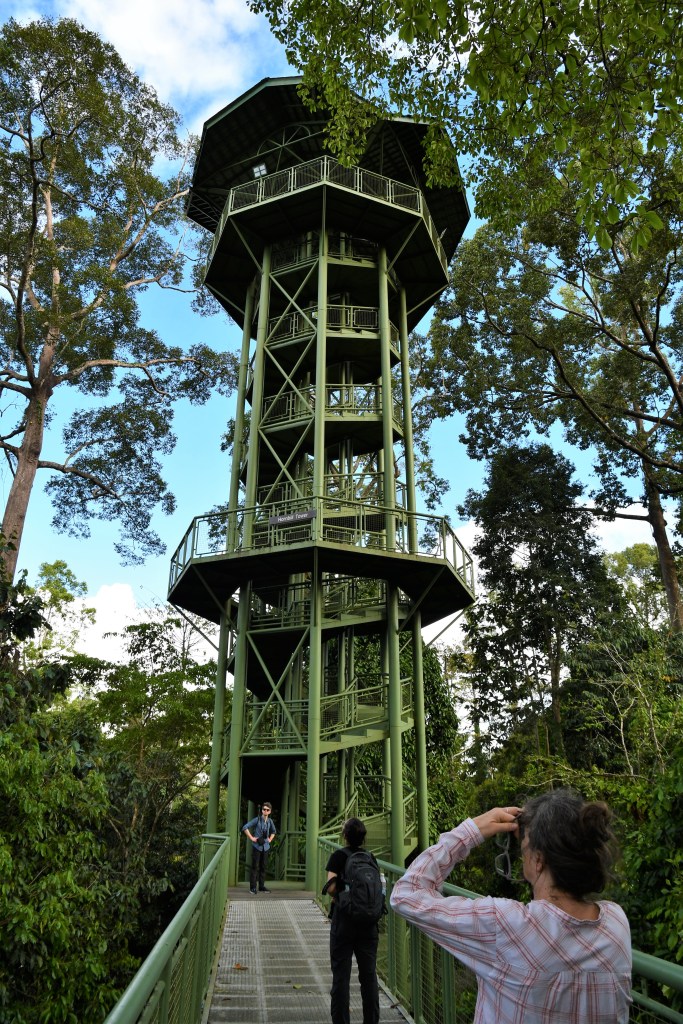
Back at the resort we had just enough time to change and meet our guide for a 4 pm guided tour of the Rainforest Discovery Centre. This one guided tour was our only original tour scheduled for today. The RDC is just .6 km from the resort and has an incredible tree top canopy trail, but 4 pm is just about peak heat and humidity, and we had been going since early in the morning.
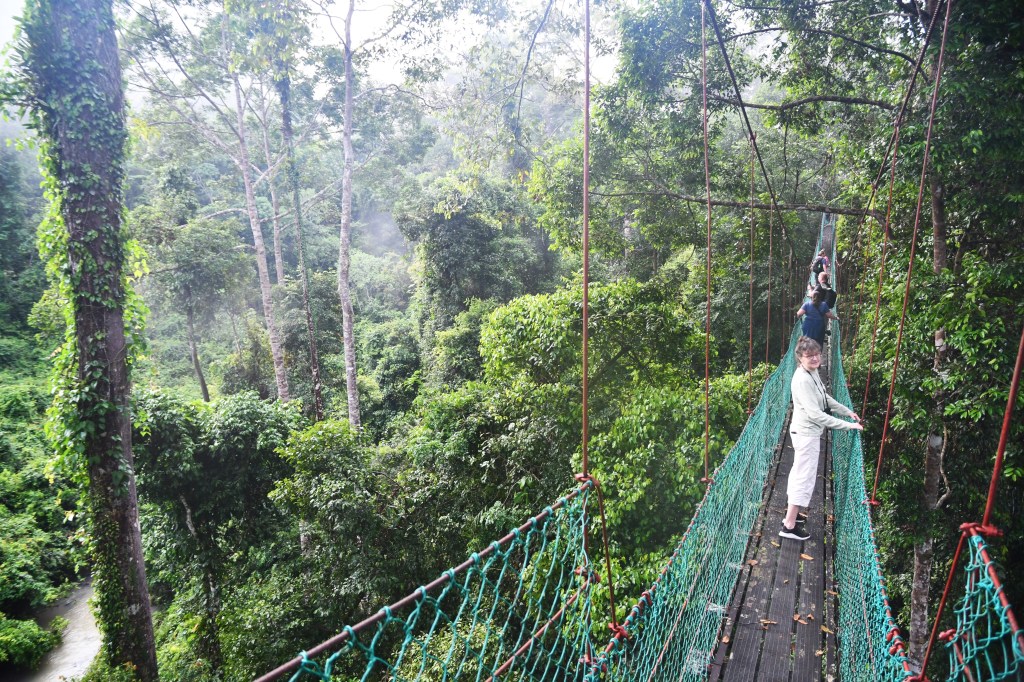
Canopy walk at the Rainforest Discovery Centre, Sepilok, Borneo.
We enjoyed the canopy walk 100 feet in the air, but were seriously dragging. We had a good sighting of a giant red flying tree squirrel gliding between trees, two rhino hornbills, and a raptor. We also saw many of the black squirrels. Being near the tree tops afforded a small breeze at times, and a few towers reached even higher than the canopy trail, but it was all we could do to walk the hour and a half and then return to the lodge. Even a ten minute plunge in the pool was a welcome respite from the heat.
That night we got a good long soaking rain, and woke to rain the next day. Thank the gods, because it cooled everything down. We packed our bags and headed back to the Orangutan Center and Sun Bear Center, before our transfer to the next lodge. It was much cooler. Our guide today told us that the temperature yesterday had reached over 40 degrees C, and was unusually high for this area. So it was not our imagination and even the local people are saying it is very hot. I think it was the hottest temperatures I have ever experienced. Once again we watched the center staff bring out food to the platforms and saw the shaggy orange little men and women eat their snack. We were glad to have had the ability to visit the centers three times. At each visit we saw something a little different.
Our transfer to the Kinabatangan River lasted about two hours. Almost the entire time we were driving on roads flanked by palm oil plantations. Some of the plantations had taller, older trees, some were newly planted, and some areas were being cleared for new trees. These two titans of industry and economy, palm oil vs. tourism, seem to be on a collision course. But the palm oil people got here first. As that industry grows, it pushes the wildlife out. Tourists come to this part of Borneo to see the wildlife along the river. The palm plantations are supposed to leave a buffer zone along the river, but there too we saw plantations right up the river’s edge.
Upon arrival at the Kinabatnangan Riverside Lodge, we kicked off our shoes (required in all common areas) and had lunch. The common areas here are wide and open with hard wood floors throughout. They have a beautiful deck along the river with hammocks and tables. Our first wildlife boat safari began at 4 pm. Our fears of even hotter and more humid conditions dissipated as we climbed into our open boat. A cloud cover provided some relief and we found it pleasant. We checked off three big ticket sightings; pygmy elephants, proboscis monkeys, and a small crocodile. Traveling up and down the river we watched for wildlife, but for me the best part was sitting on the river and listening to elephants communicate with each other.
A Proboscis Monkey on our first river safari.
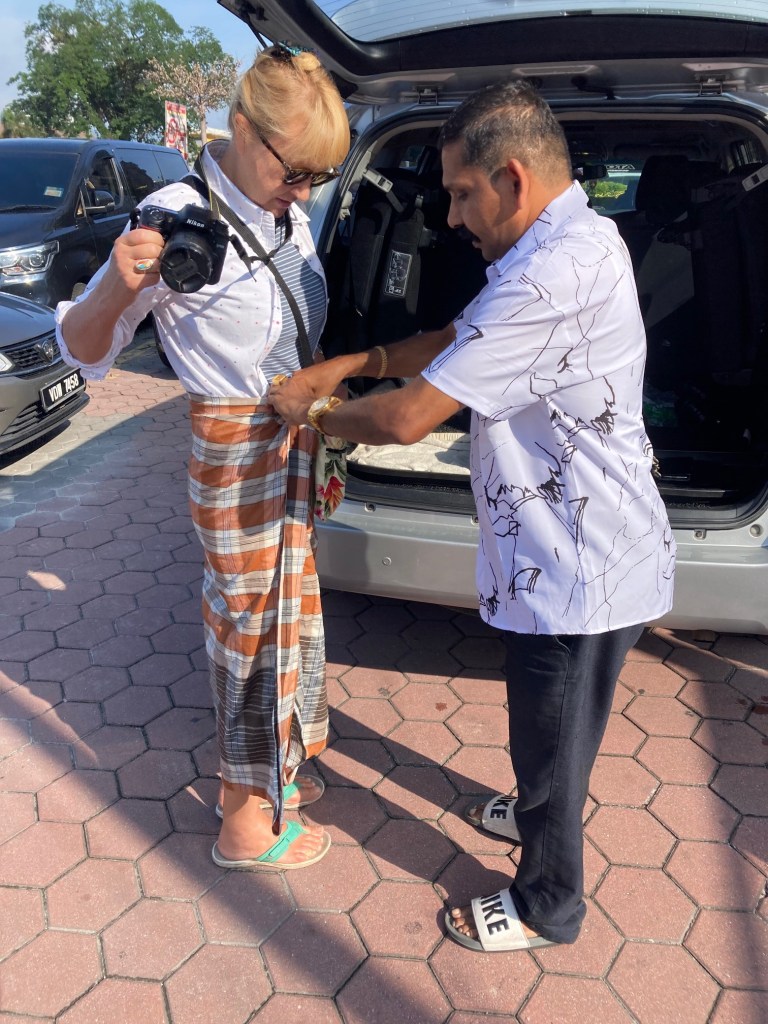
Back at the lodge we were instructed how to wear the sarongs provided in the rooms. It was, of course, our choice, and we wore them to dinner. We had musicians playing traditional music with drums and gongs during dinner. Being a majority Muslim country, alcohol is not widely consumed. At the last two lodges, the choice has been between a chardonnay or a merlot, neither one of which I am a fan. So this has been a good time to “cleanse.” We are eating steamed rice with fish and vegetables, and water.
Rocking the sarong for dinner.Dinner entertainment at the river lodge.
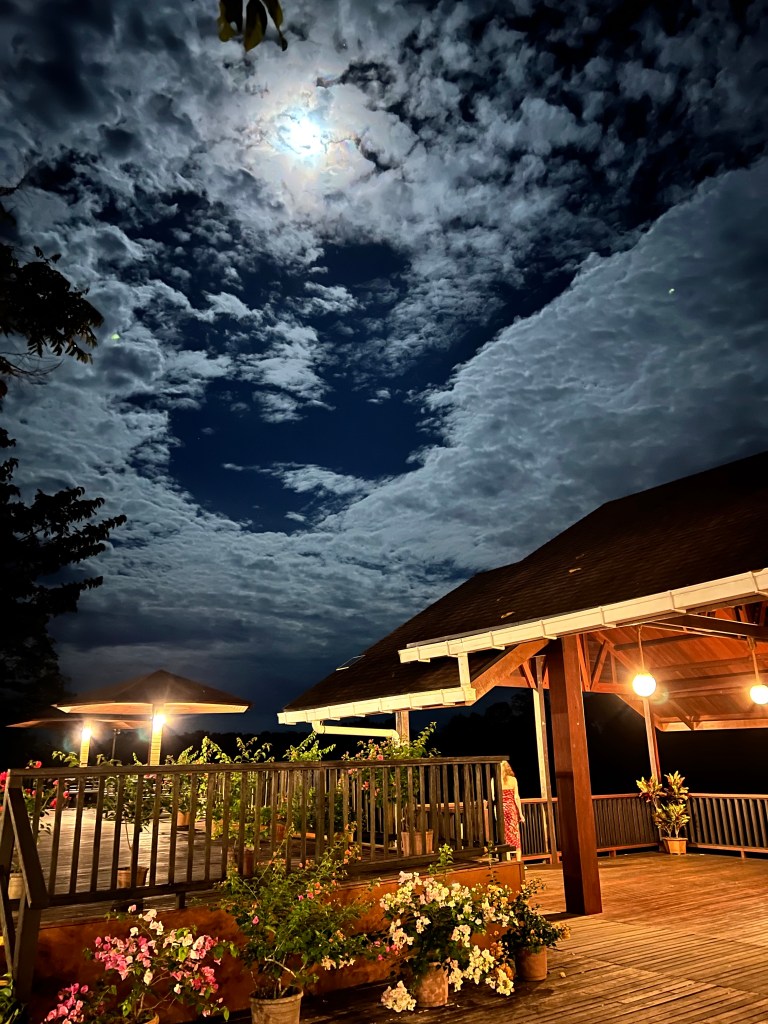
After dinner we walked onto the deck by the river, under what looked to be a full moon, or nearly full. The un-retouched photo below was taken on my iPhone 13 Pro. The iPhone takes better low light pictures than my Nikon, and is easier to use.
Full moon over the Kinabatangan River. Taken with an iPhone 13 Pro.
It is all about the river here, so at 0630 we had our second wildlife boat safari. We had a better sighting of the pygmy elephants and quite a few proboscis monkeys.
A tributary off the Kinabatangan River.
Pygmy elephants along the Kinabatangan River
We saw quite a few Proboscis Monkey’s along the river.
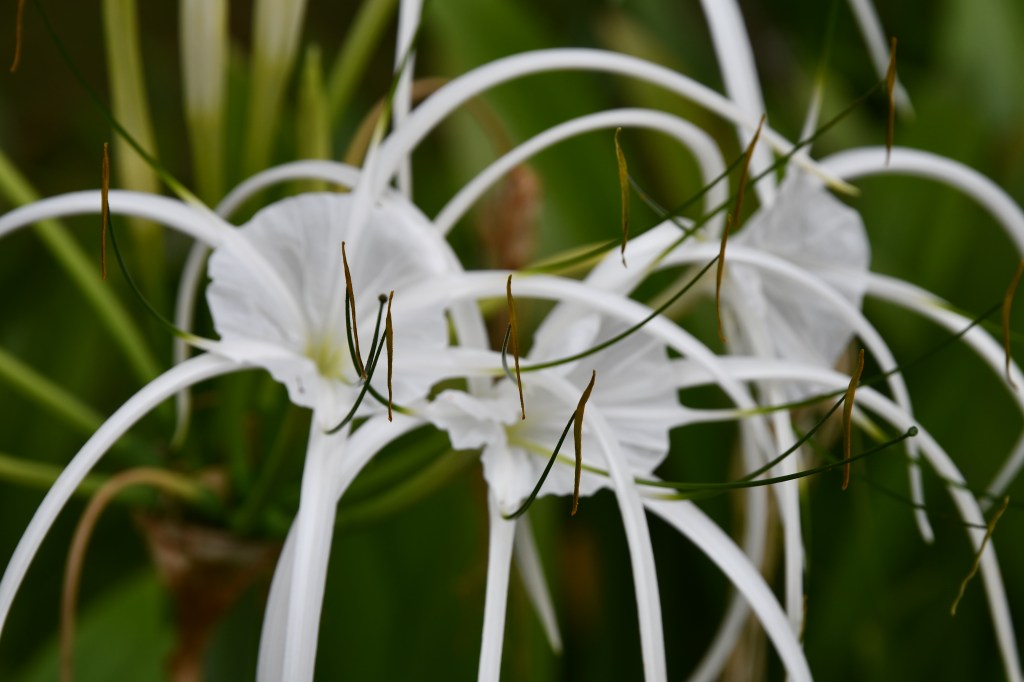
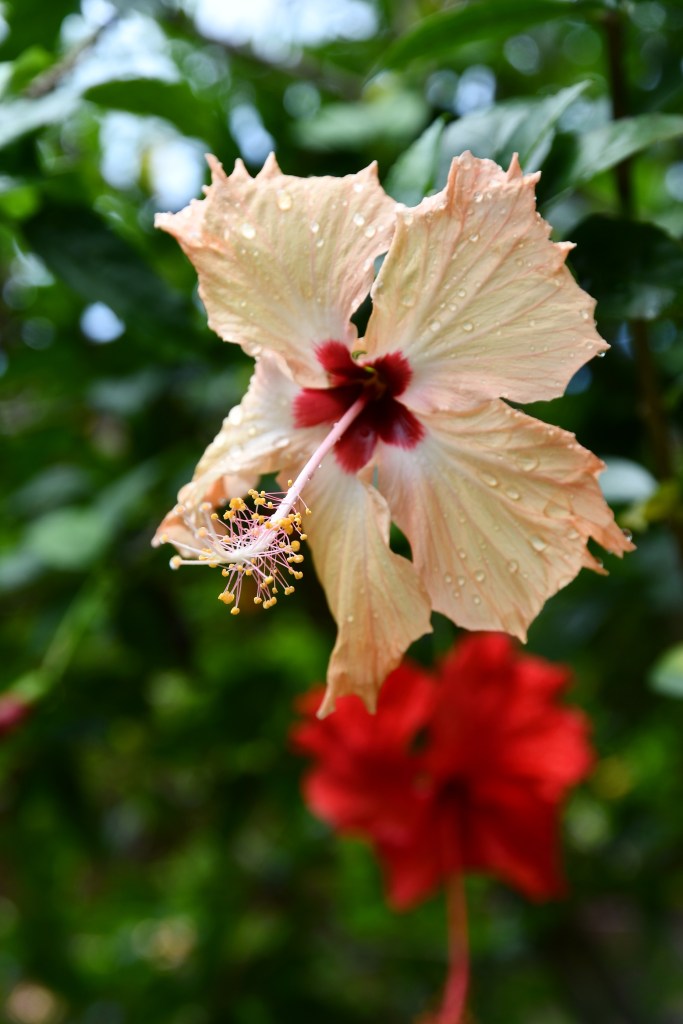
We spent the midday in hammocks, and enjoyed slightly cooler temps. Everywhere you go, there seem to be hundreds of macaque monkeys. We saw a lot at the organgutan center and they run all over the resort. Many of the plants here I recognize and are used in Florida landscaping. I have seen giant elephant ears, hibiscus, alamanda, spider lilies, caladiums, and ixora.
Hammock duty.The Kinabatangan River.
Giant elephant ears are everywhere.
Our third wildlife boat safari started at 4 pm. We had our first sighting of a wild orangutan in the trees along the river. We also saw the elephants again, but this time we had flashbacks of a leopard sighting in Botswana, where two dozen jeeps crowded around one leopard. There were 17 boats idling, watching the elephants feed along the edge of the river. It felt hypocritical to be on an “eco tourism” boat trip with engines idling. We are hoping that our tourist dollars will help conservation and have a positive effect on the preservation of the wildlife and wild areas. We can only hope.
Another dinner of steamed rice and vegetables, and water. Tomorrow we are up early for a transfer to the Borneo Rainforest Lodge.
The entrance to the original old Hotel Majestic, built in 1932. We are staying in the newer part. The older section has beautiful tile floors and interiors. The original 1932 portion of the Hotel Majestic.
On our second full day in Kuala Lumpur we were on our own. After the two guided tours and a lot of activity, we wanted some time in a more peaceful setting. The KL Bird Park, the world’s largest free-flight walk-in aviary, was within walking distance of our hotel.
We wandered through the bird park for about two hours. Despite the early hour, it was quite hot and humid.
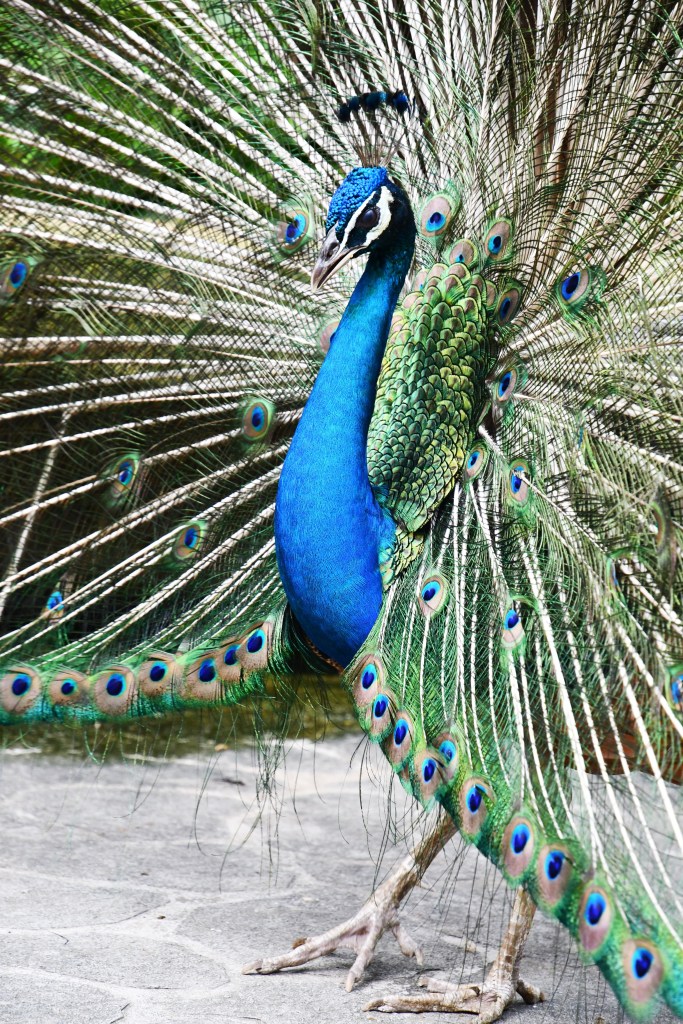
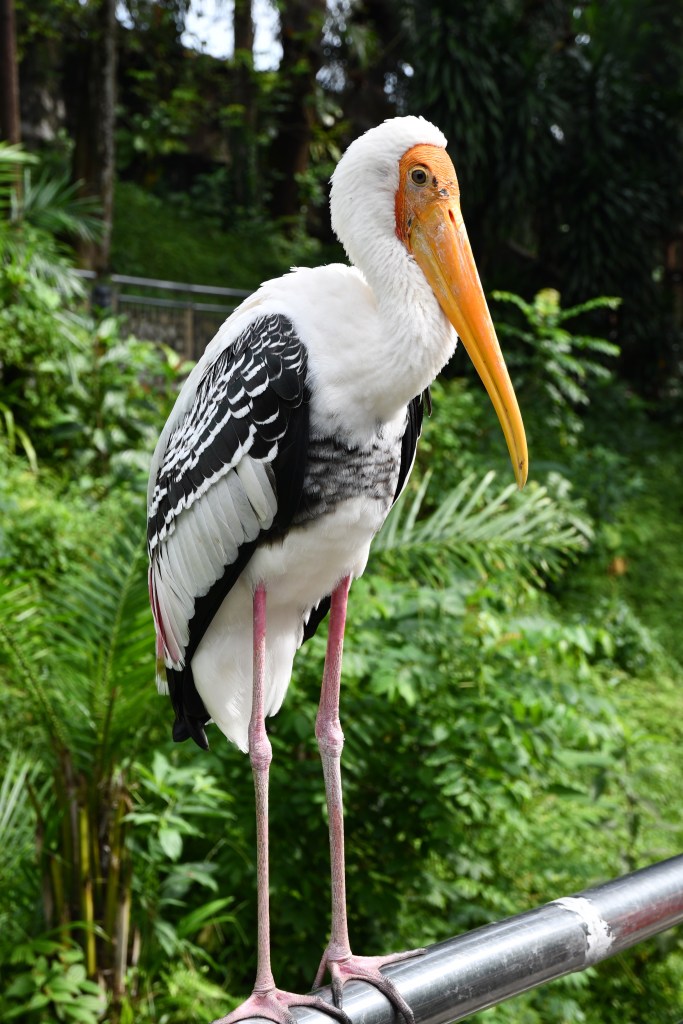
The walk-in aviary.
Our plan after the aviary was to walk to the orchid garden. Stepping into a gift shop to find temporary relief from the heat and humidity, the sales person told us the orchid garden was closed. He saved us a bit of walking. He asked where we were from. When we said the United States, he said “I’m sorry to say but your last president made America look stupid.” We agreed with him and it led to more discussion.
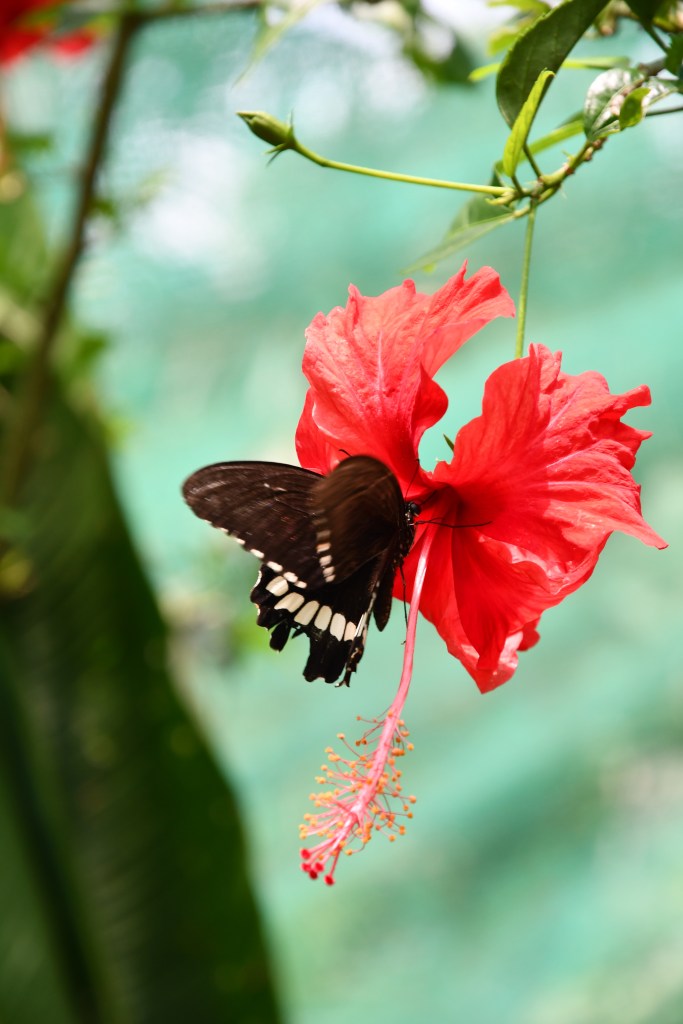
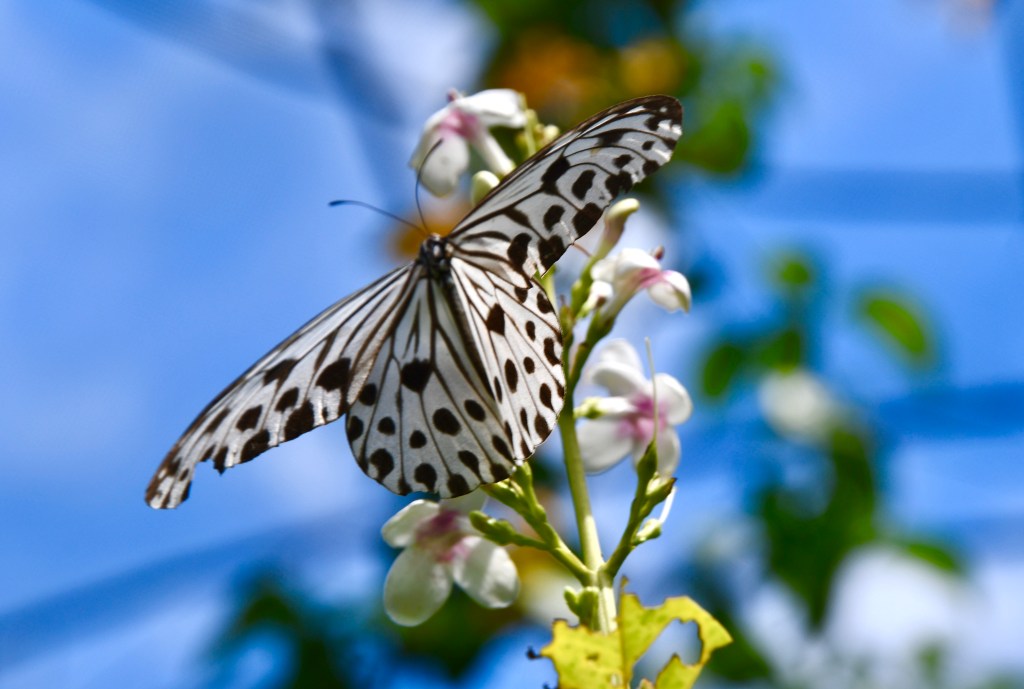
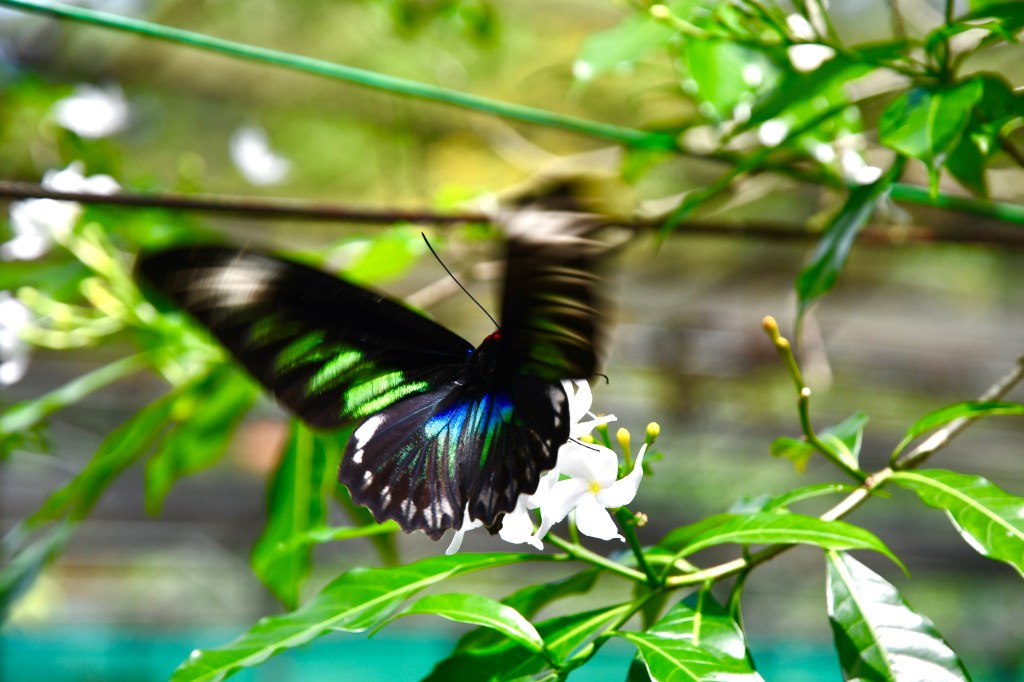
A butterfly in the Kuala Lumpur Butterfly Park.
A short walk from the Bird Park we found the Butterfly Park. It was a truly peaceful place. Walking through the darting butterflies, around ponds and fountains, it was so hot and humid it felt like we were being misted. But the many butterflies were so beautiful we stayed about an hour.
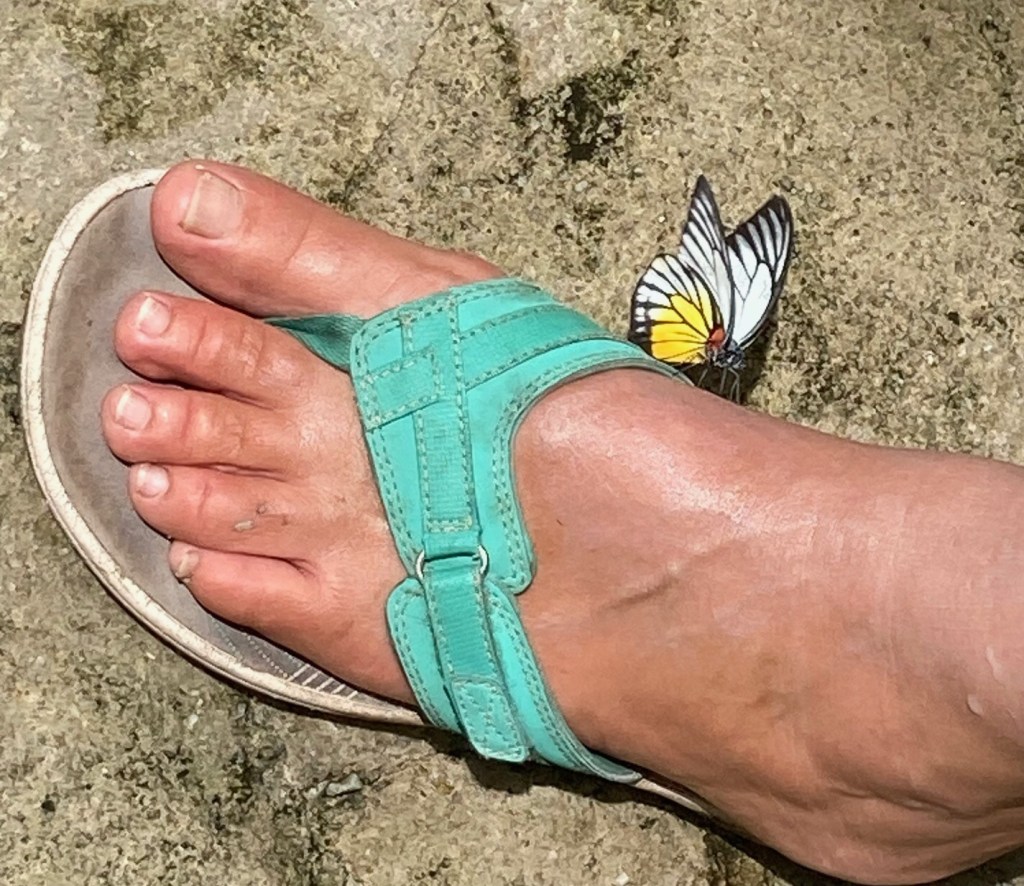
The butterflies even land on your shoes. Already drenched by noon, we decided the hot afternoon was best spent in the hotel pool. So we headed back to the Hotel Majestic.
A butterfly on my shoe.
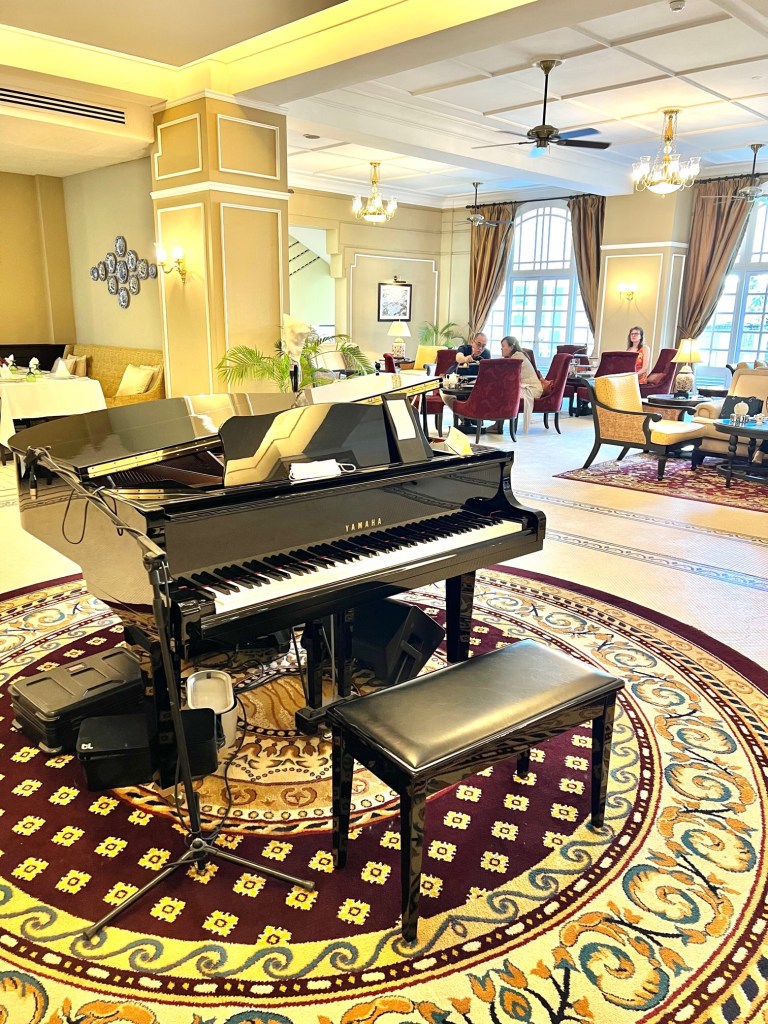
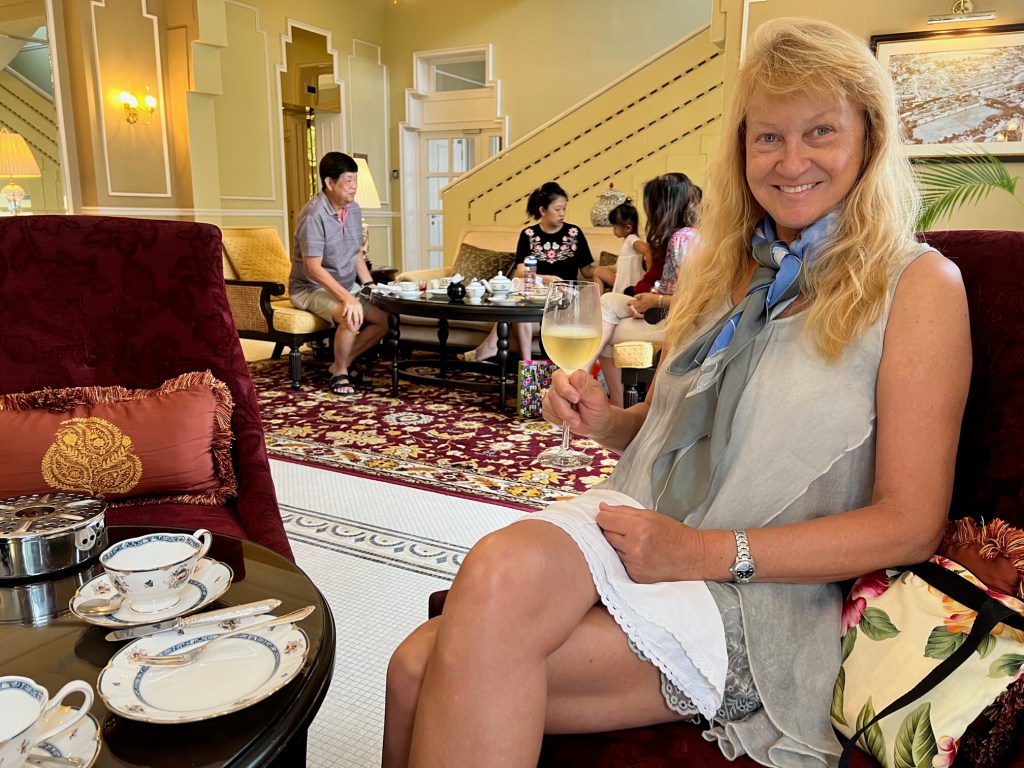
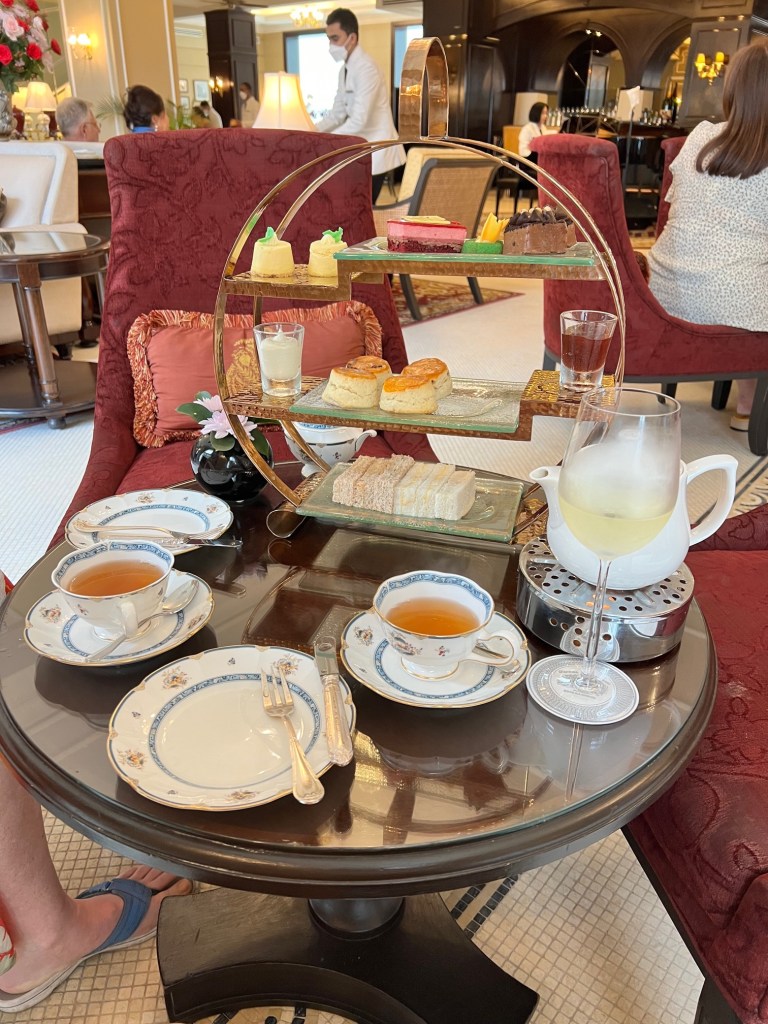
By 3 pm we had cooled sufficiently and were ready to try the hotel’s afternoon tea. It runs from 3 to 6 pm and is quite popular. They had a pianist at the piano.
After nearly 48 hours of travel, we touched down at the Kuala Lumpur airport. This trip was arranged by my sister using Selective Asia, so we didn’t do this one free style on our own. I was relieved to be met by a driver at the airport and whisked to our hotel in town. We are staying at The Majestic Hotel, and it is quite nice.
In our itinerary I was wary of the 5 pm evening walking tour, having just traveled two days to get here. I would have preferred to decompress in a quiet spot, but my sister talked me into the tour reasoning the walking would do us good.
I was pretty much a zombie but we met our guide and began our Malaysian adventure without further ado.
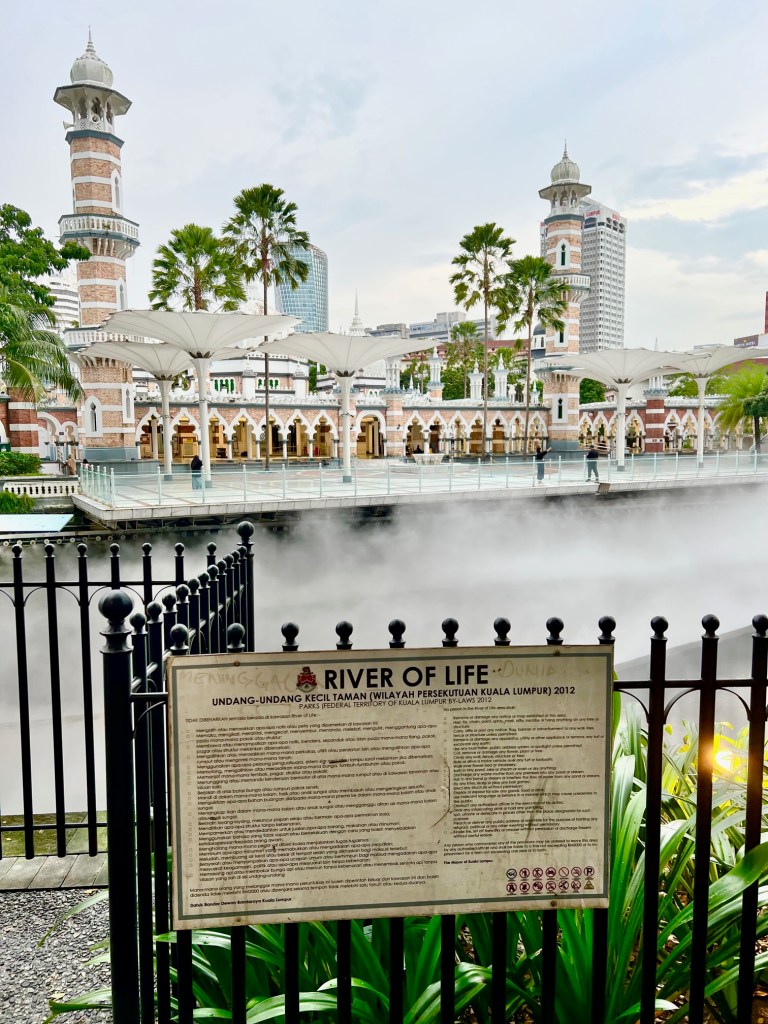
The muddy confluence of two rivers, Kuala Lumpur. The government has been doing cleaning and restoration of the river.
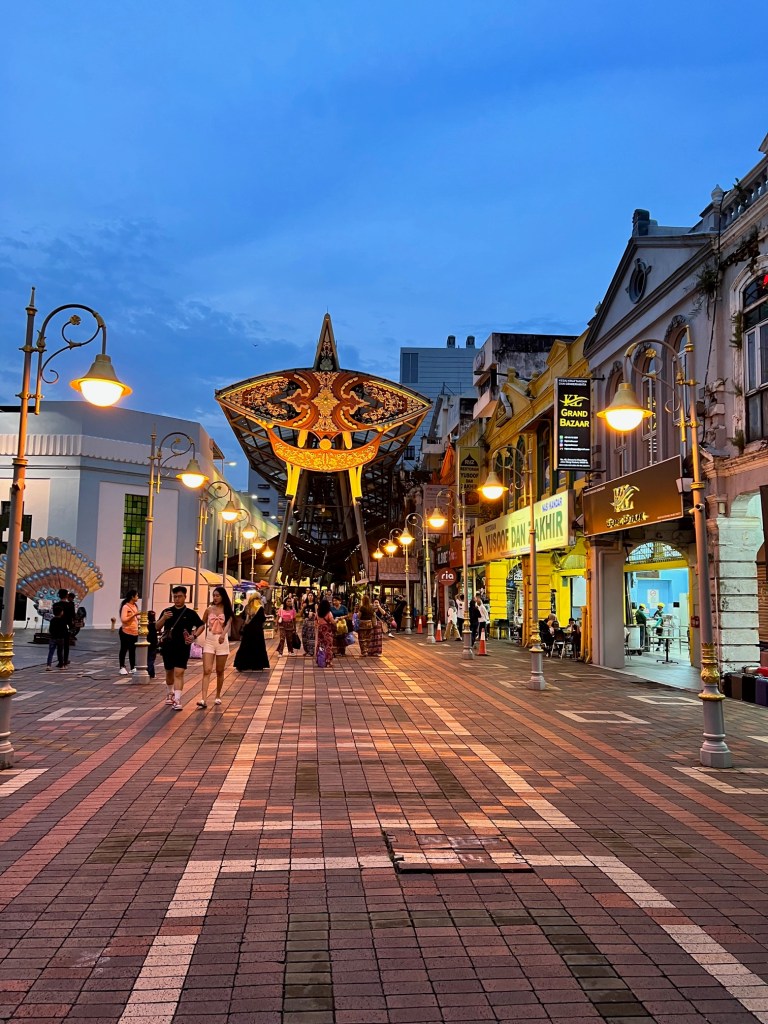
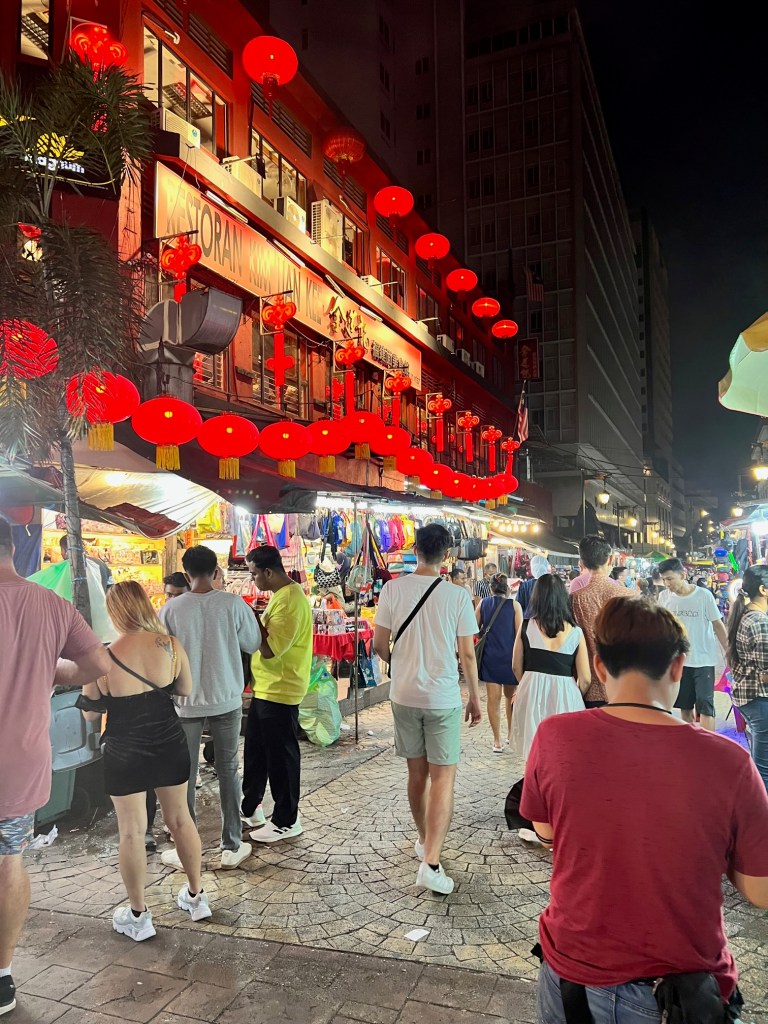
Our guide was knowledgeable and understanding of our less than enthusiastic demeanor. He explained where the name Kuala Lumpur came from (muddy confluence), walked us through several markets, fed us street food, and used the Malaysian equivalent of Uber (Grab) when I just couldn’t go on.
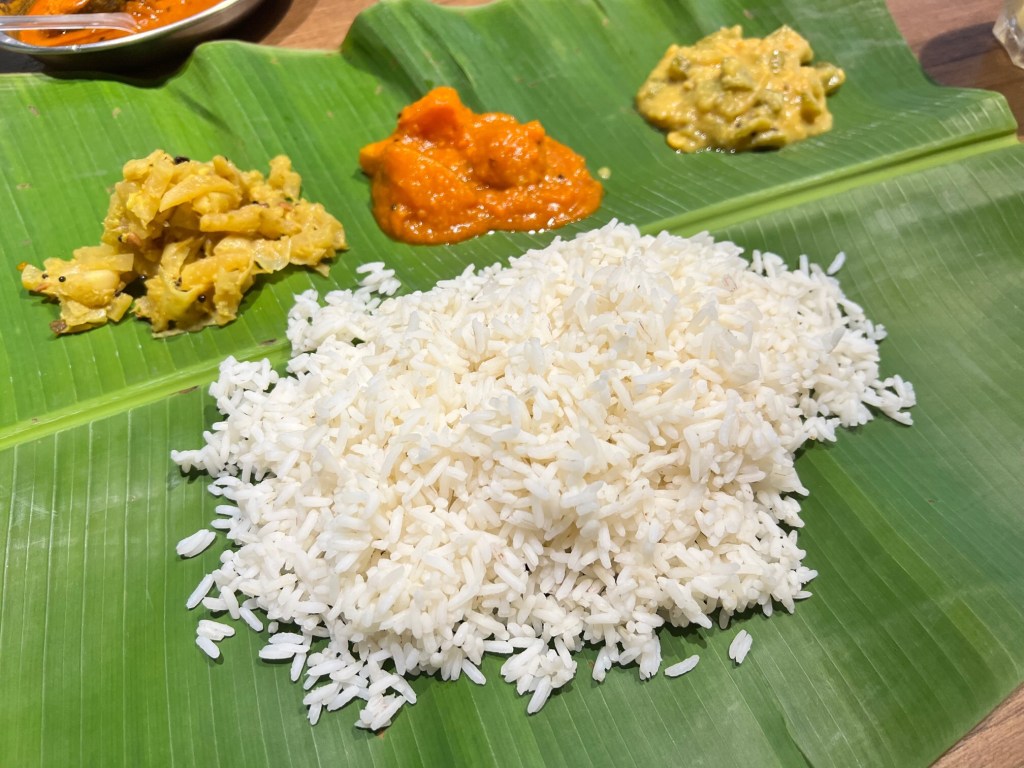
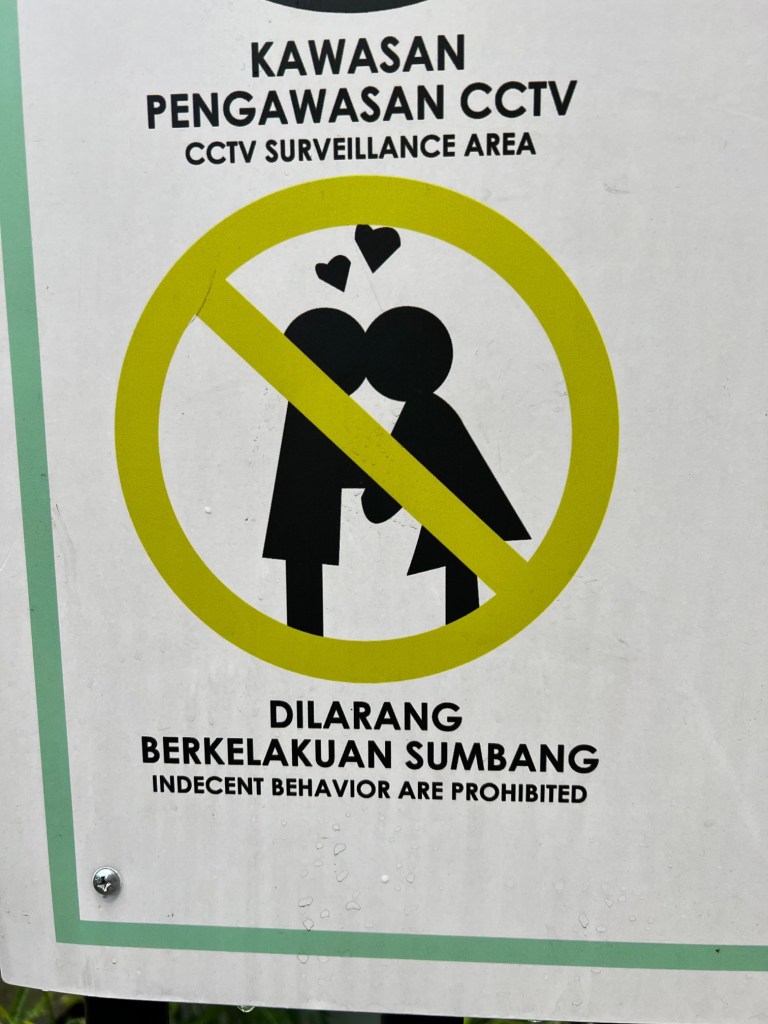
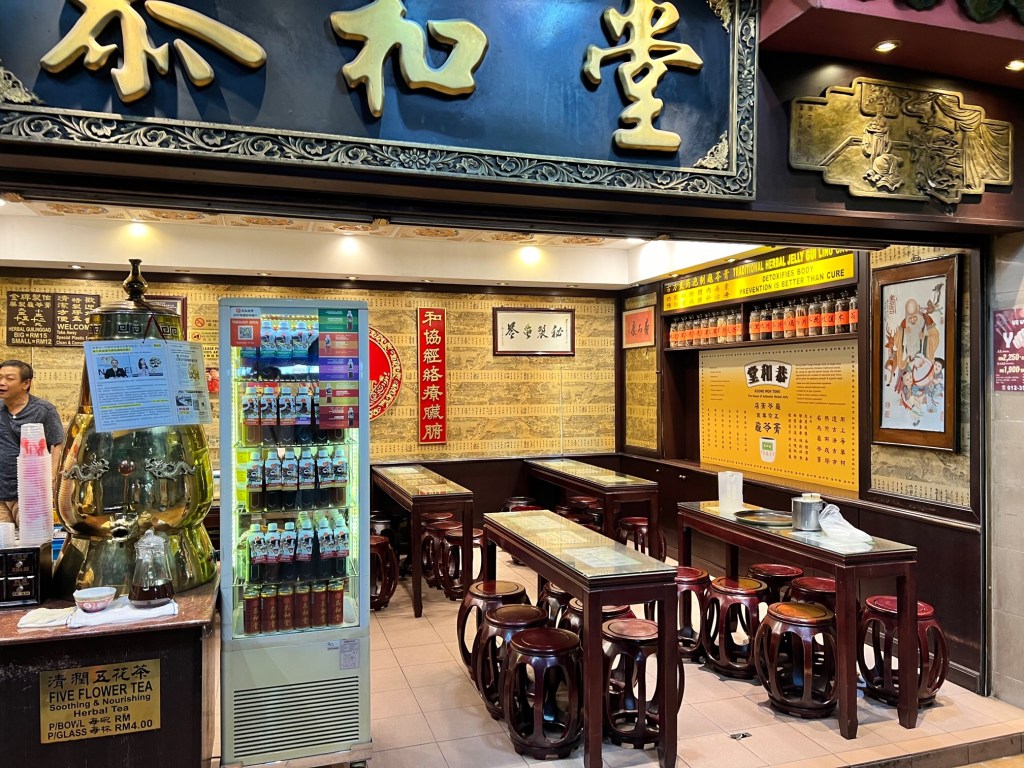
Rice with vegetables served on a banana leaf. We had this in Little India.A market near the river.You can be arrested for “indecent behavior”. After questioning our guide we found that it refers to more than a peck on the cheek or holding hands. A market in China town. The intense sights, sounds, and smells took their toll and we headed back to the oasis of our hotel.
I had to apologize to our very wonderful guide for my lack of enthusiasm during our walking tour. I do like to see the real parts of a city or country, but lack of sleep will dampen anyone’s spirits. We headed back to the hotel and collapsed.
The city is very clean, cleaner than my own home town of Portland Oregon right now. It has several ethnic areas including Little India and China town. We were told that on the street any type of clothing is acceptable and we saw the range from burkas to shorts and tank tops. The local currency is the Malaysian Ringgit, which right now is 4.4 to the US dollar.
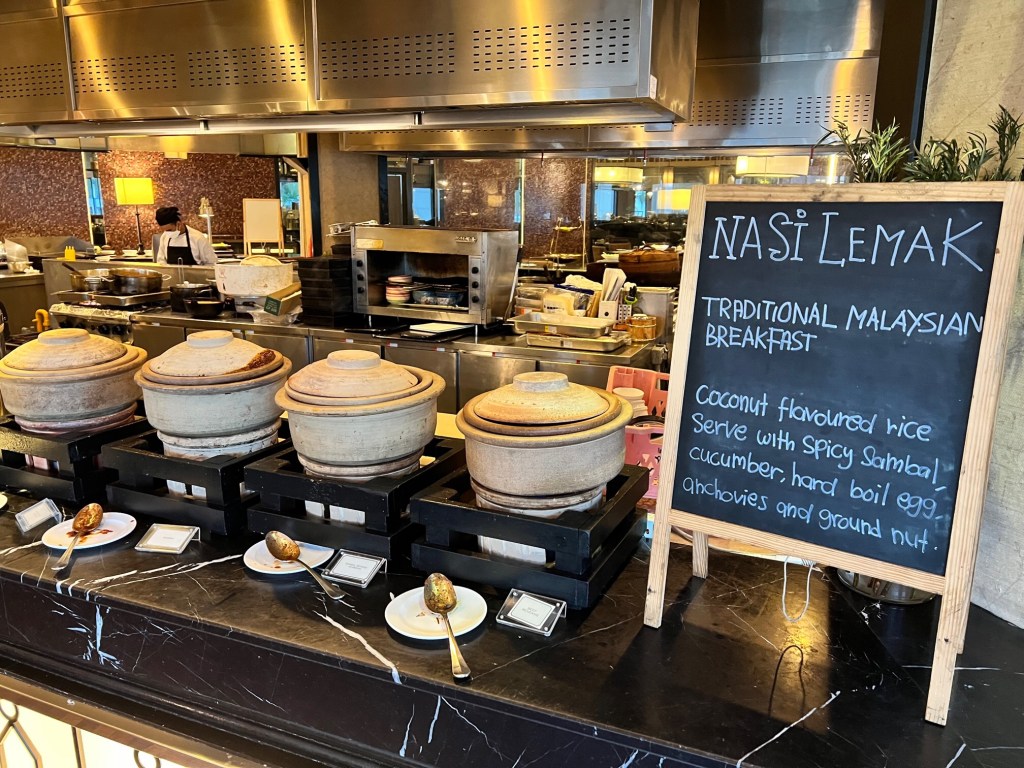
The traditional Malaysian breakfast buffet at the hotel. The buffet included many selections, from a Western style (thank the gods) to many Asian breakfast favorites.
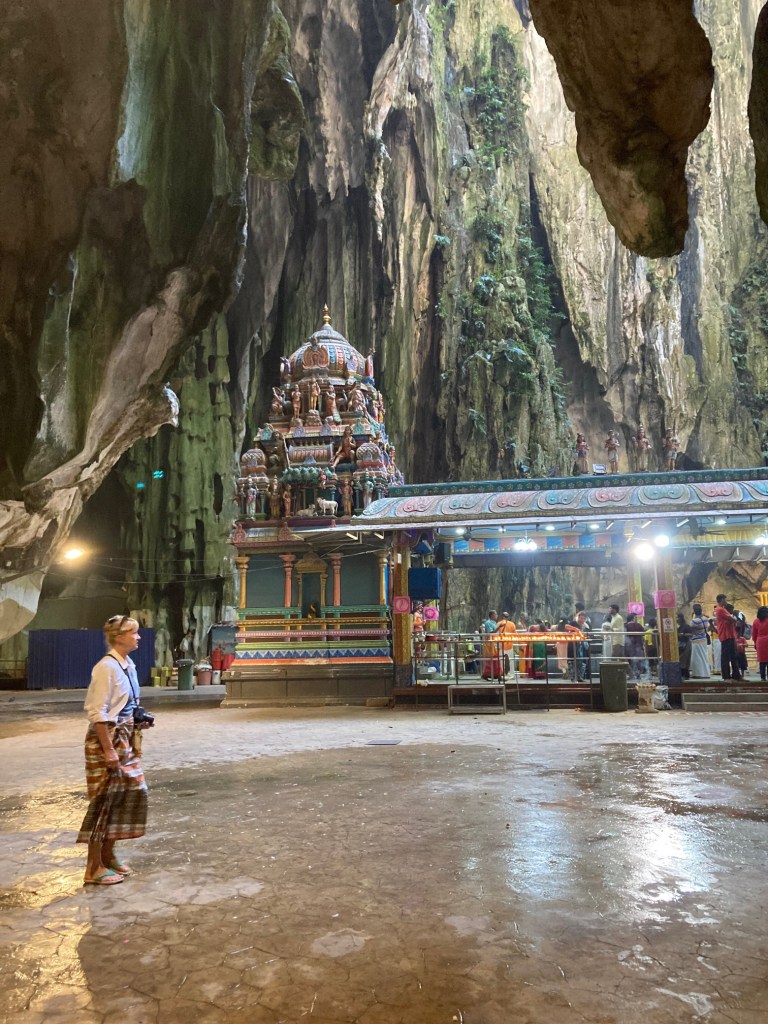
After a restorative ten hours of rest and a stellar breakfast buffet at The Majestic Hotel, we met Patrick, our guide for a morning city tour. We couldn’t have asked for a better guide. Enthusiastic, full of information and years of experience, when we mentioned our number one sightseeing wish of the Batu Caves, he quickly shifted gears, ditched the scheduled tour and expertly sidestepped the long queue of cars and deposited us near the entrance.
Although my attire was suitable for around town, I would not have been allowed into the Hindu temple with knees showing. No worries. Patrick loaned me a covering, fixed me up, and away we went.
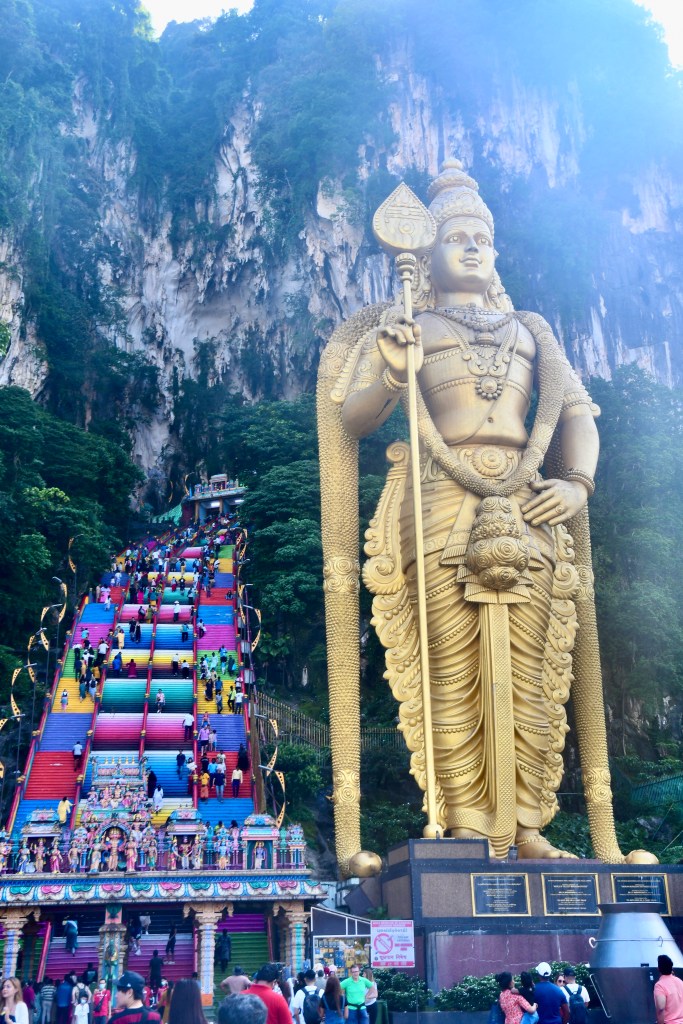
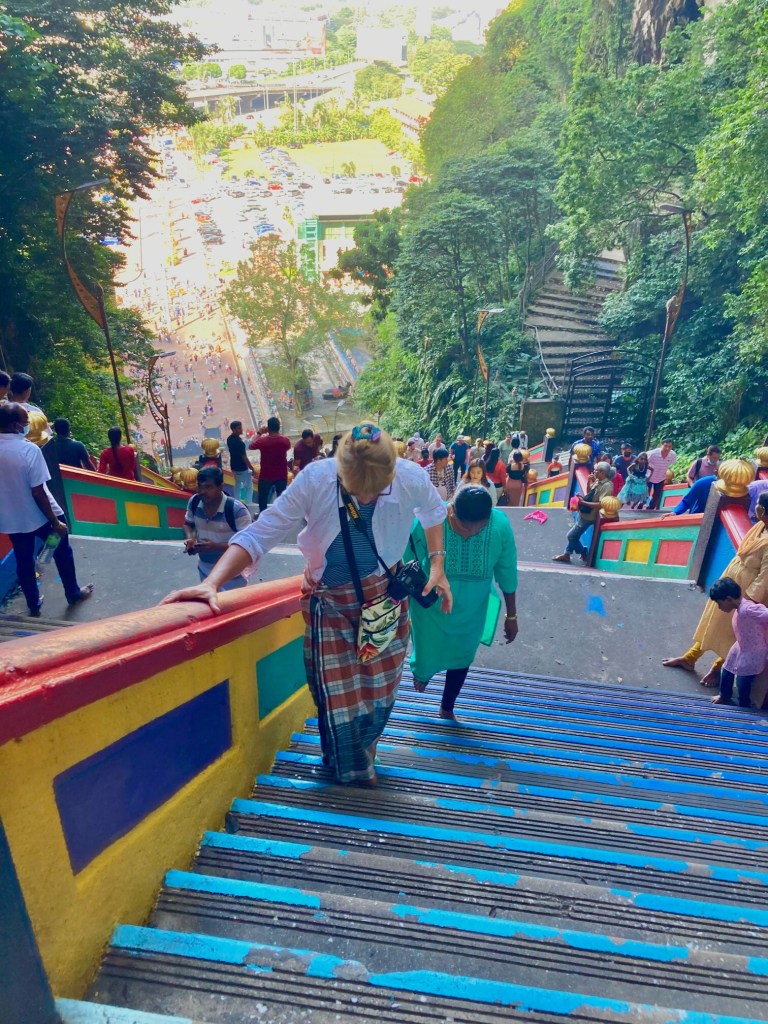
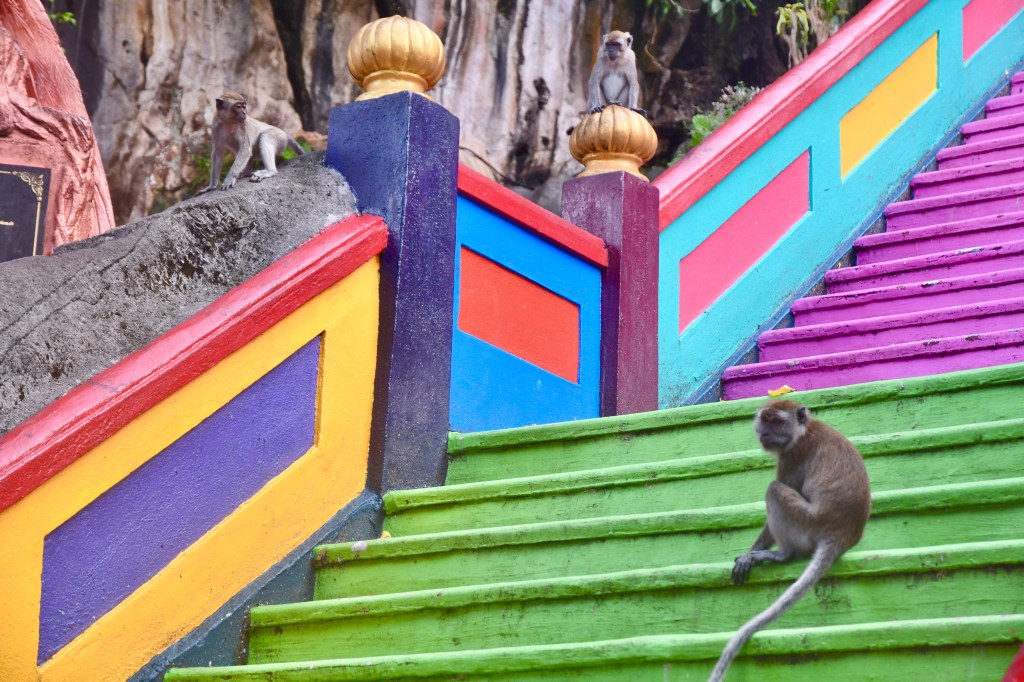
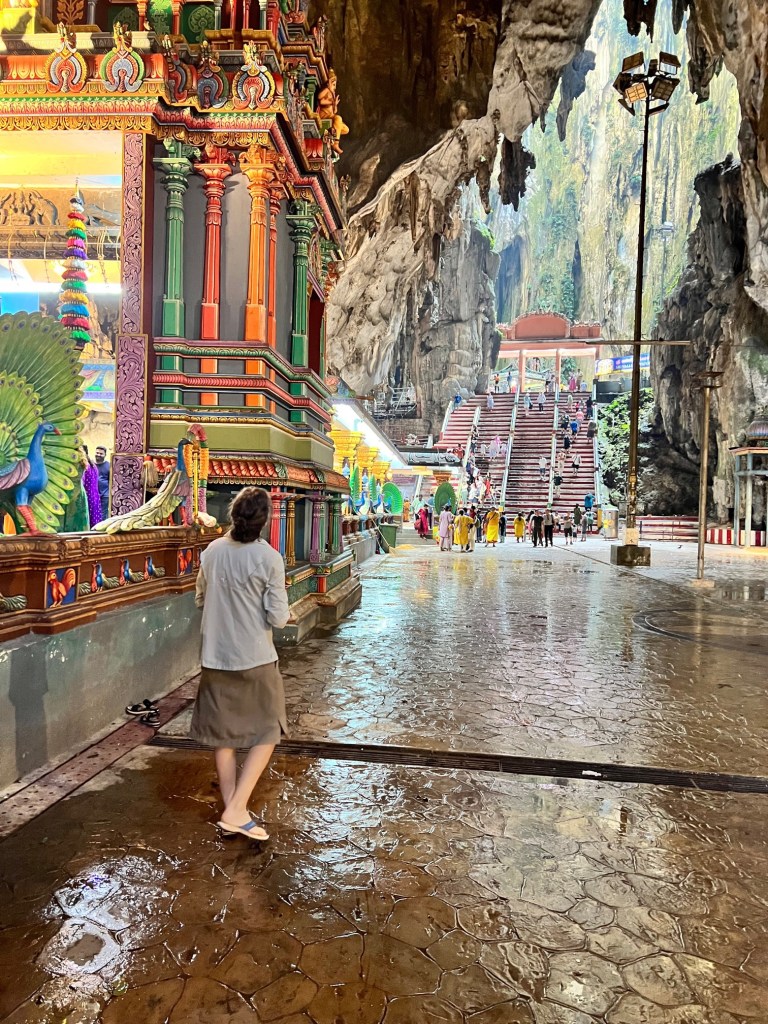
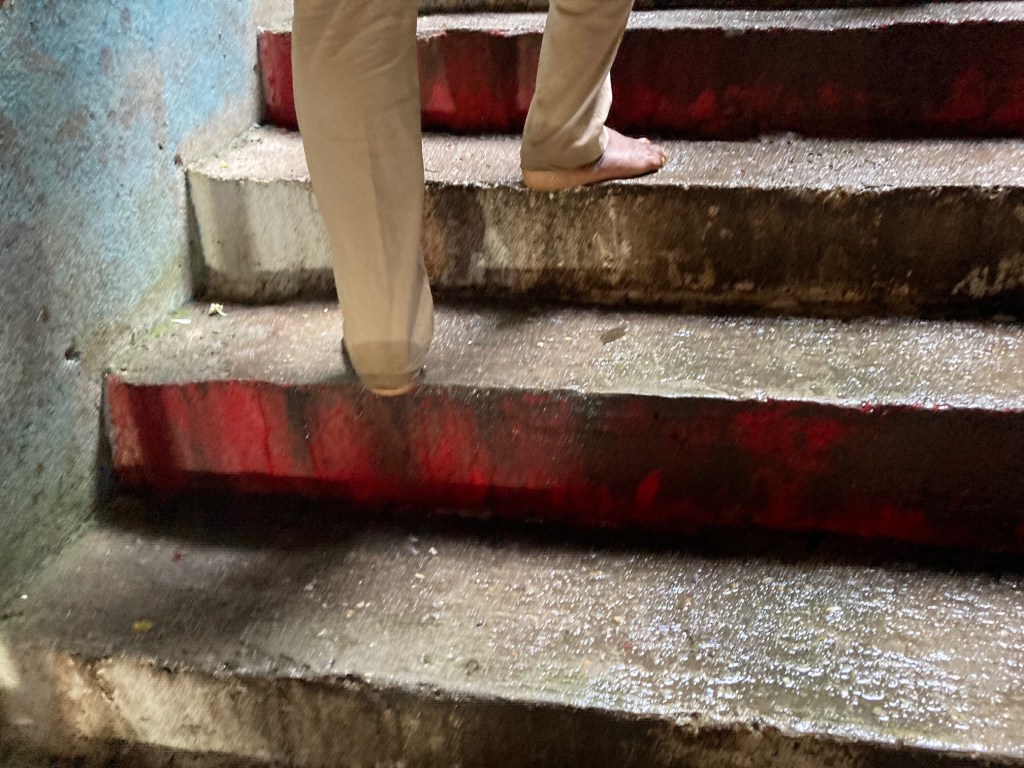
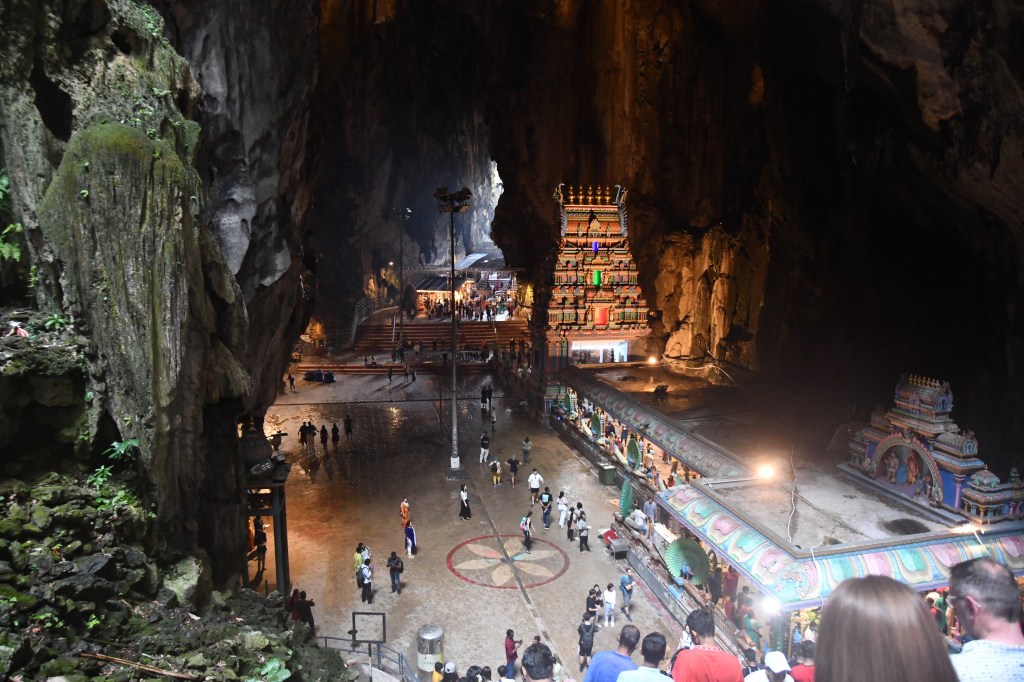
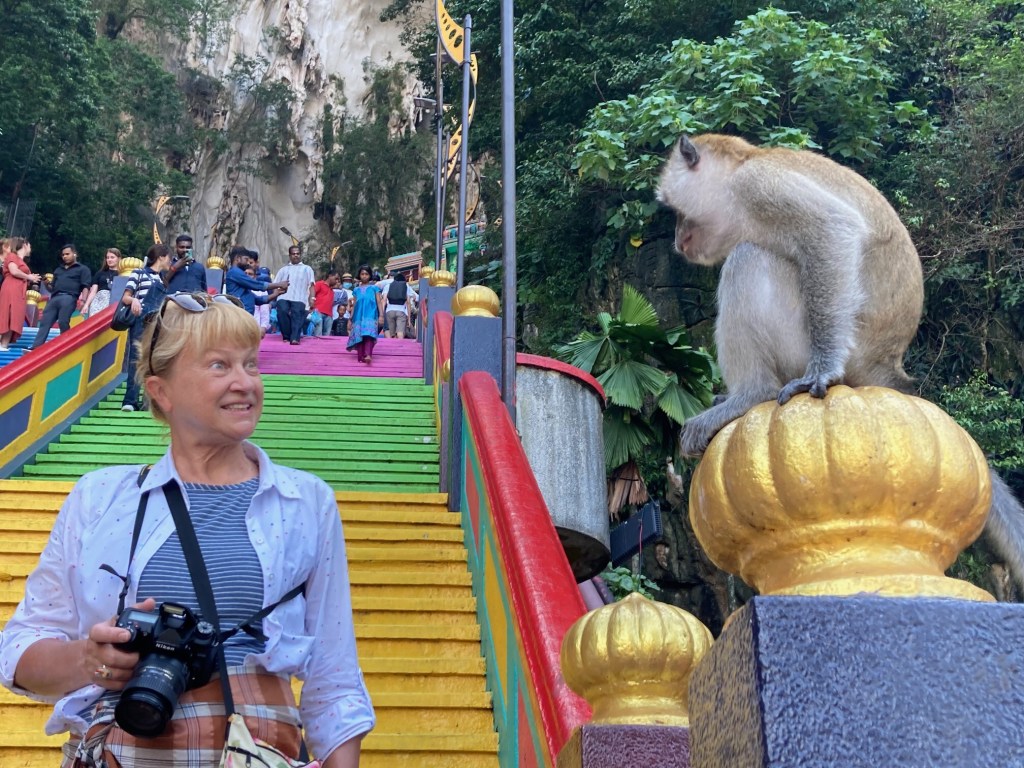
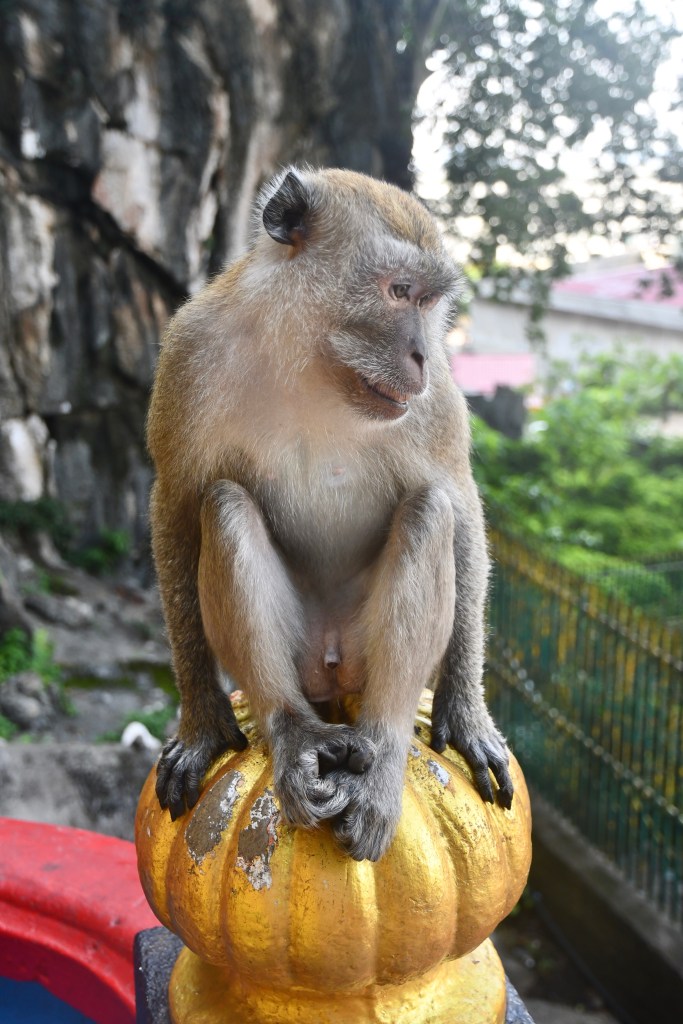
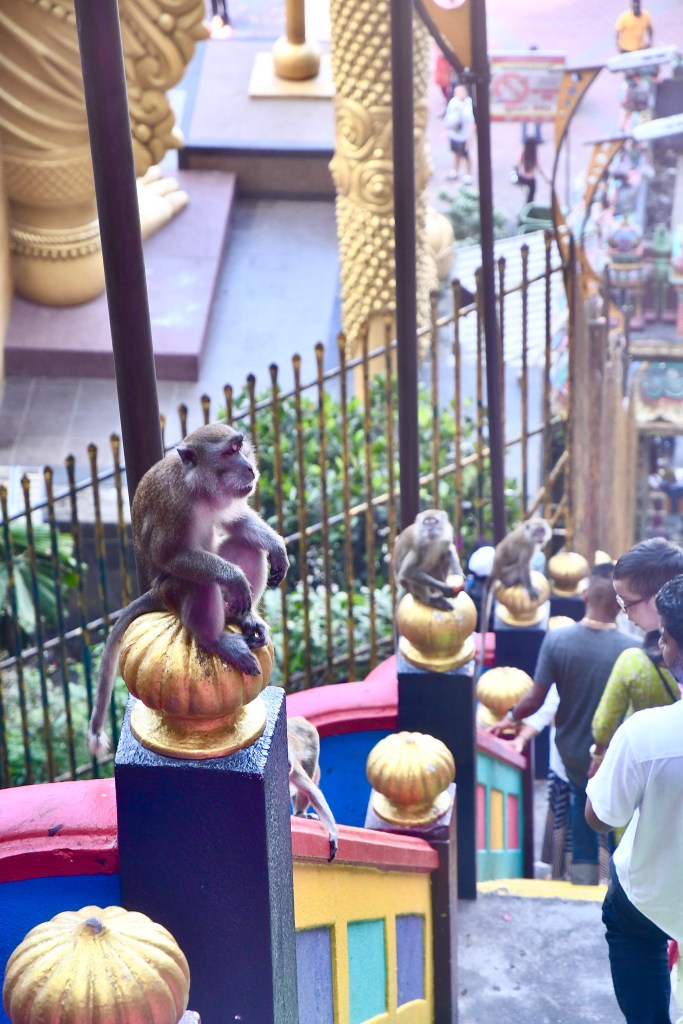
The Batu Caves are not far out of town. It was a Sunday, and very crowded. We climbed the 272 steep steps to enter the caverns. Monkeys scamper between the tourists and the worshippers. Incense is burning, music is playing, and despite the crowds, people are respectful and polite. I skipped the parts of the temple that required shoes be removed.
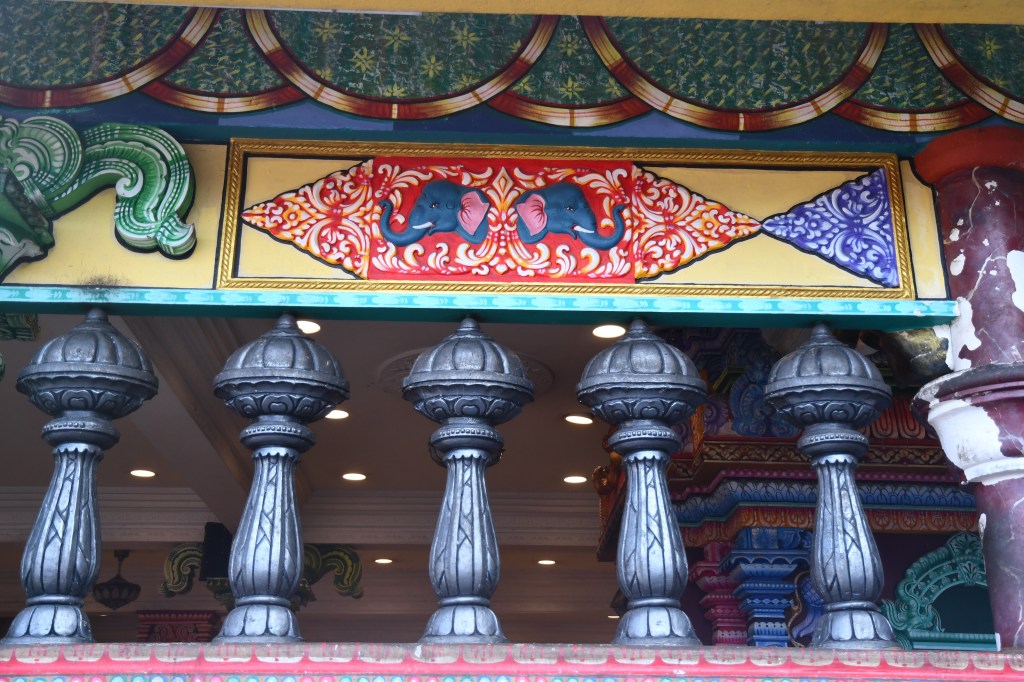
The entrance to the Batu Caves. You climb 272 steep steps to the entrance. It is nothing if not colorful. Climbing the steps up to the caves. Inside the caves.Many people were barefoot.One of the monkeys and I make faces at each other.
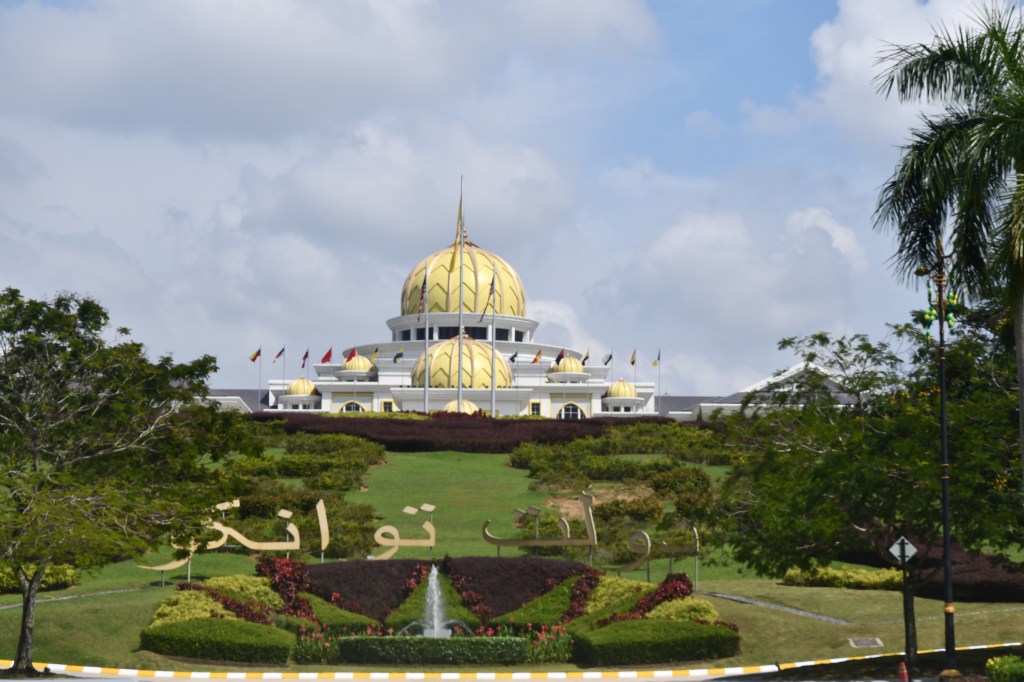
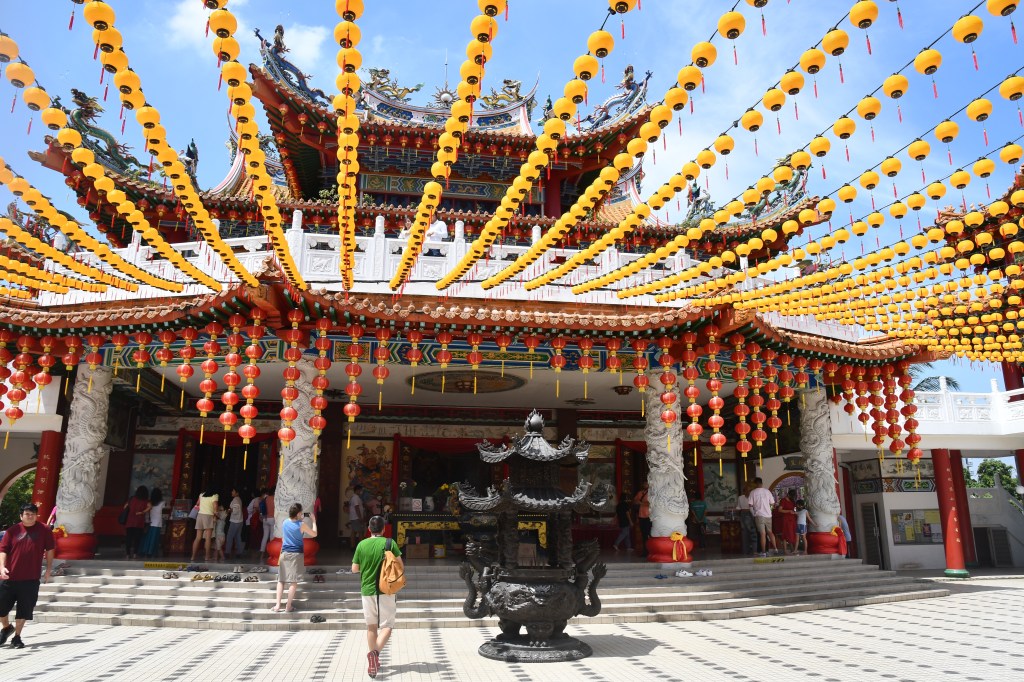
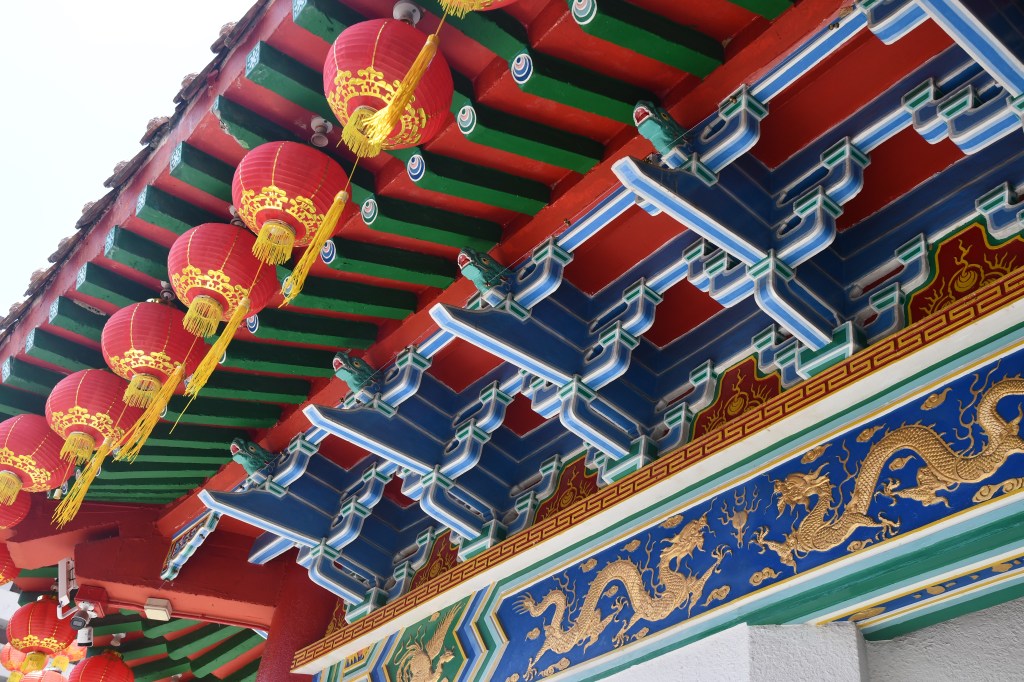
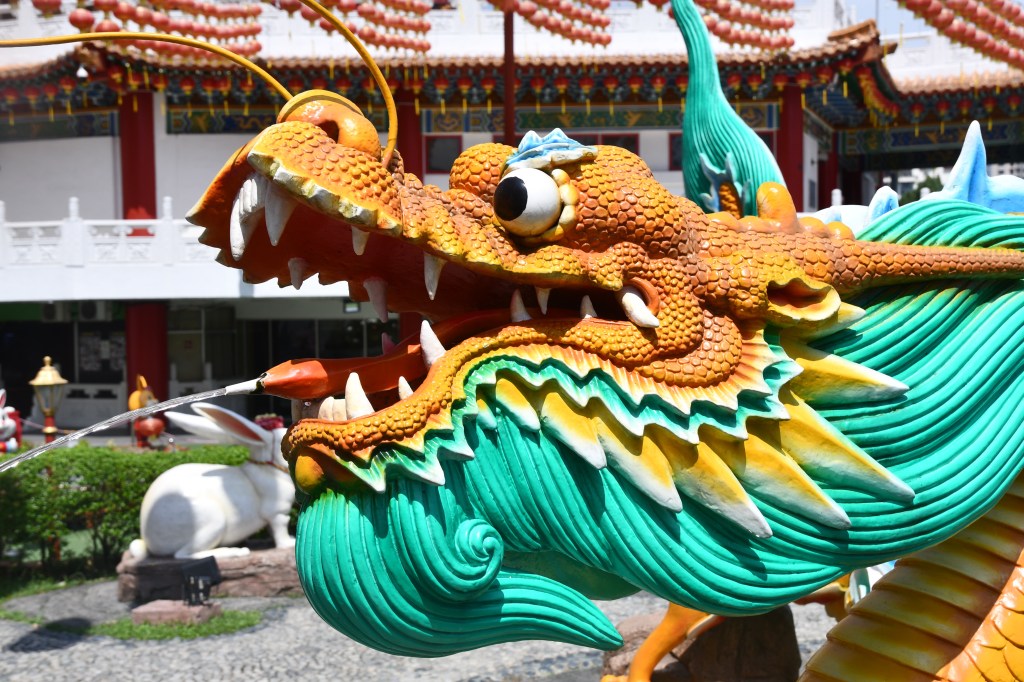
It was quite warm. Daytime temperatures routinely reach into the 90s F, with afternoon rains. We drank many bottles of water and relished Patrick’s air conditioned car. After the Batu Caves, Patrick showed us a Mosque, the new palace, and a Chinese temple.
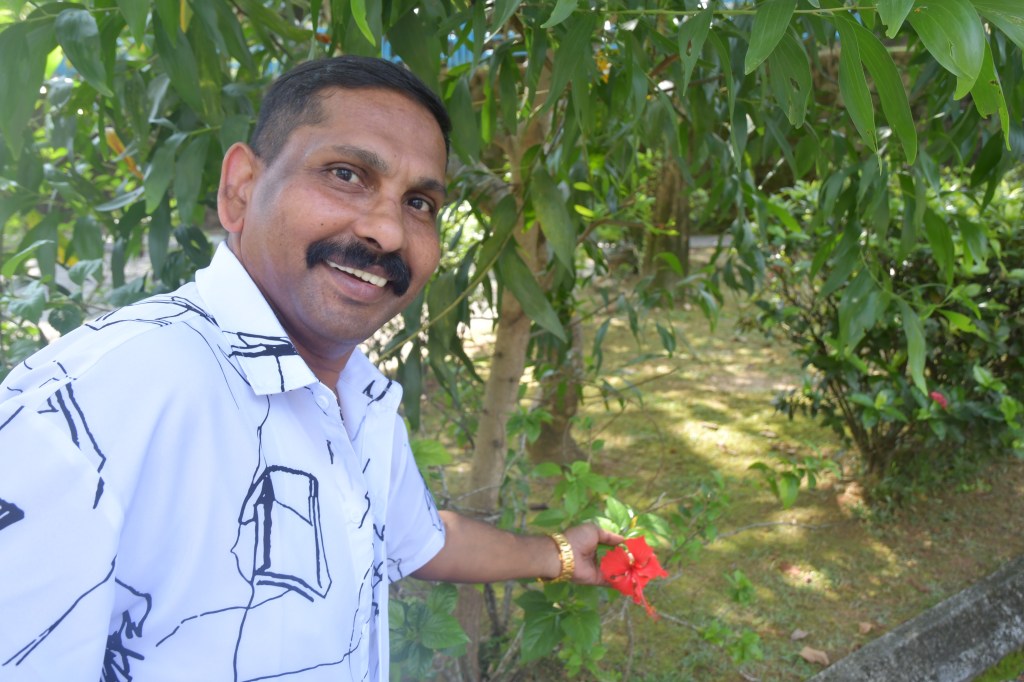
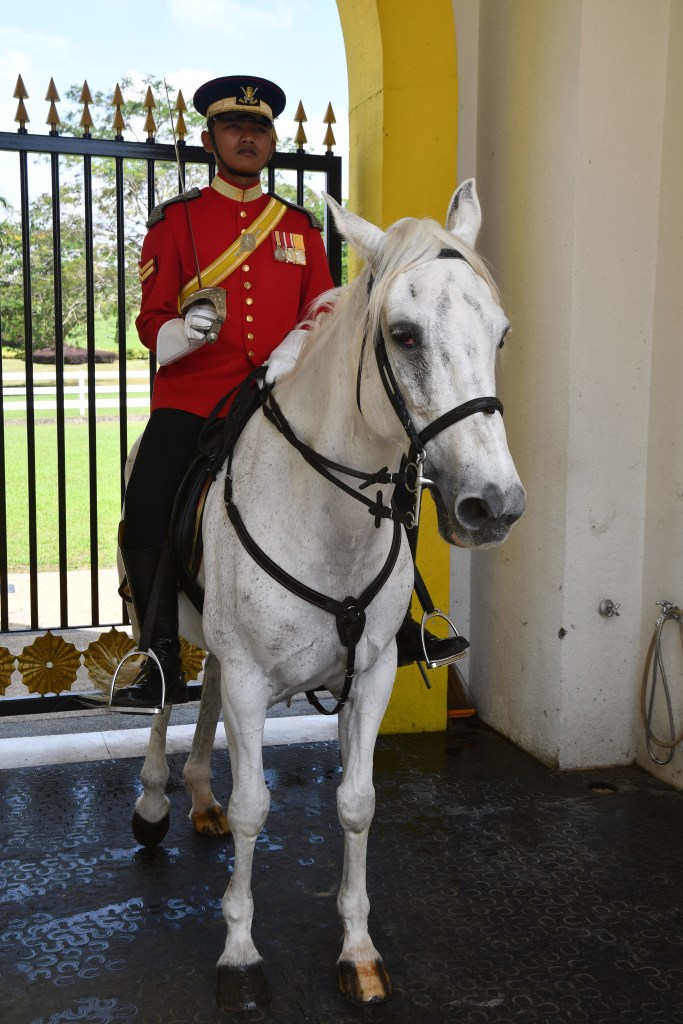
Patrick explains that the hibiscus is the state flower. It is also in the crest. The new Palace.A guard at the palace. The horses have 1 1/2 hours duty, then go back to the stables. The floor of the guard house had a thick rubber mat for the horse and a large fan.
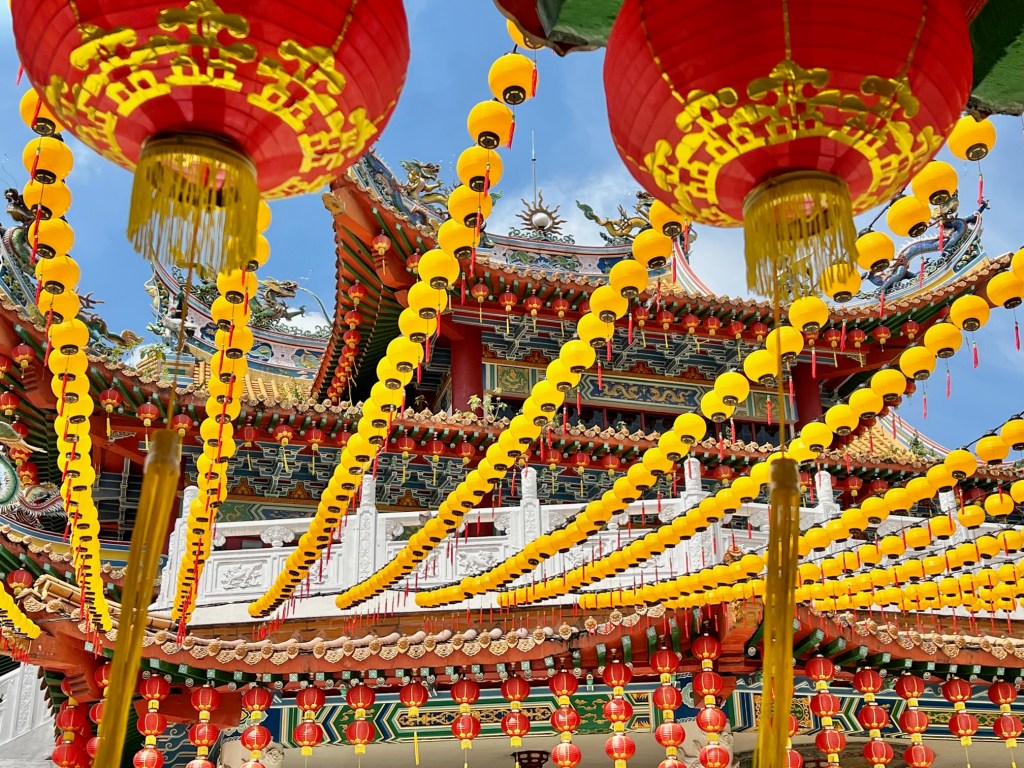
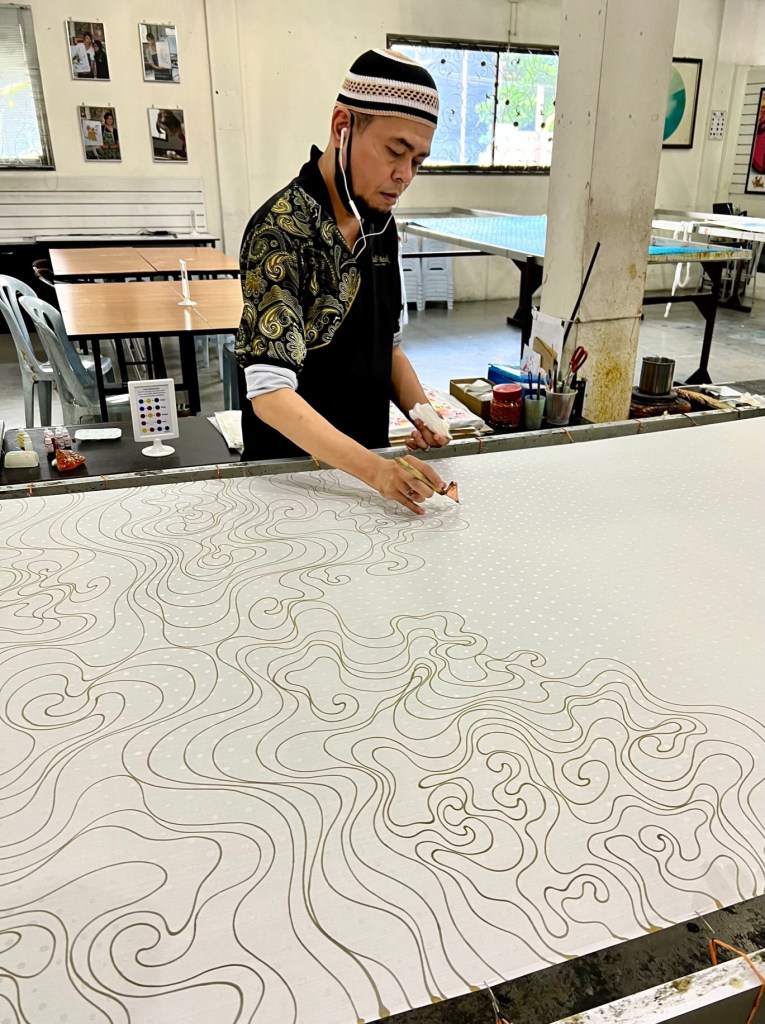
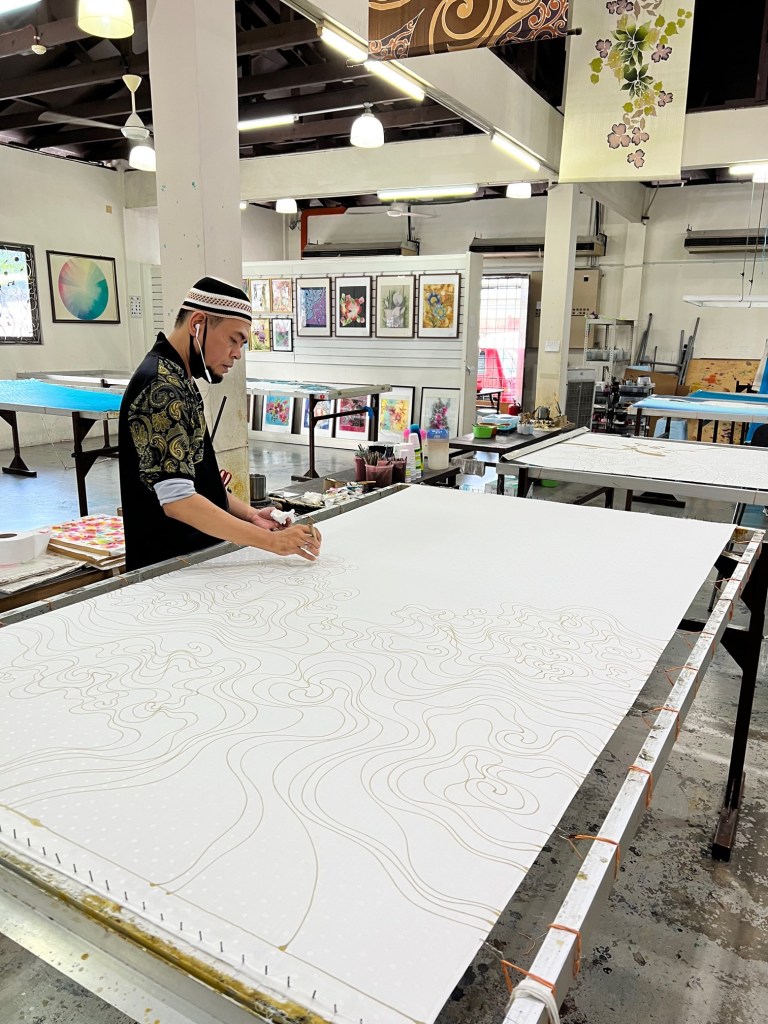
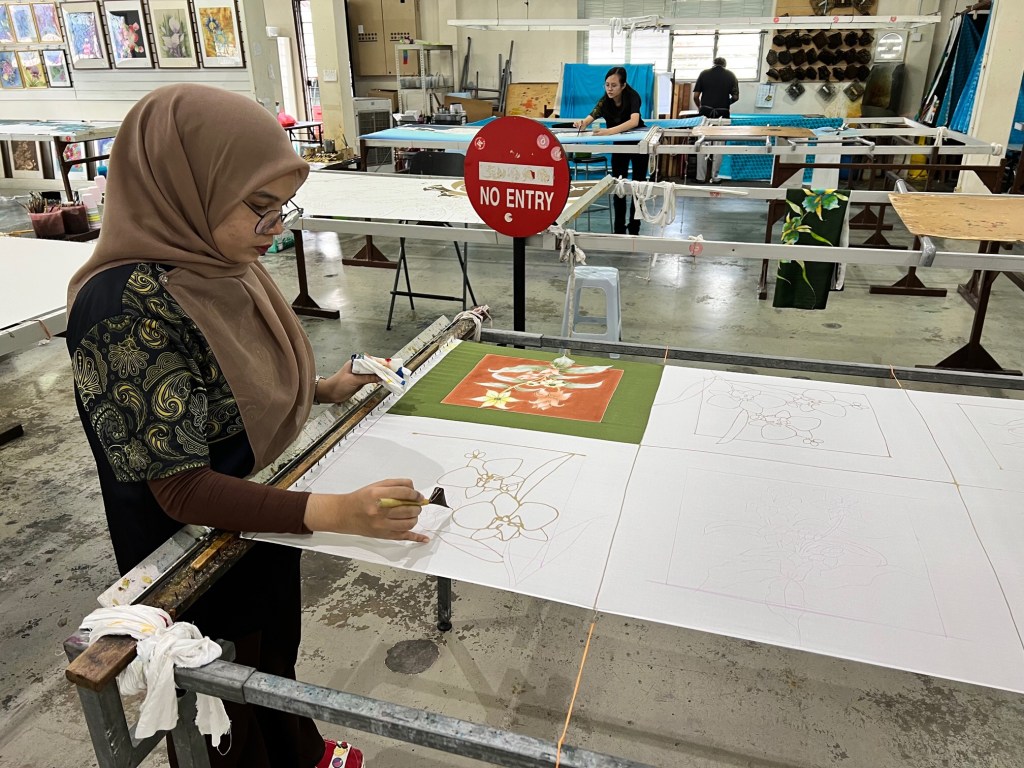
We visited the worshipping places of the local religions, (so colorful compared to my Lutheran background!), then asked to see a batik handcraft shop. Malaysia is known for Batik. Patrick took us to a handicraft spot where we could see the artists working on batik pieces.
An artist works free hand with a wax pencil, creating a design.Painters fill in the artist’s work. The paint must dry for several hours, then it is set into the cloth.
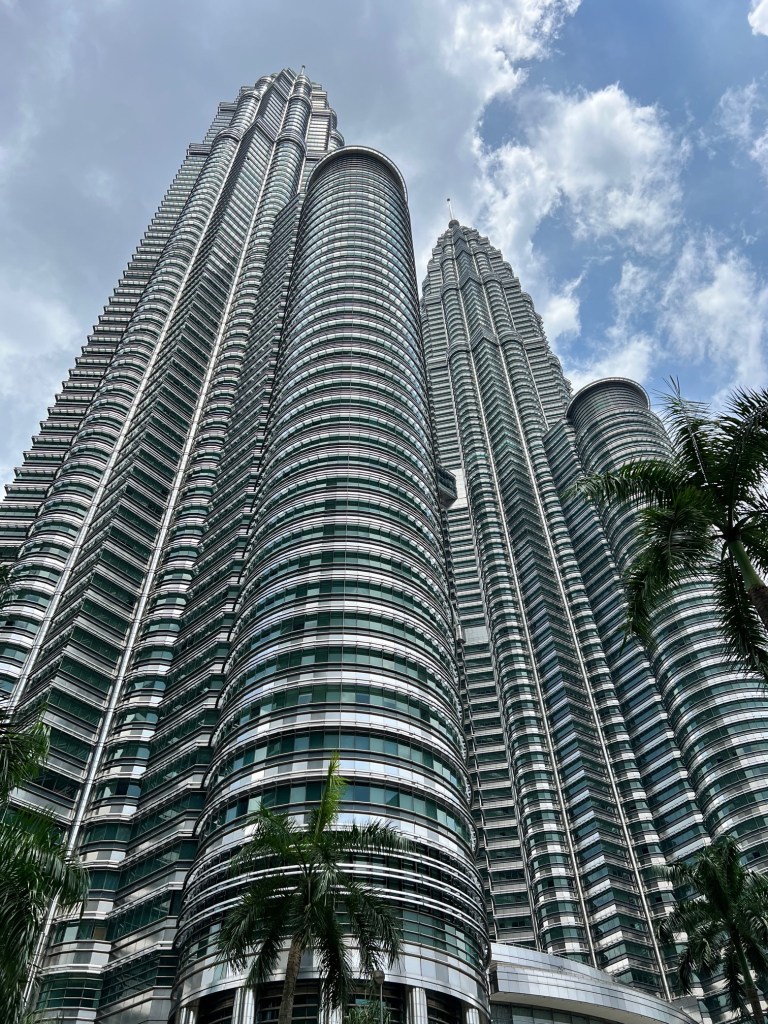
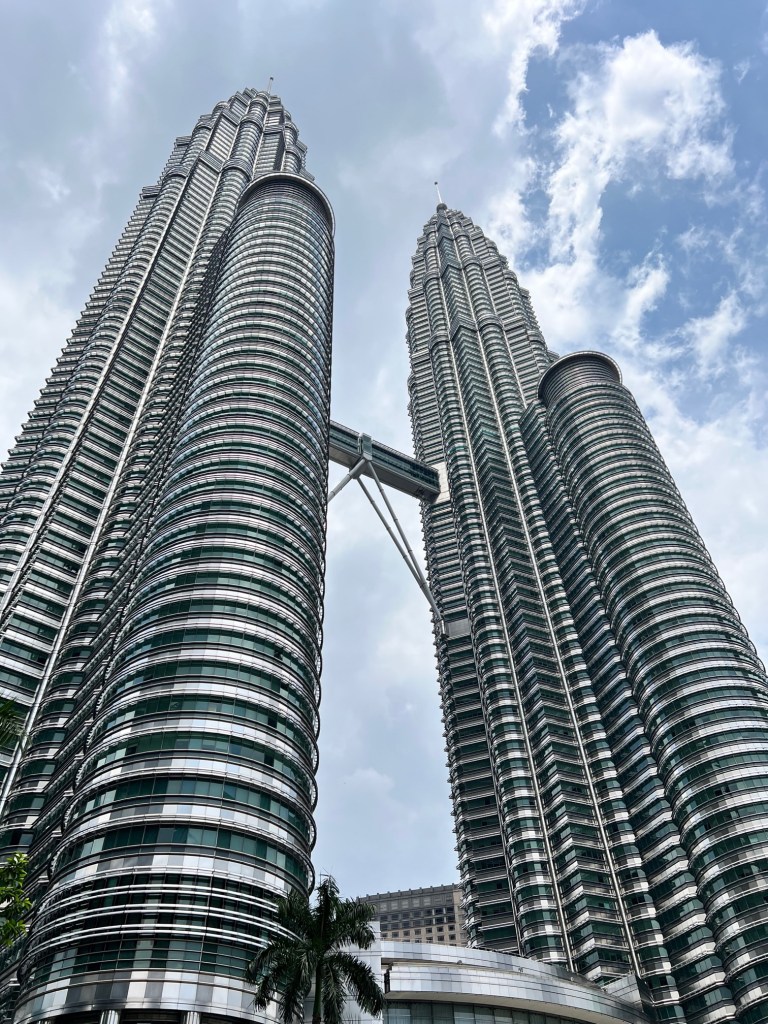
I did have to buy a few beautiful pieces. From the batik shop we headed to the very modern and glitzy part of downtown to tour the tallest twin towers in the world. This is something we would not have chosen to do on our own, but we were given tickets, and the Petronas Twin Towers are a proud symbol of Kuala Lumpur so we did the tour. This is also where we said goodbye to Patrick and thanked him for his efforts.
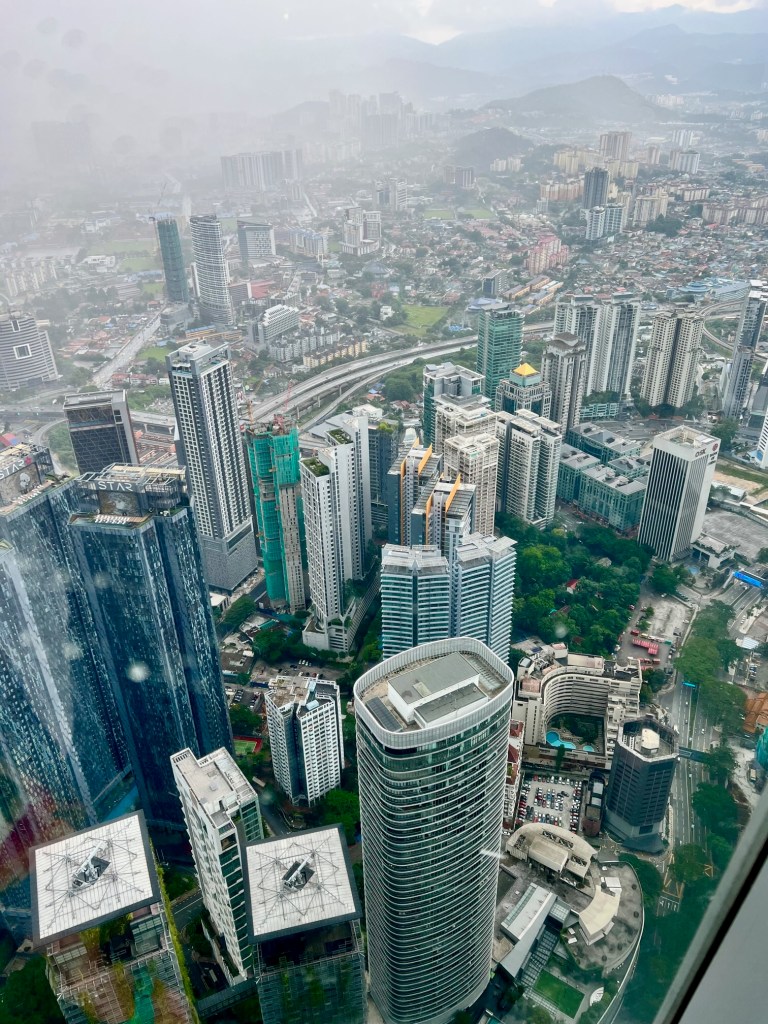
I do not enjoy elevators, so it was an uncomfortable trip to the observatory on the 88th floor. The towers are 451 metres tall (1,480 feet) and do give you a great view of the city. The best part for us was the thunderstorm that passed while we were on the top floor.
We watched from the top floor observation area as a thunderstorm passed over the city. There were lightning strikes all around.
We made our way back to the hotel via the underground system. It was very similar to Europe and easy to navigate
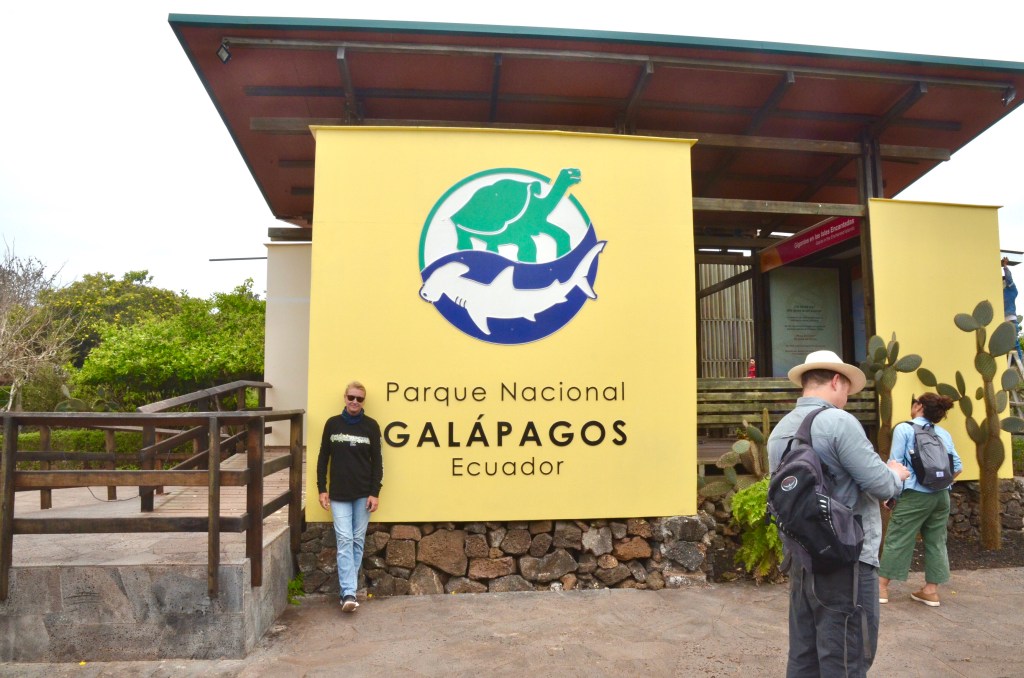
At the Galápagos National Park Service headquarters and the Charles Darwin Research Station, a UNESCO World Heritage Site.
Our last full day of the cruise was spent mostly on dry land. No Galápagos visit would be complete without seeing the giant tortoises.
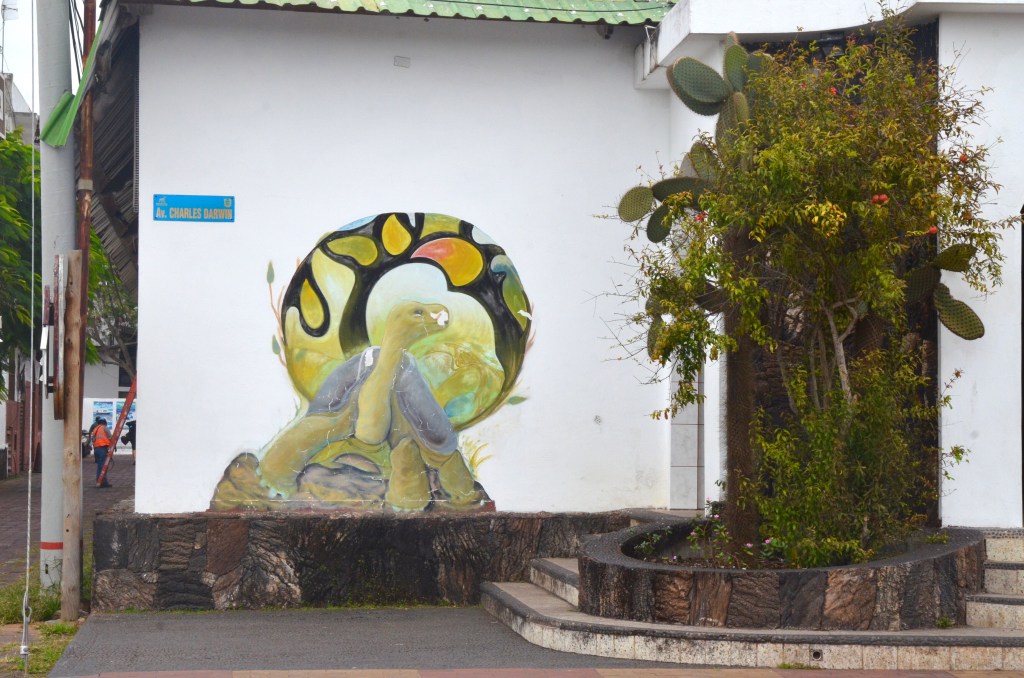
A mural on the side of a building on Av. Charles Darwin in Puerto Ayora on Santa Cruz Island.
There are statues and streets in Darwin’s honor around the area. Ecuador is doing a very good job in regards to protecting their National Park and the giant tortoises. We toured the visitors center where they hatch the tortoise eggs collected from the islands.
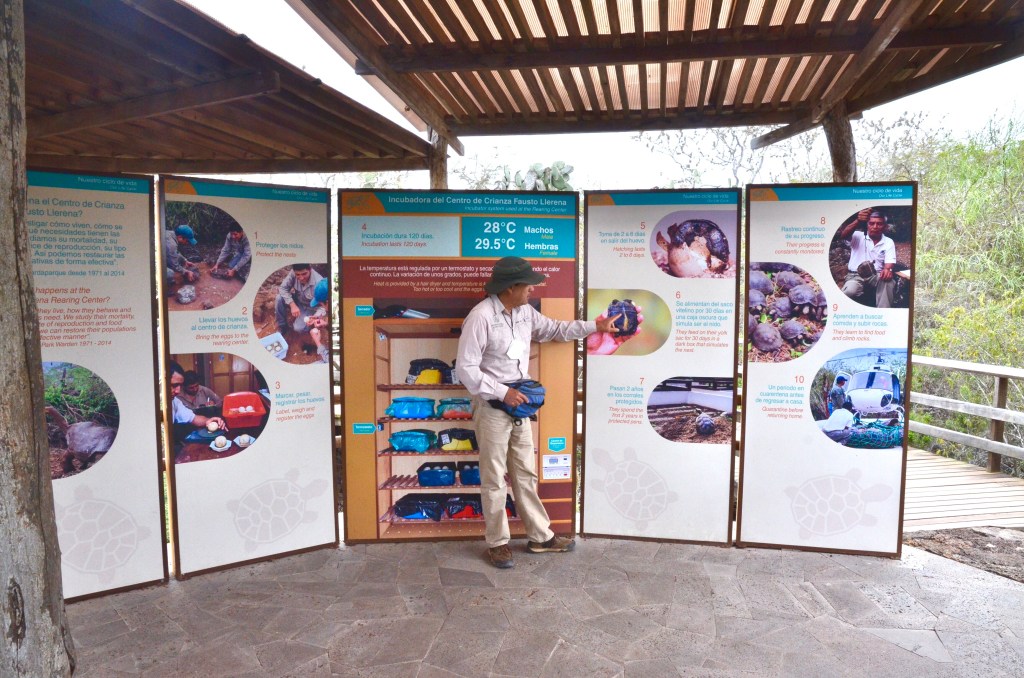
Alex, our guide, explains how the government collects and hatches the tortoises with their Giant Tortoise Breeding & Rearing Program.
Each batch of eggs is marked with a color to indicate which island it came from. The program began in 1970 when the last 14 remaining tortoises were rescued from the island of Espanola. The program has restored that population to over 1,000 individuals today.
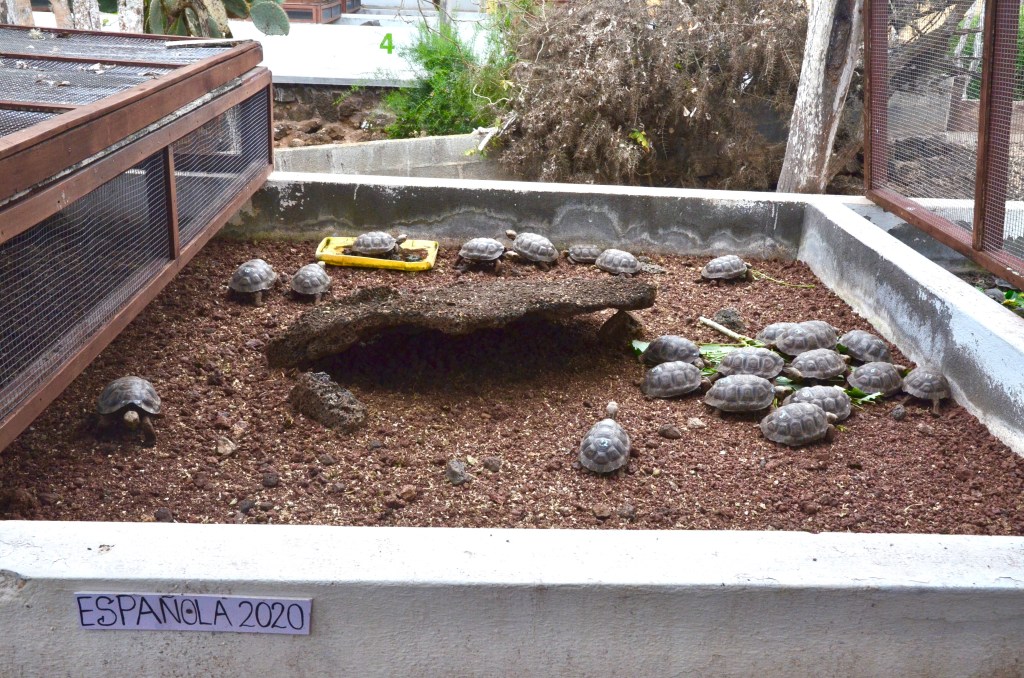
These small tortoises came from Espanola as eggs in 2020. After hatching their shells are marked with colors just as the eggs were.
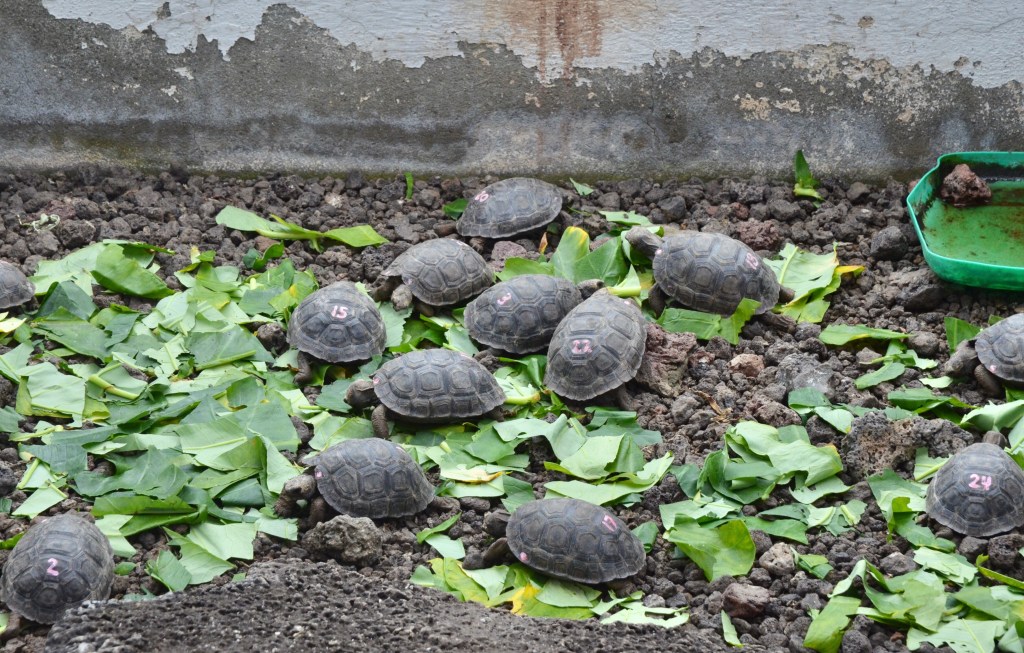
These small tortoises hatched this year. The eggs were collected on Floreana. When the young tortoises are big enough to survive on their own they are returned to the island from which they were taken.
As they grow larger the tortoises are moved to larger pens.
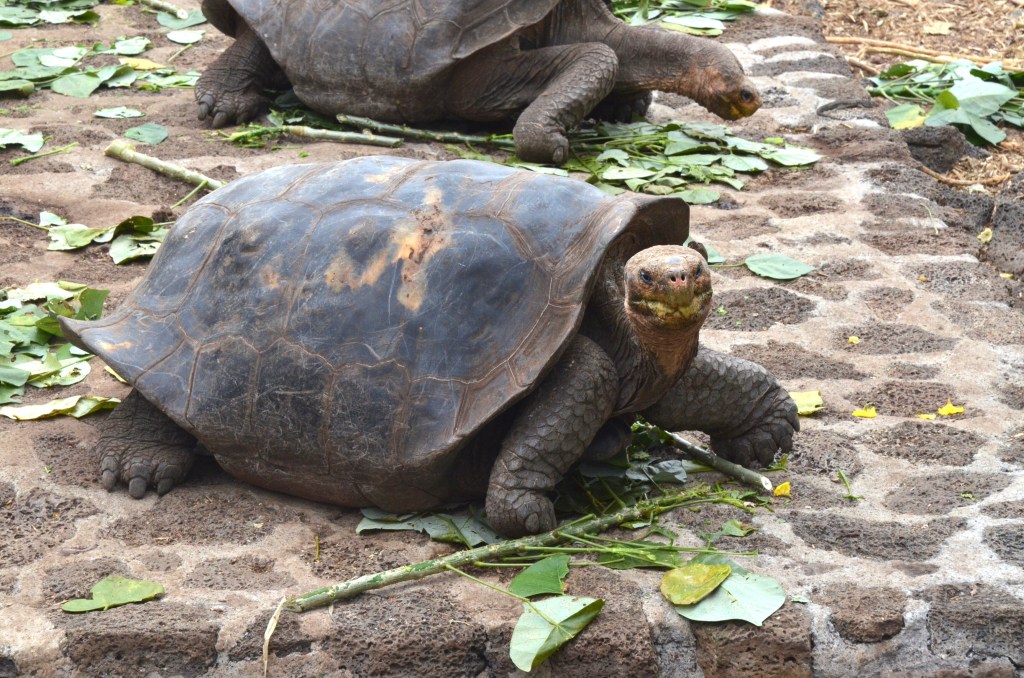
They grow very large, weighing hundreds of pounds.
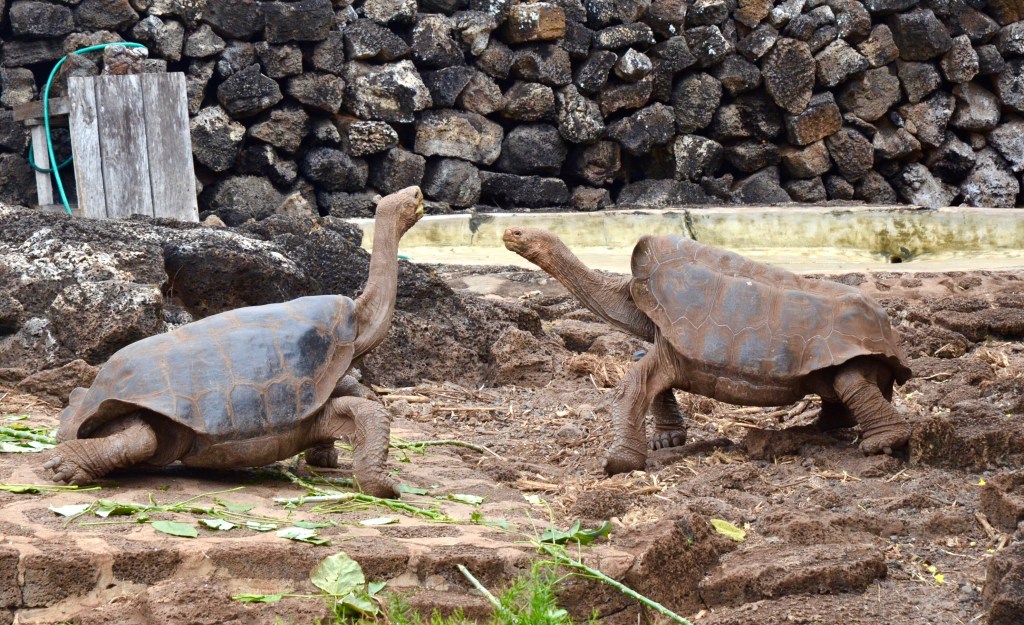
These two large Giant Tortoises had a disagreement.
After our morning visit to the Research Station, we headed up into the Santa Cruz Highlands. The flora changed from cactus to lush green fields and forests.
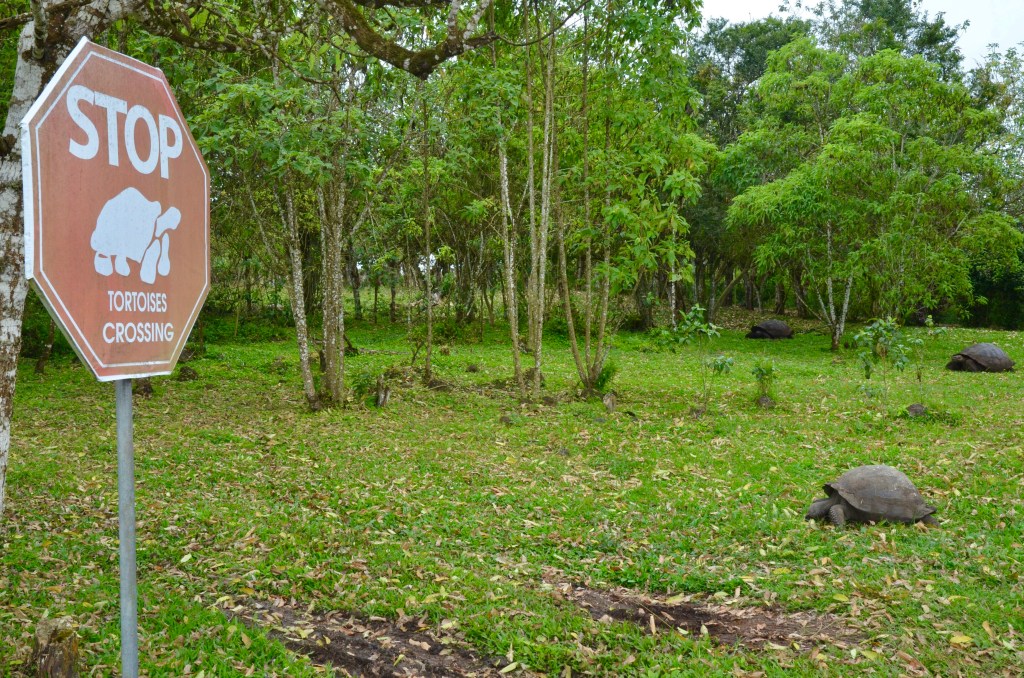
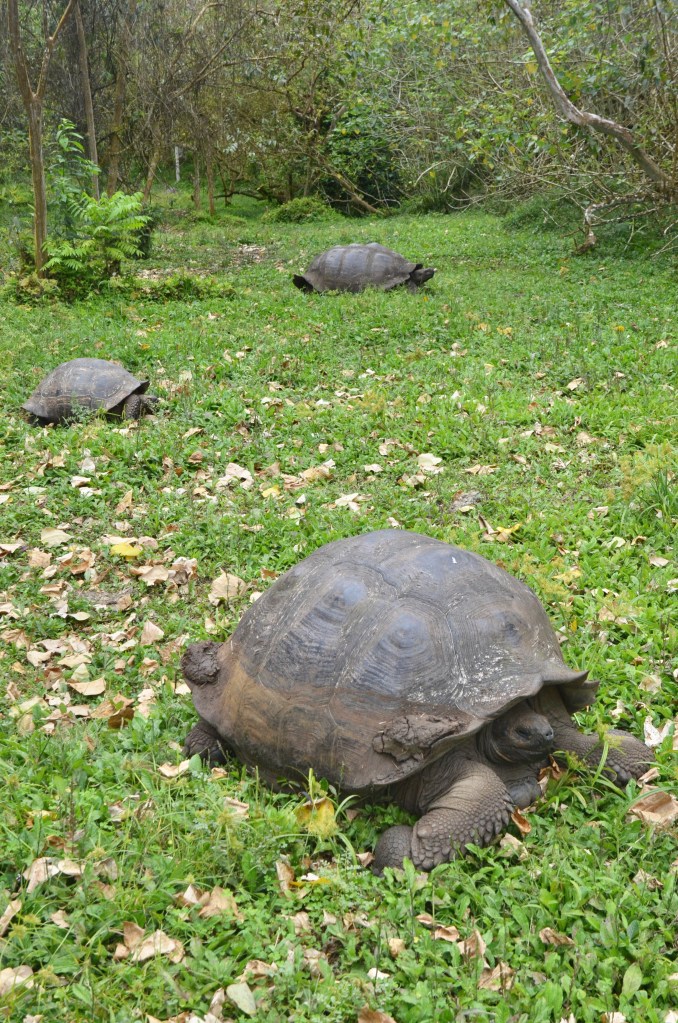
Wild Tortoise Reserve in the Santa Cruz Highlands.
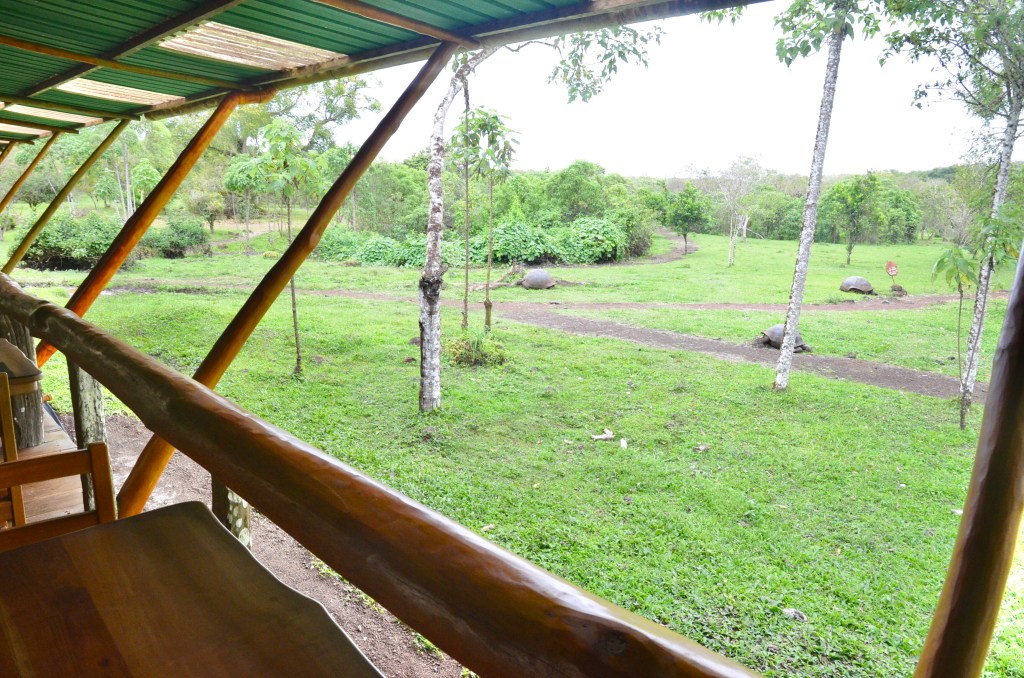
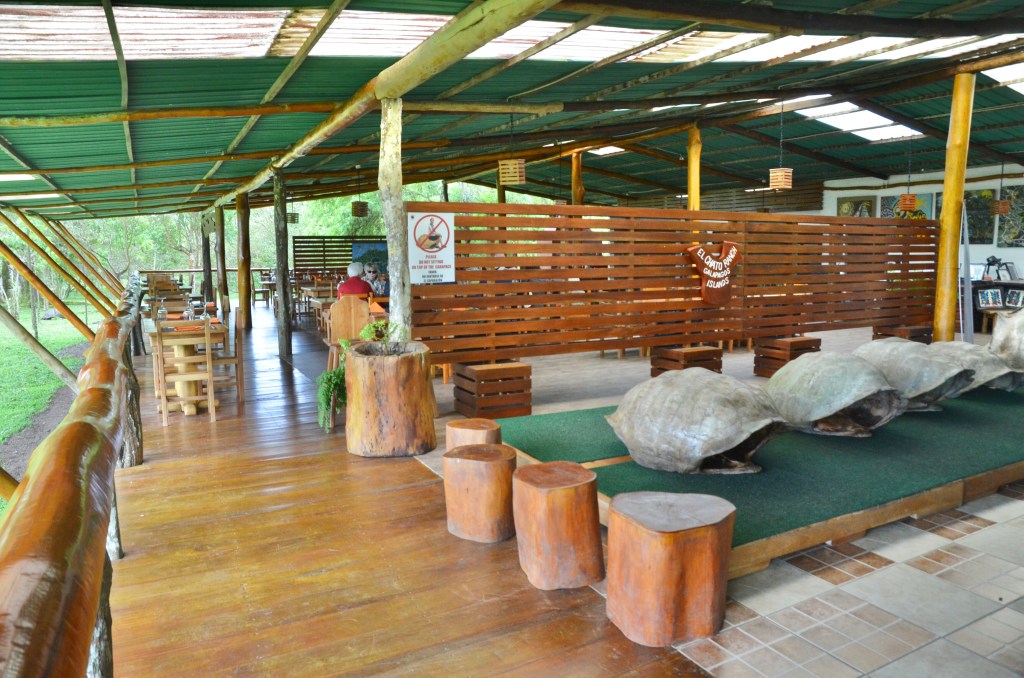
We had lunch at the reserve restaurant, which is open to the fields where the tortoises are free to roam. Descending into a lava tube at the tortoise reserve.
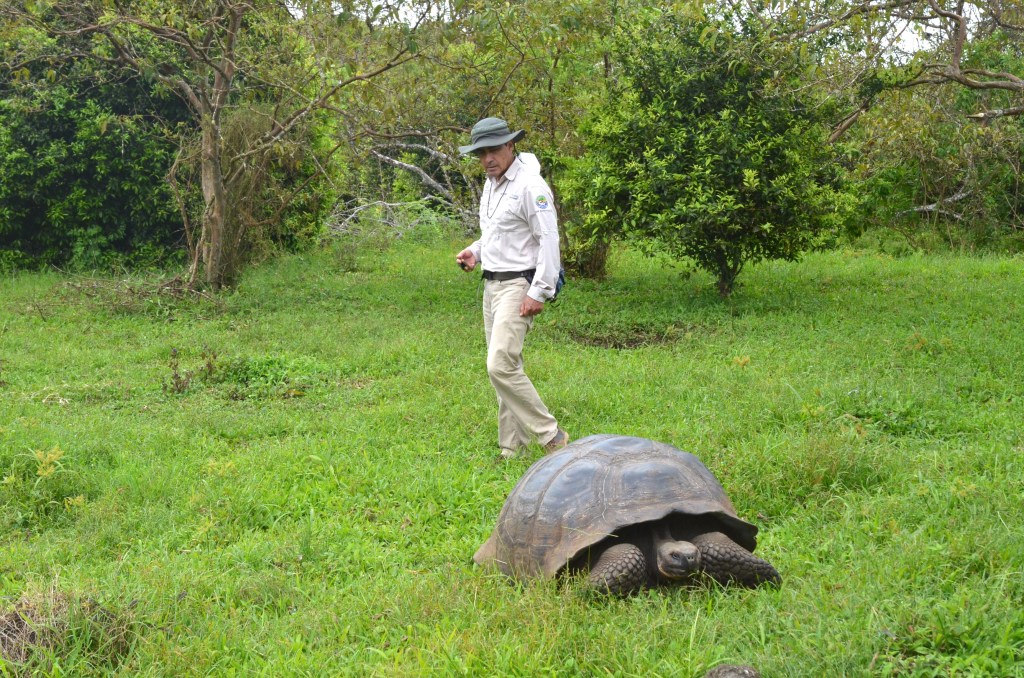
Alex demonstrates how to approach a Giant Tortoise without scaring it.
We walked through the fields and counted many tortoises.
Tucker attempts to make a connection with a tortoise.
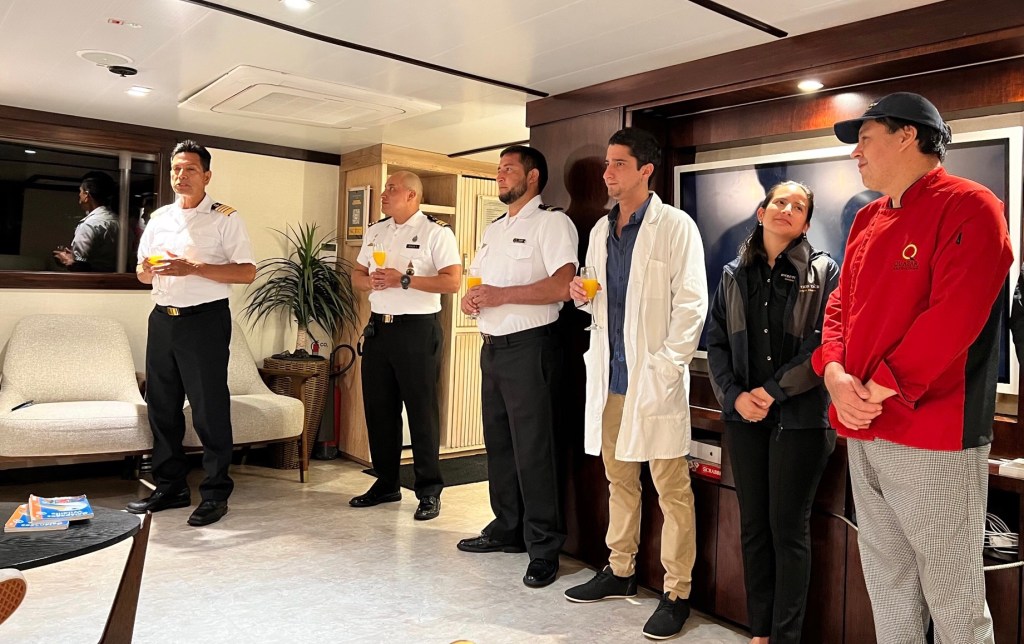
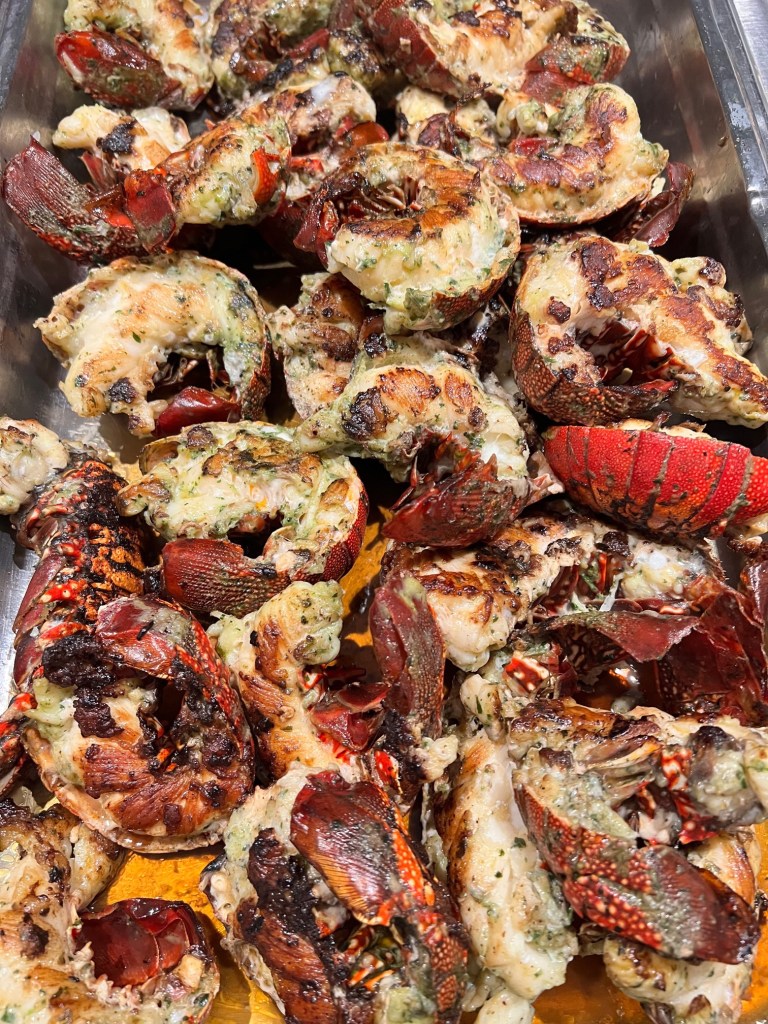
Back onboard the Evolution we had a farewell dinner of lobster and a champagne toast for our wonderful crew.
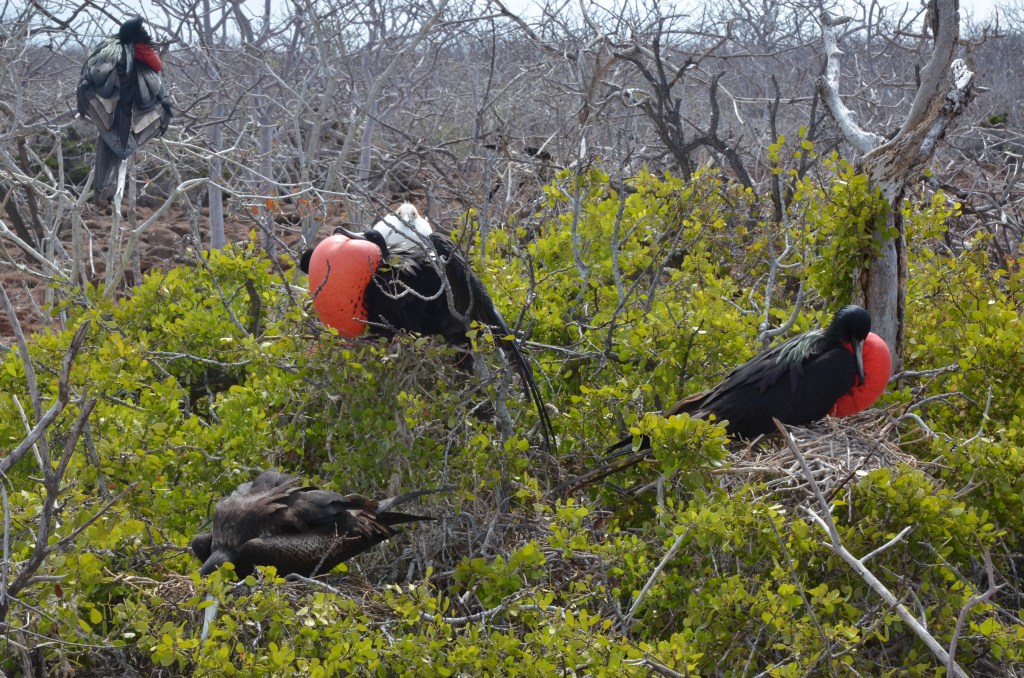
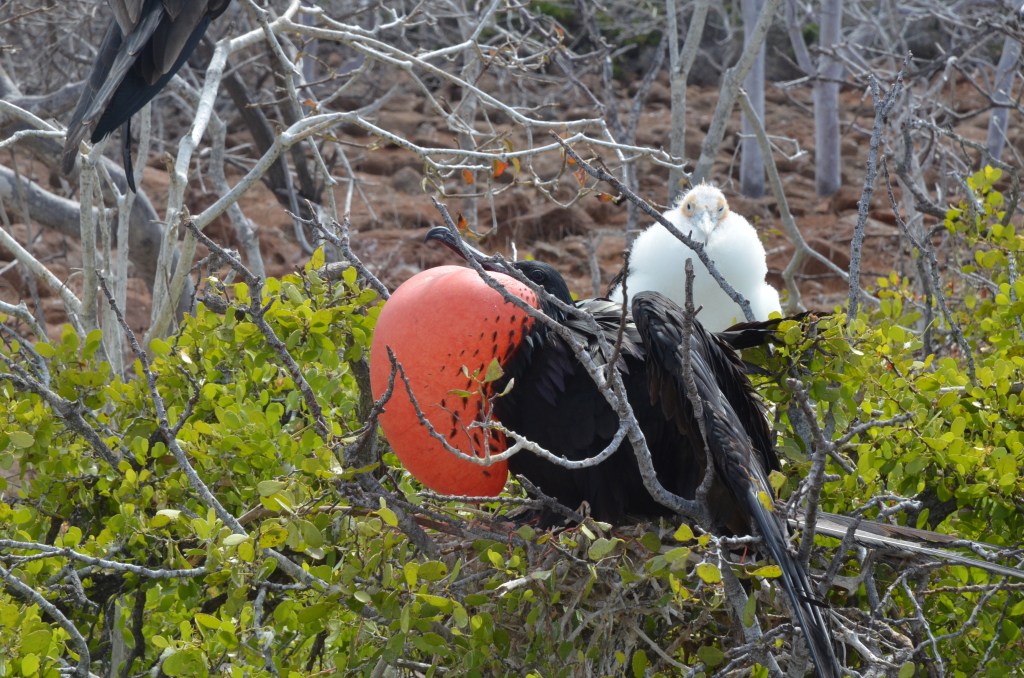
A male frigate bird inflates his red pouch (gular pouch) to attract a mate on North Seymour Island.
We started the morning by touring North Seymour Island, known for its nesting frigate population.
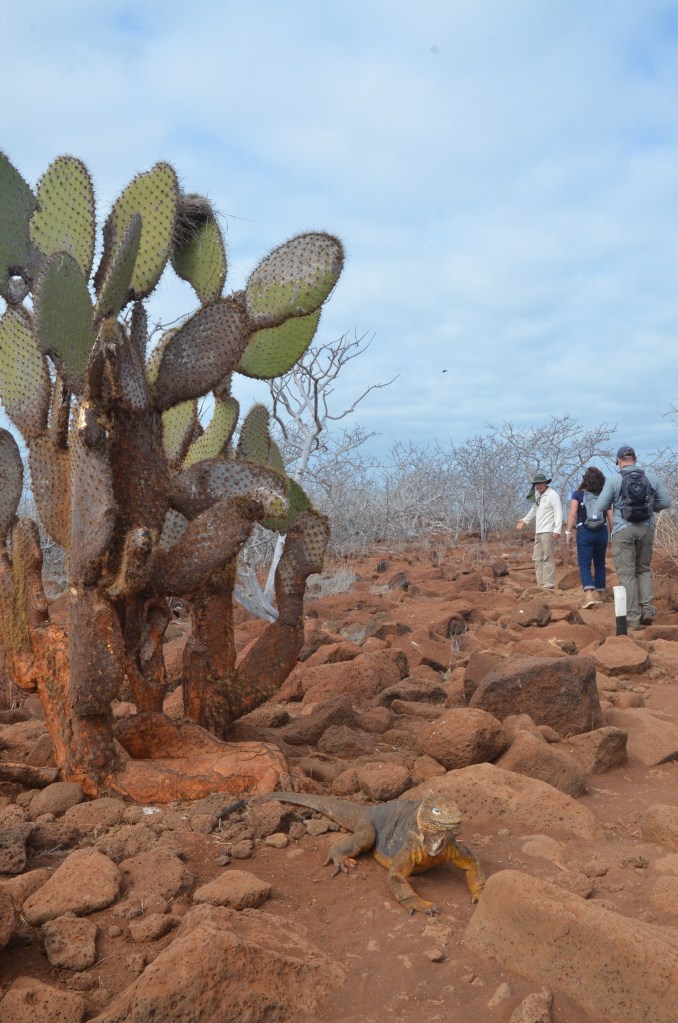
This yellow land iguana is being cleaned of dry skin and parasites by finches. Our guide was very excited when he saw this and said you don’t get to see this often.
After our frigate bird observations we again donned our wetsuits and snorkeled along the shore of the same island. The water was cool and choppy. Our best sighting today was a spotted eagle ray.
Lunch on board the Evolution.
Back onboard we took a hot shower and sat down for lunch. Lunch usually includes a discussion of the mornings snorkel sightings.
After lunch we repositioned to Santa Fe Island for kayaking and a nature walk.
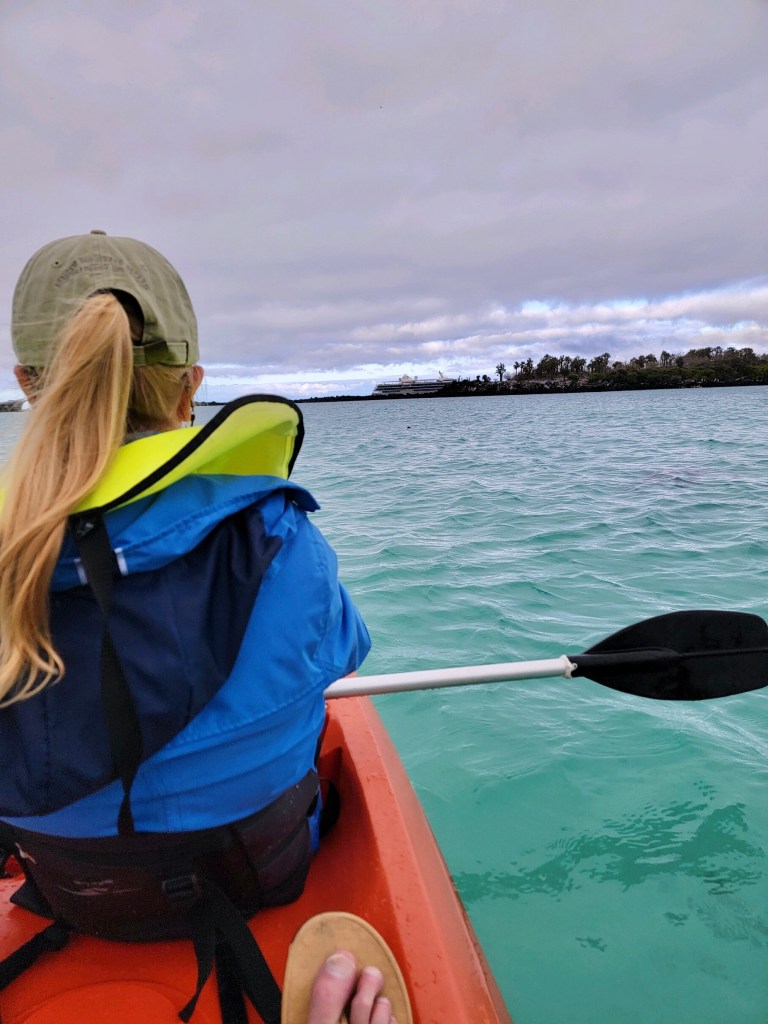
Looking at the sea lions from the kayak as they look at us.
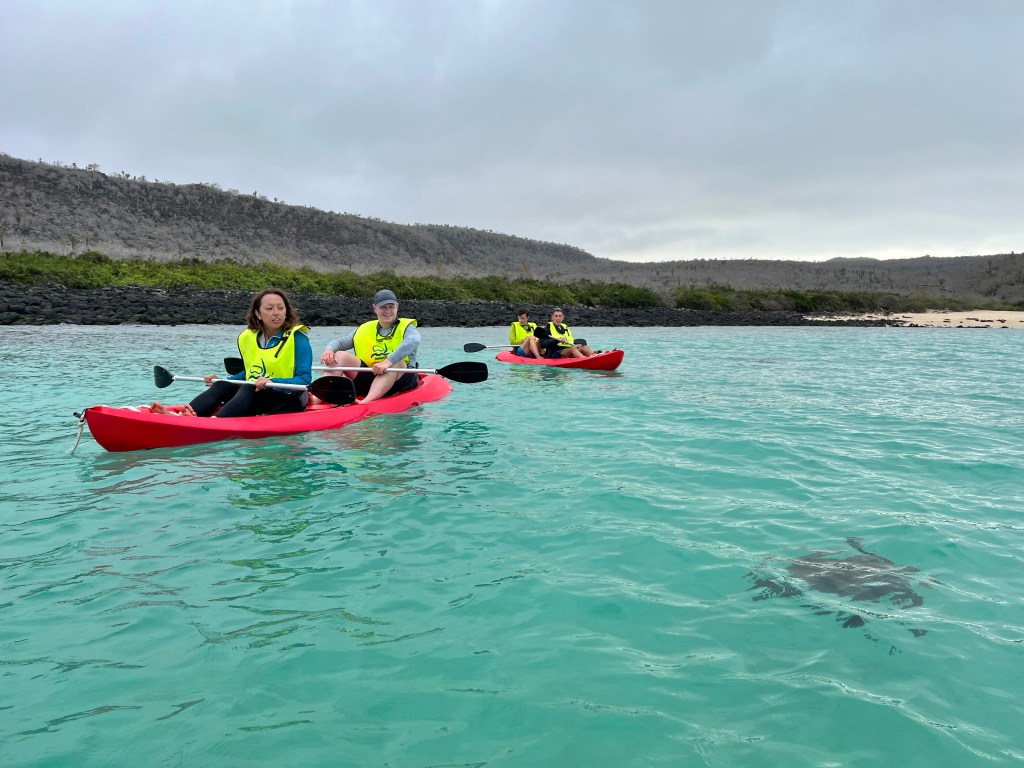
On the kayaks in a sheltered bay on Santa Fe Island.
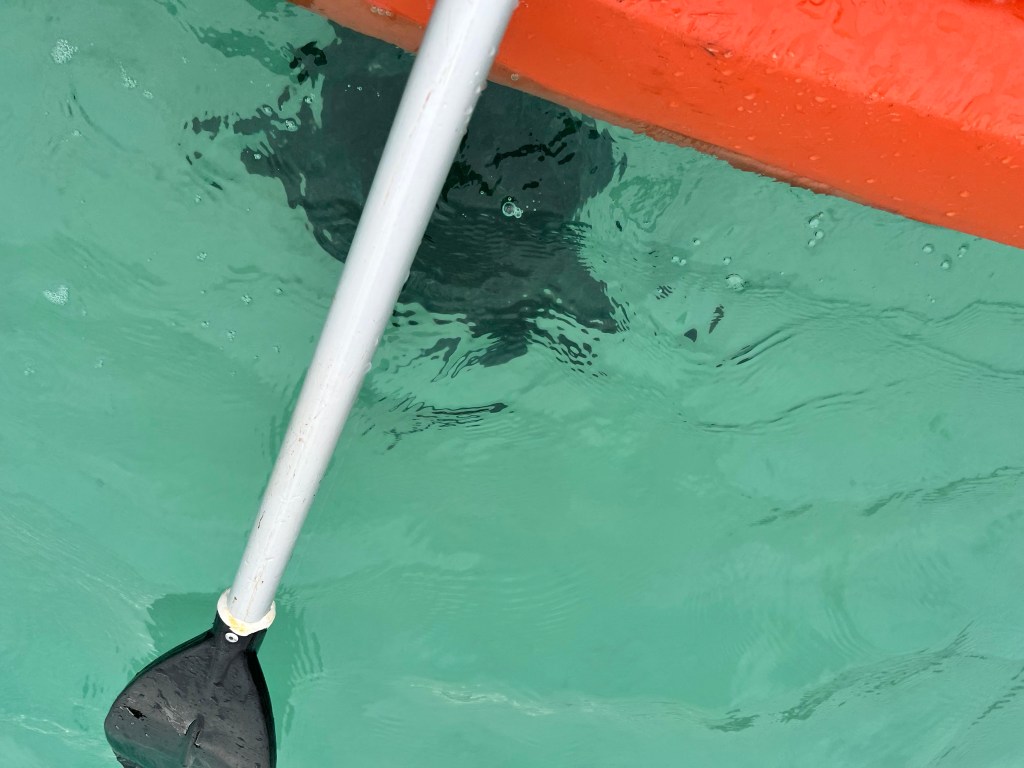
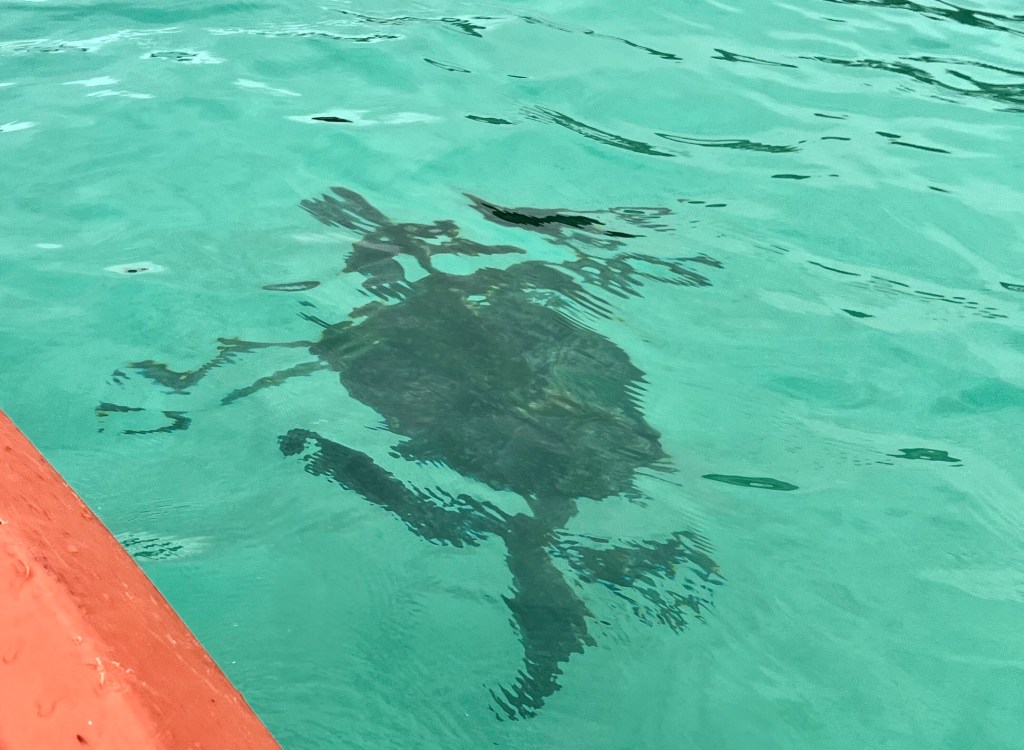
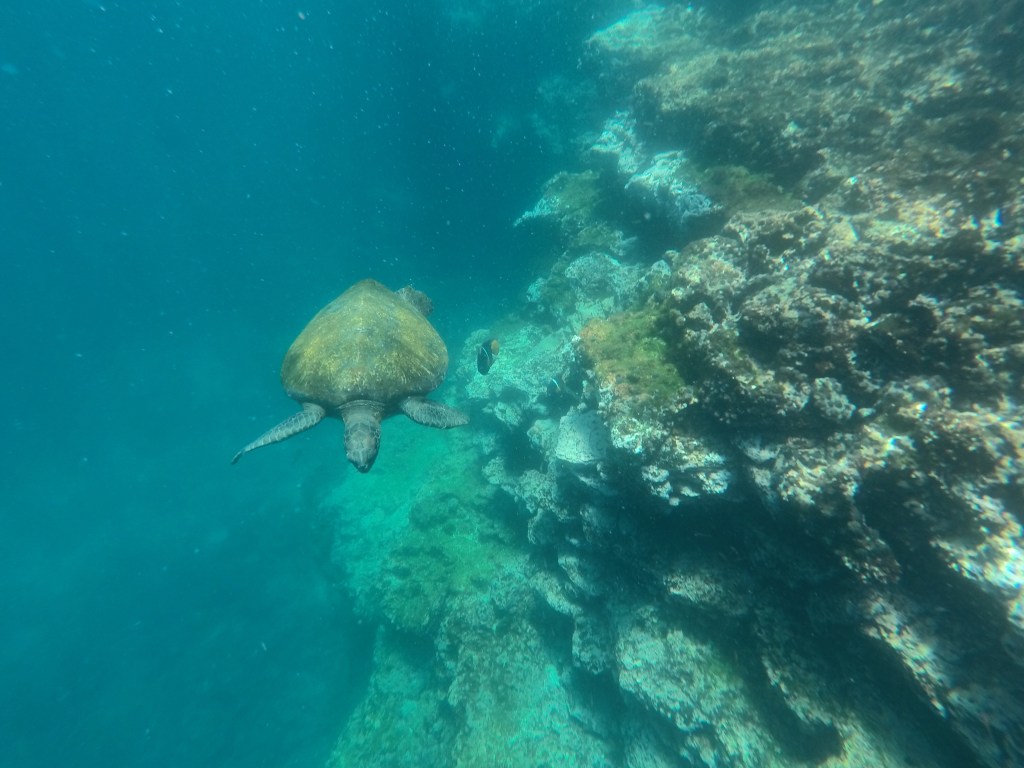
We saw a lot of turtles and sharks while kayaking.
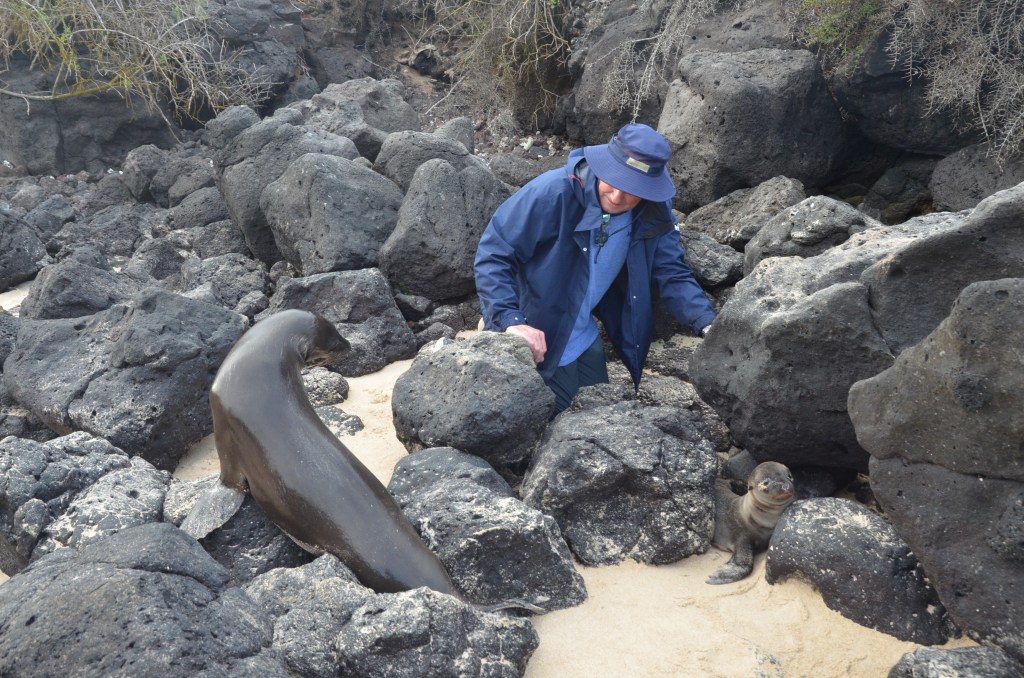
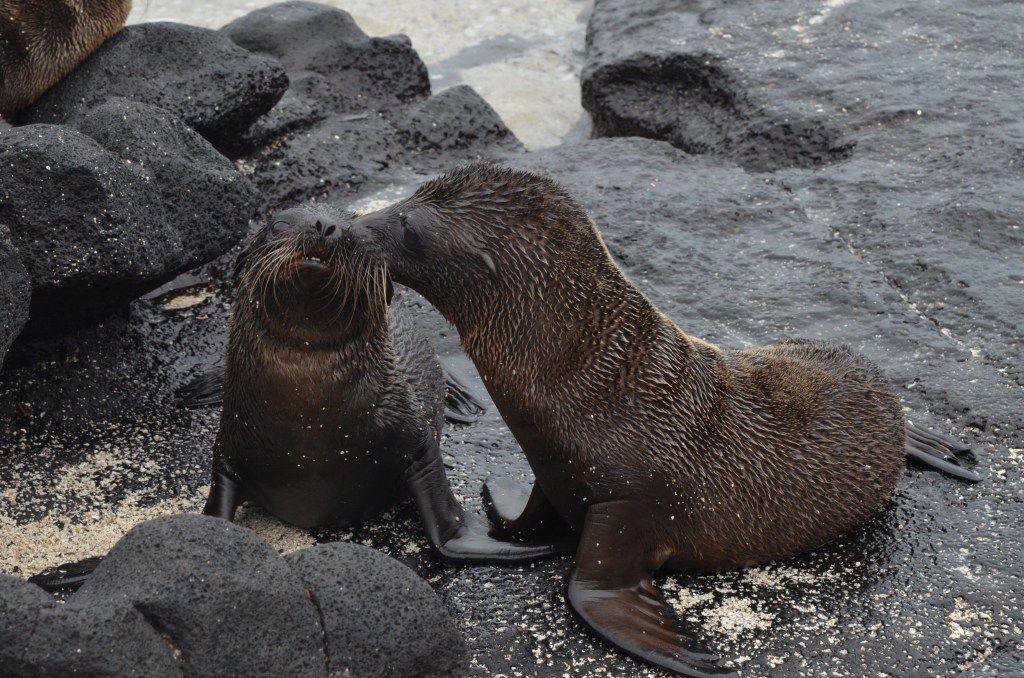
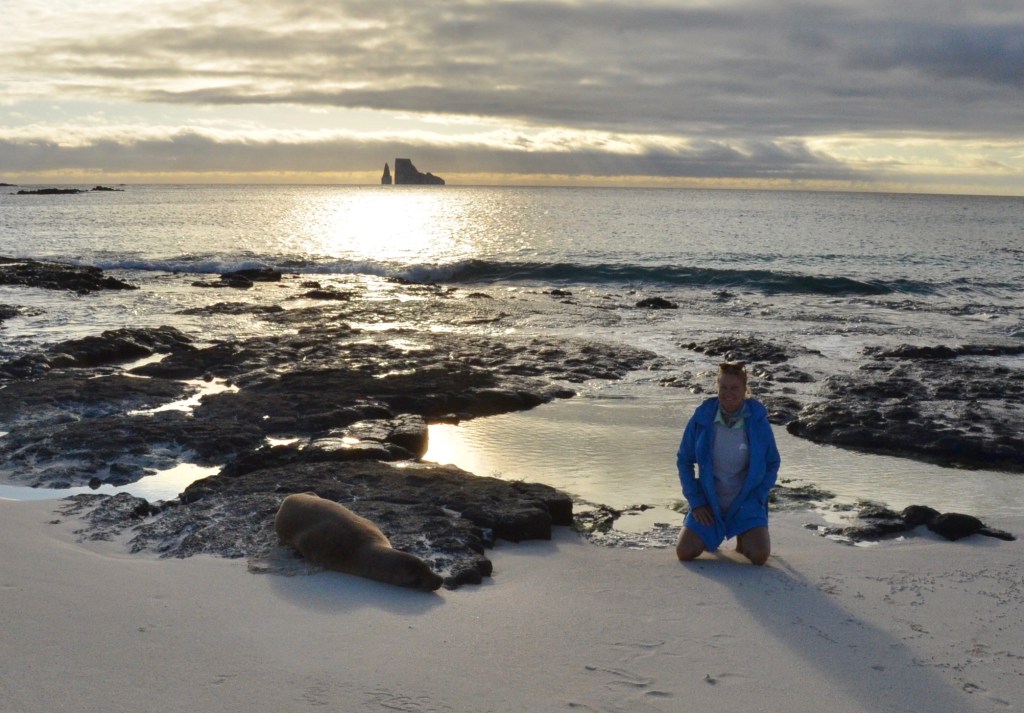
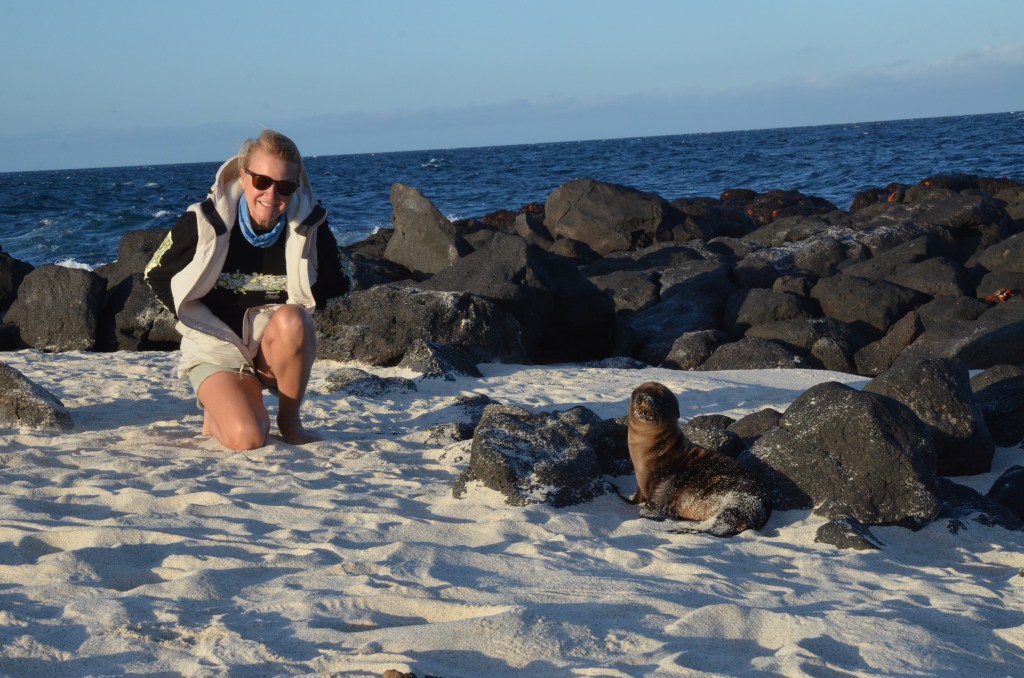
Following the lagoon kayak, we landed on the beach of Santa Fe Island for our nature walk. As we sat on the rocks and put on our walking shoes, a sea lion pup emerged from the rocks. Like all the pups, it showed no fear, only curiosity.
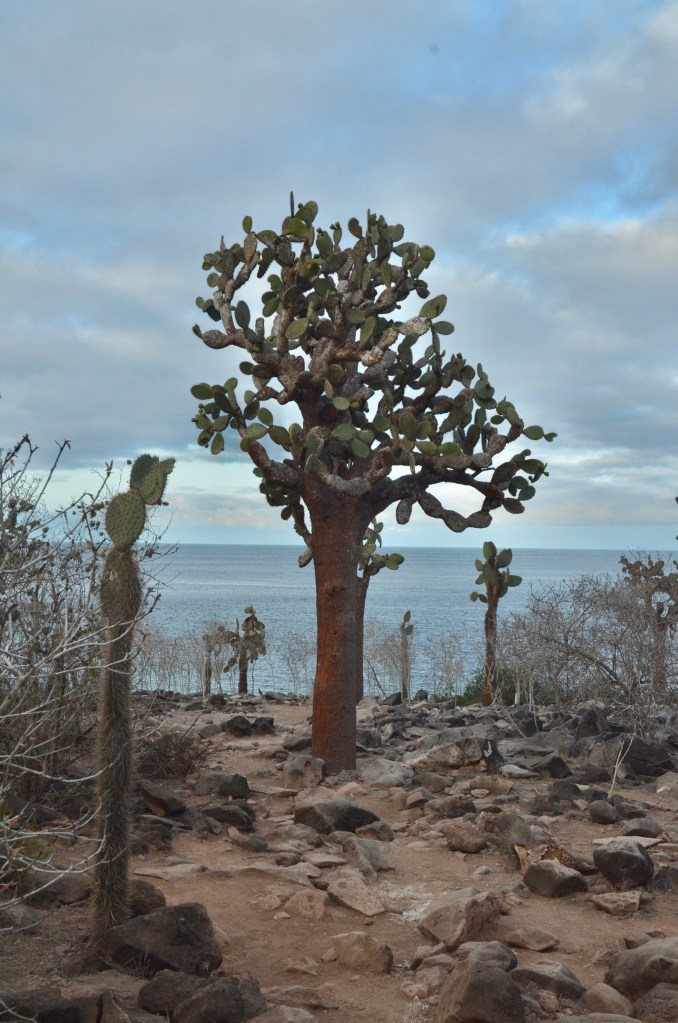
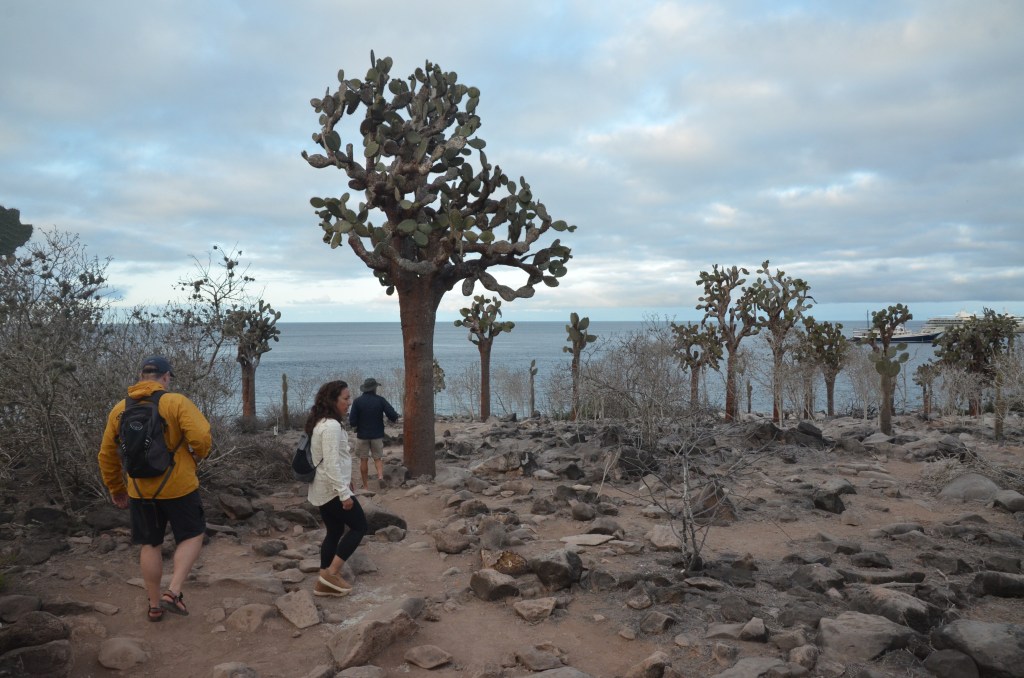
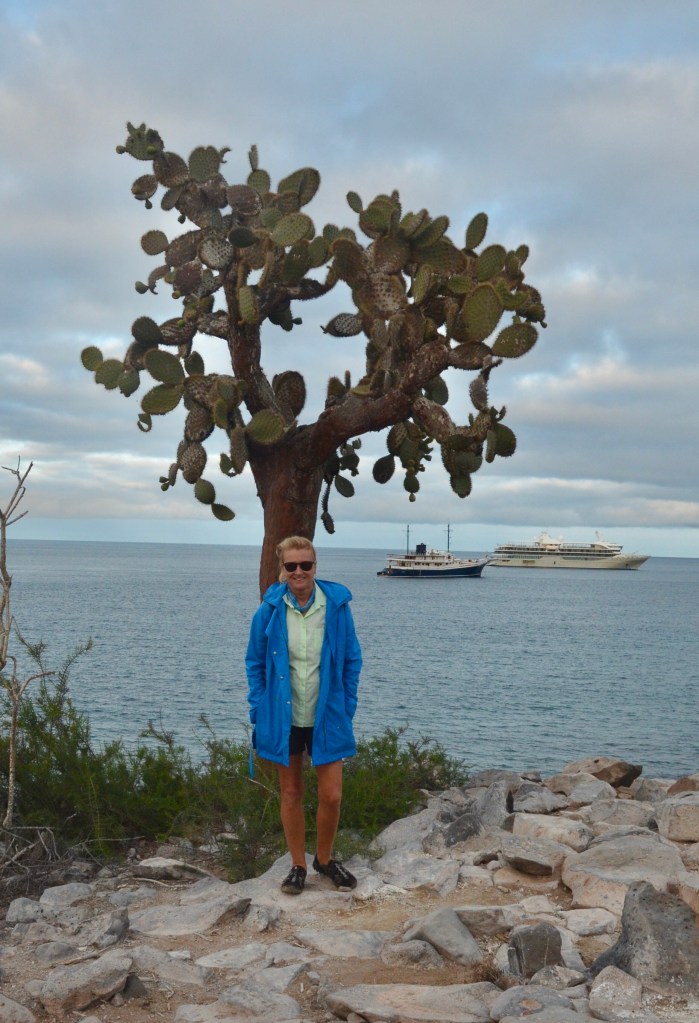
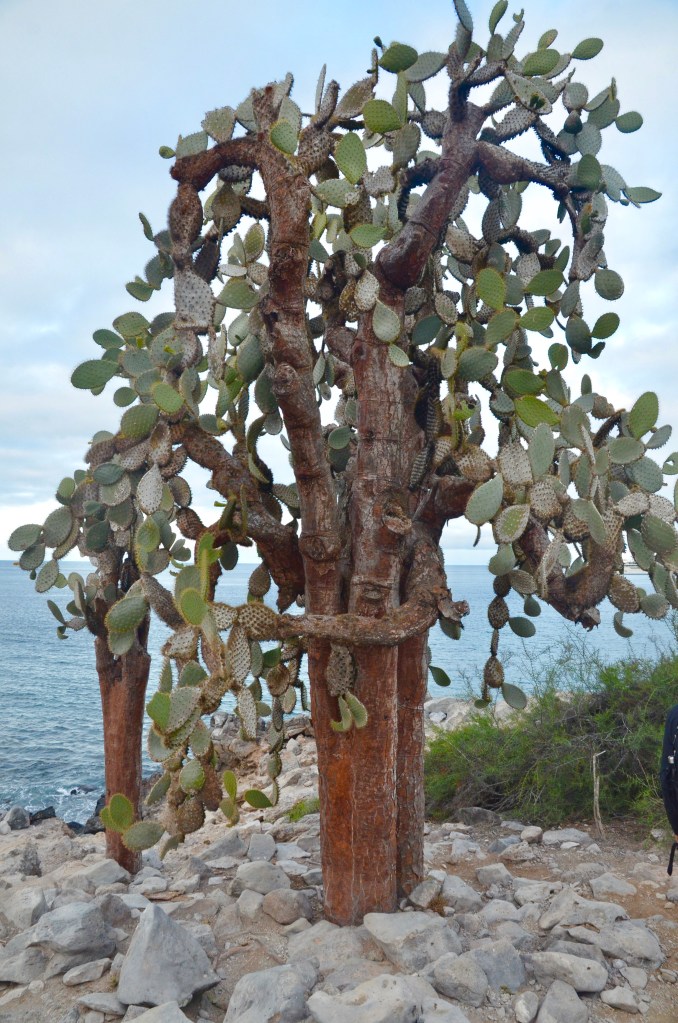
Santa Fe Island is also called Barrington Island. Our guides told us the islands have several names, and one even has seven. Santa Fe is one of the oldest islands, having been formed from an uplift instead of a volcanic eruption. That makes the island flat, instead of conical. We walked through rocky terrain and a cactus forest. Alex said some of these cactus are over 200 years old.
200 year old cactus forest.
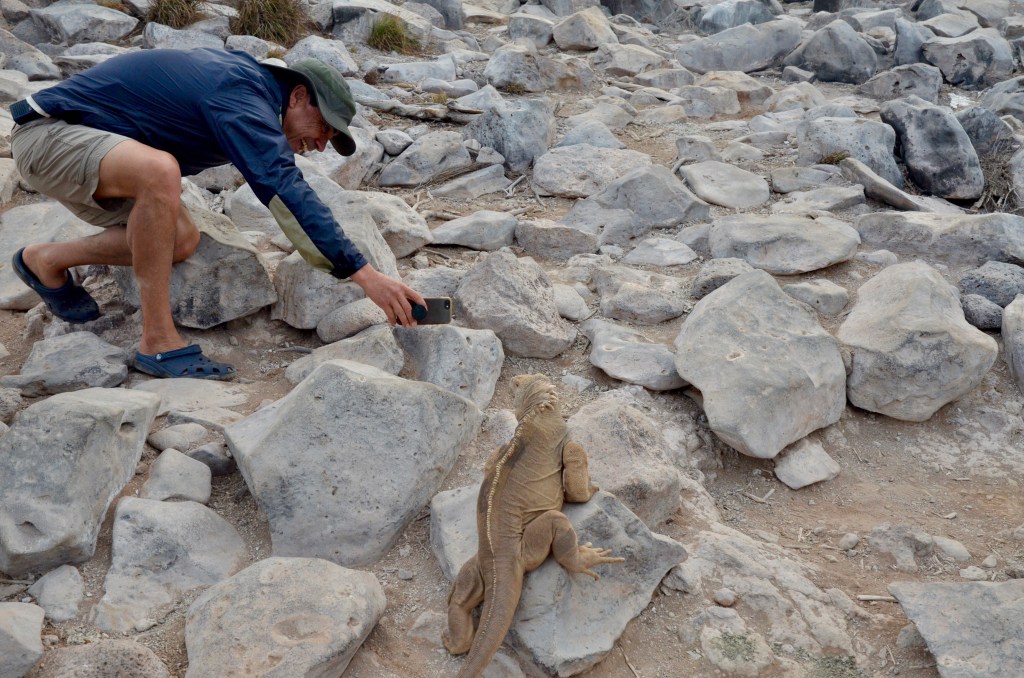
Alex, our naturalist guide, photographs a Santa Fe land iguana.
A sea lion relaxes on the top rock while the Evolution is anchored in the background.
The crew surprised Tucker with a cake and a round of “Happy Birthday.”
Today we started on Floreana Island. The bay is called Post Office Bay.
From our itinerary package:
In 1793 British whalers set up a barrel as the islands post office, to send letters home on passing ships. The tradition continues to this day, simply by dropping a post card into the barrel without a stamp. The catch is you must take a post card from the barrel and see that it gets to the right place.
I dropped 2 postcards in the barrel; one to Maine and one to Oregon. I picked out 4 postcards to deliver; two to Portland, Oregon, one to Salem, Oregon and one to Seattle.
We had two opportunities to snorkel today and we did them both. Our first swim was in Post Office Bay. We saw many turtles feeding in the rocks. It was the best turtle snorkel yet.
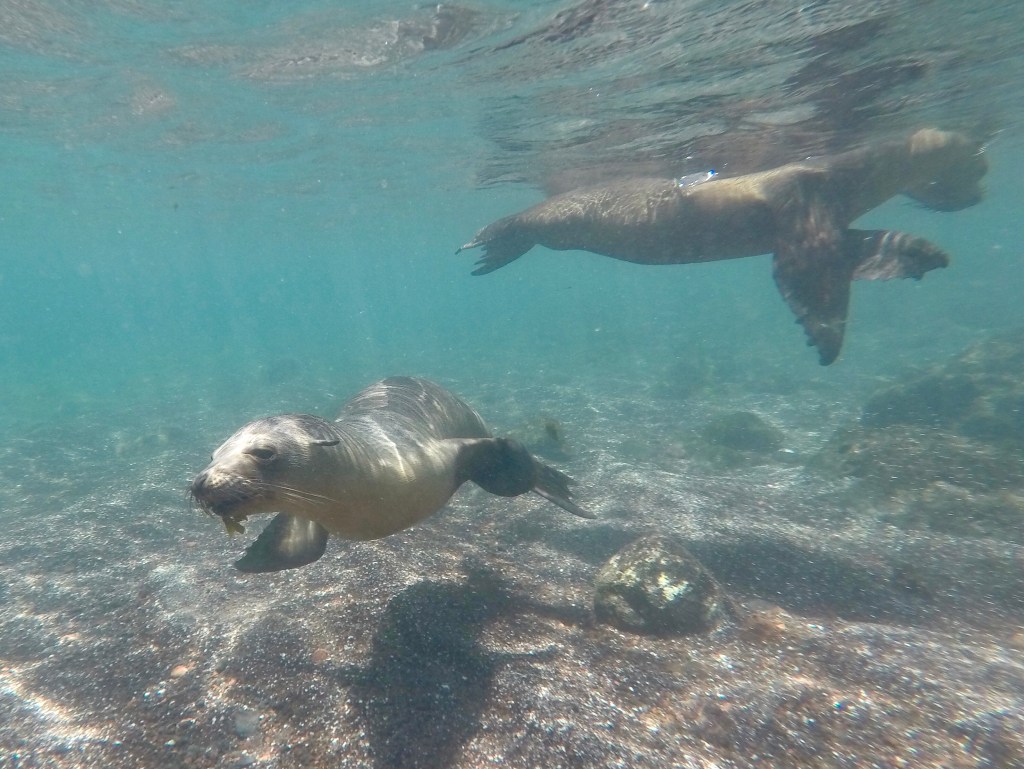
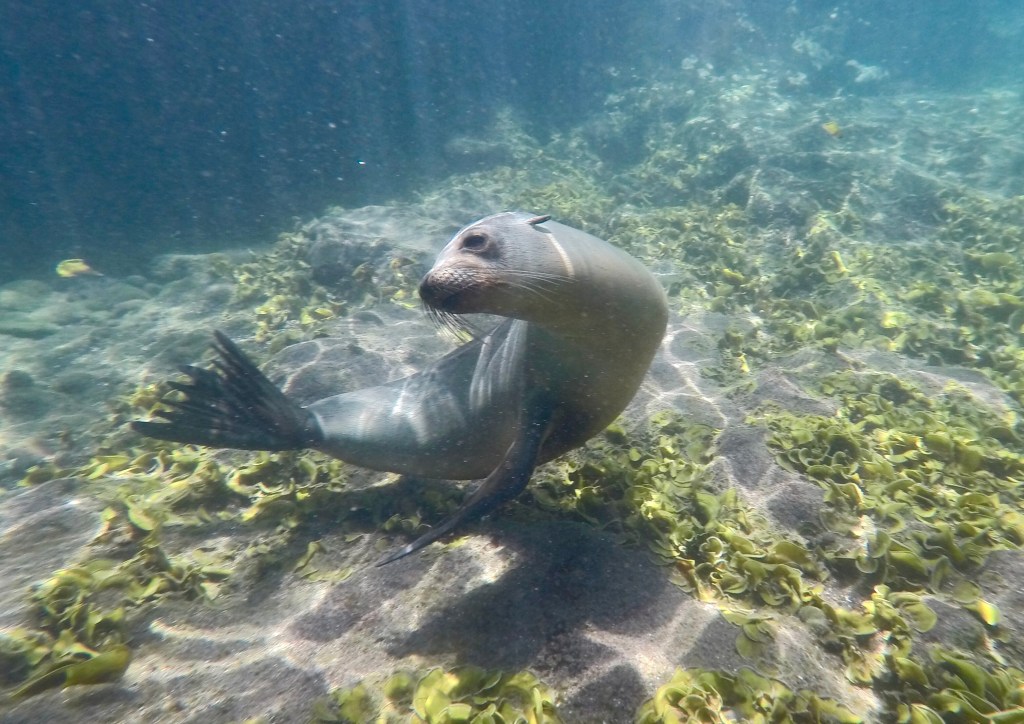
Our second snorkel was around a small island very close to Floreana called Champion Islet. It is billed as “one of the top snorkeling sites the Galápagos offering prime underwater sea lion interactions.” We can vouch for that. We swam with pups and year old sea lions. It was great. These two snorkeling experiences were the best of the trip. We saw turtles, sharks, and had some very close encounters with sea lions.
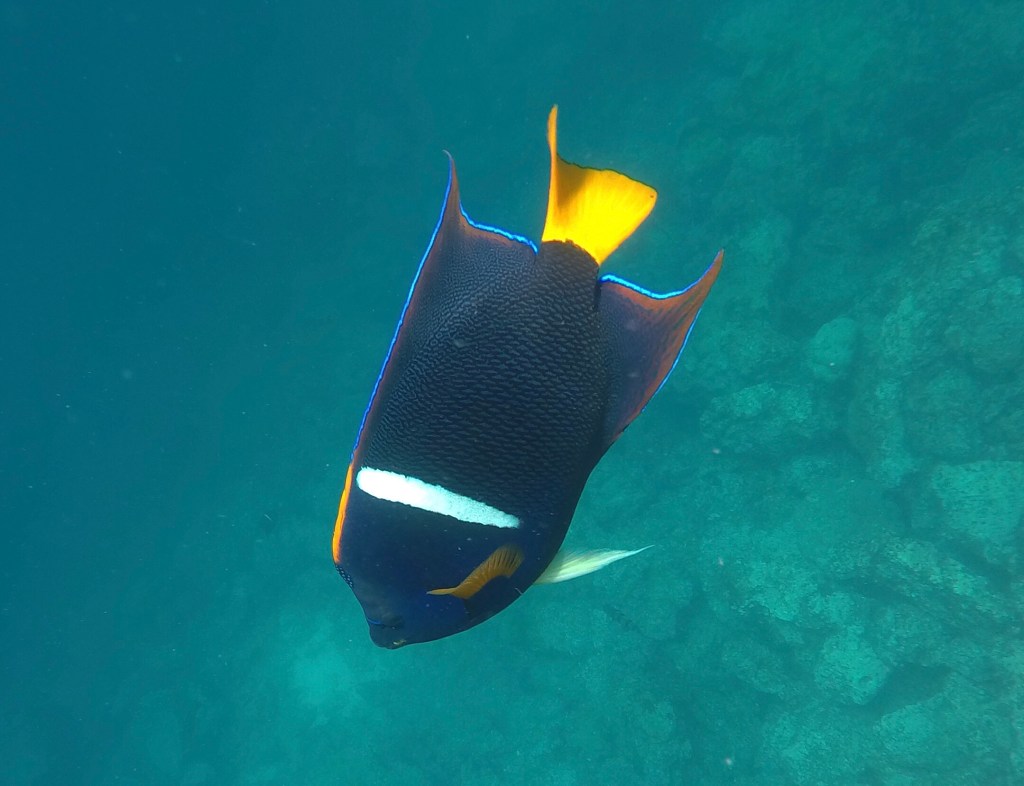
King angel fish.
Lennie and me after our last snorkel of the trip.
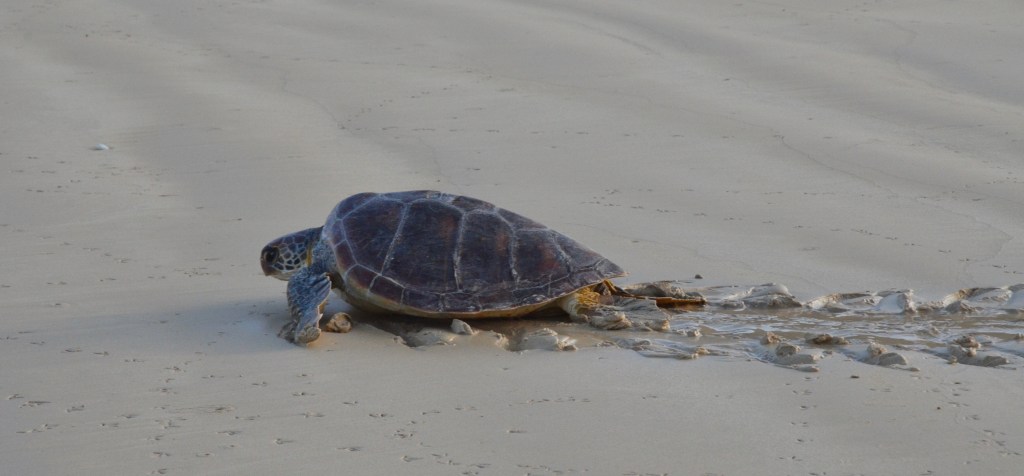
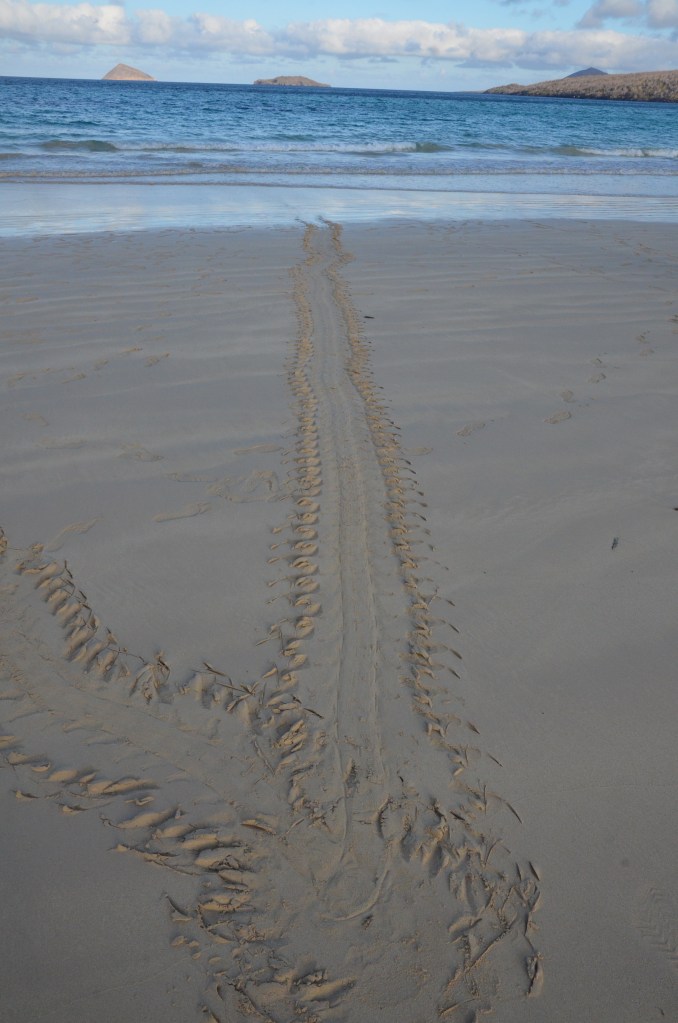
After two wonderful snorkel experiences we had lunch and repositioned to a different side of the same island of Floreana. We took a panga to the beach. Walking a rocky trail onto yet another beach we came upon a stretch of sand where two smaller sea turtles were struggling. Judging from the tracks, the turtles had come up on the beach and then turned around to go back into the sea. One was close to the water and slowly making progress. The other sea turtle was higher up on the sand and stopped. She looked exhausted. Several of our group picked her up and set her closer to the water. We watched as she made her way back to the safety of the sea.
On a beach on Floreana Island, the Galápagos.
A Sally lightfoot crab and reflection on Floreana Island as the sun nears the horizon.
Overnight we had motored to Sombrero Chino Island. It is a tiny cone island off the coast of Santiago Island. This is one of the few places you can see the Galápagos penguin. After breakfast we climbed into the pangas and slowly cruised the coastline, but no penguins.
Sea Lion pups playing.
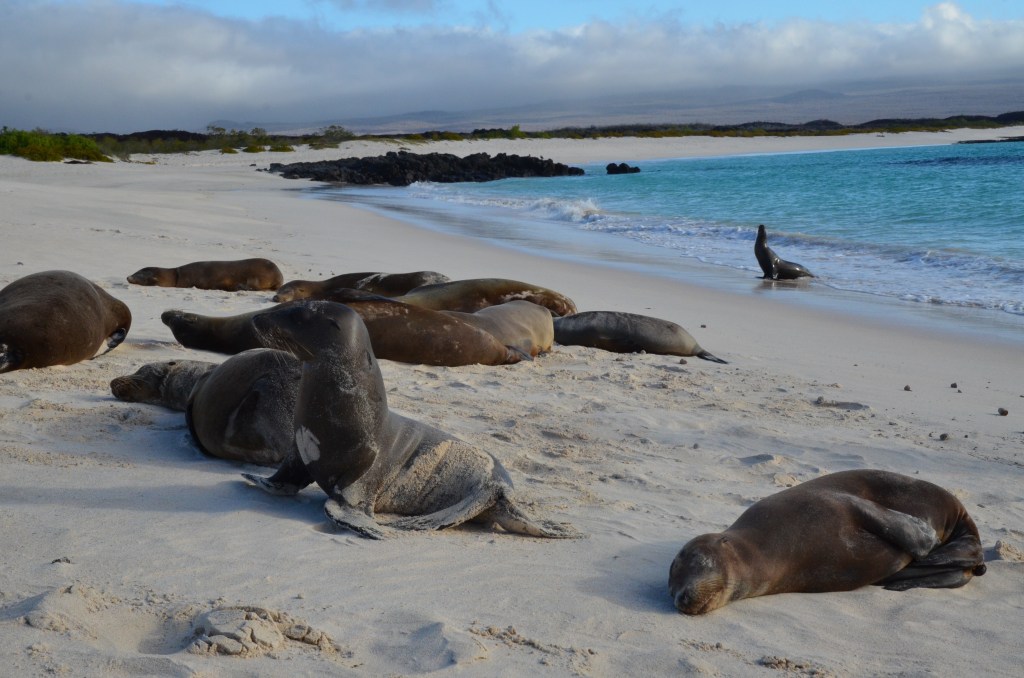
As we pulled up onto the beach, we could already see that this small sandy spot served as a sea lion pup nursery. There were pups playing with each other, as one large male sea lion kept watch.
This sea lion pup was just hours old. The after birth was on the rocks.
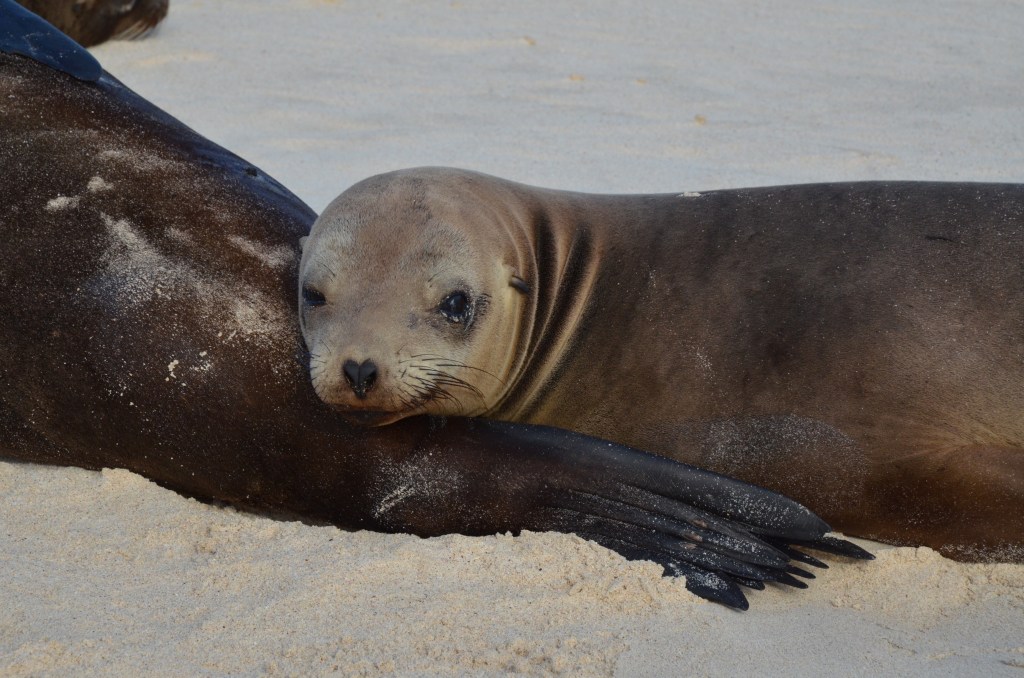
We saw a mother nursing her pup and Alex, our Naturalist Guide, found the afterbirth in the rocks. This little pup was hours old.
Tucker photographing the Galápagos hawk.
Galápagos hawk
Me on the trail.
Sombrero Chino Island, lava and Galápagos carpet weed.
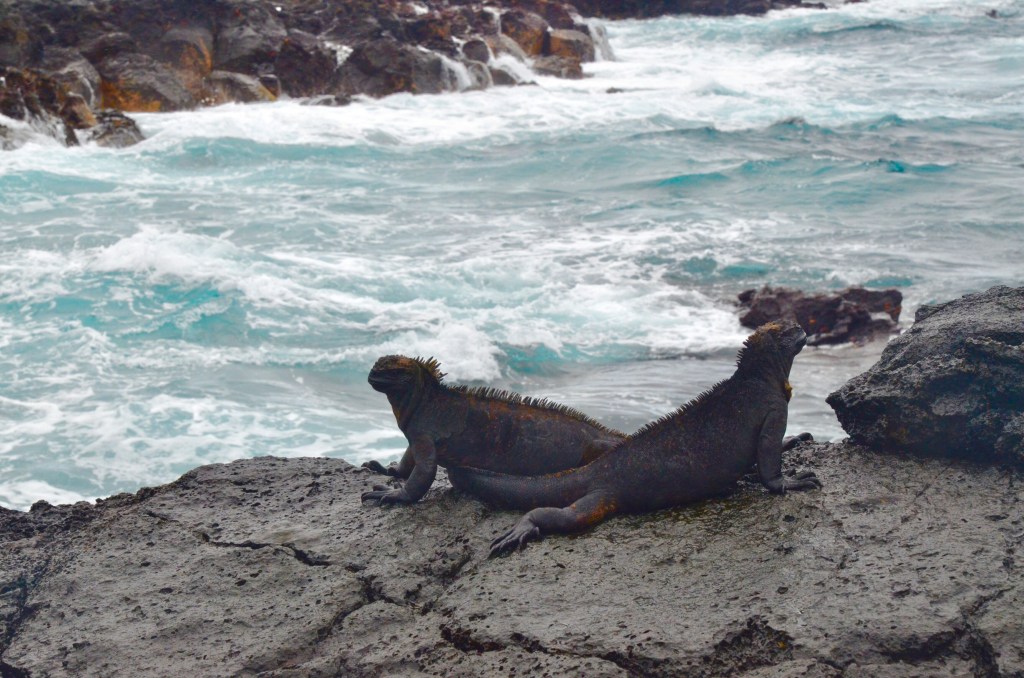
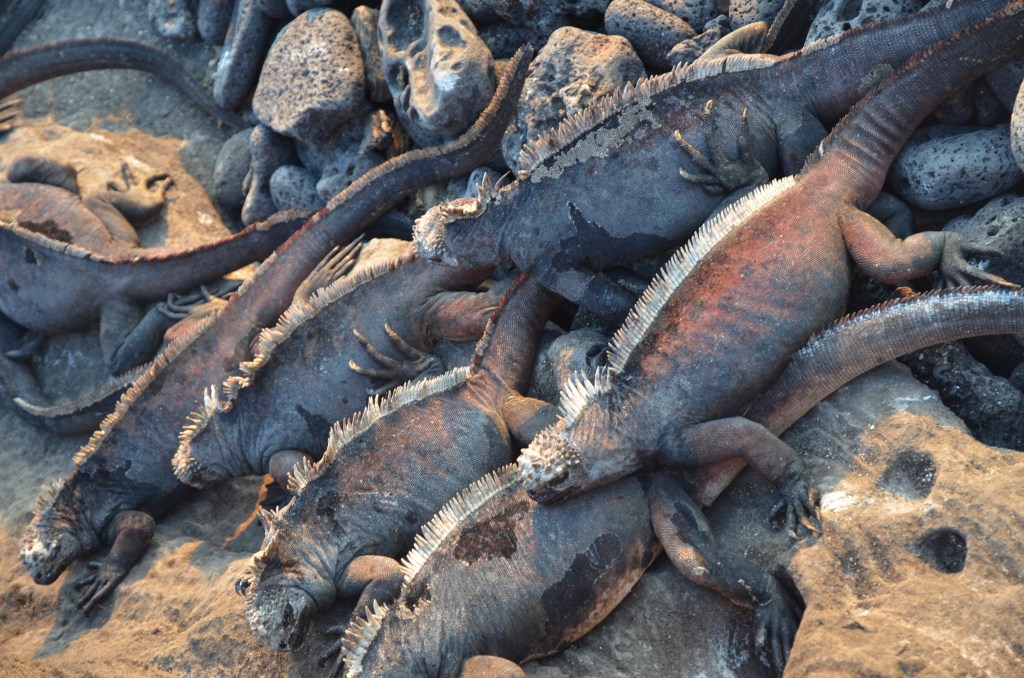
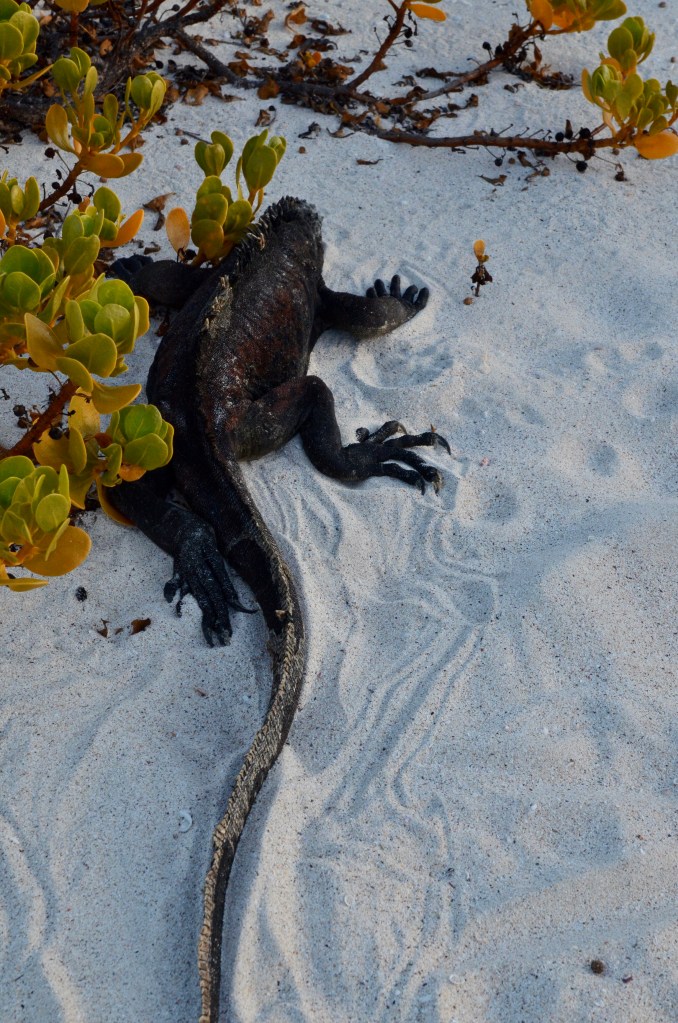
We saw many Marine Iguanas.
At the end of the trail we had a true photo opportunity with Marine Iguanas, crabs, and beautiful waves.
Marine iguana surrounded by Sally light foot crabs.
Marine iguanas.
Marine iguanas.
Walking the trail back to the pick up spot.
The panga returns to pick us up.
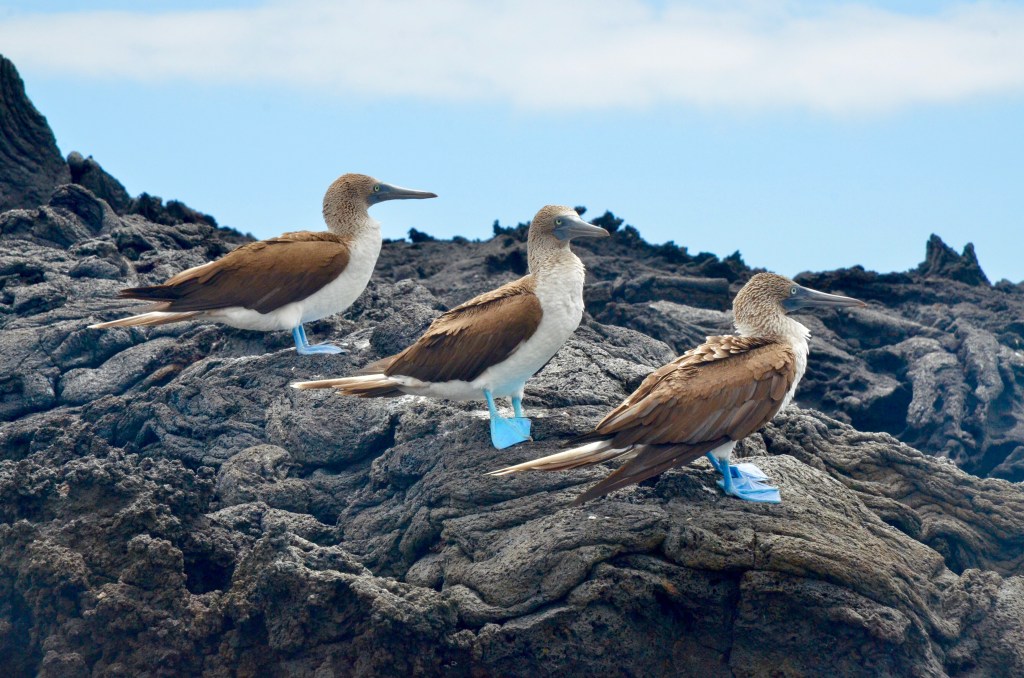
Making our way back to the Evolution we cruised along the lava rock shore and found blue-footed boobies.
Three blue-footed boobies with the Evolution in the background.
Blue-footed boobies.
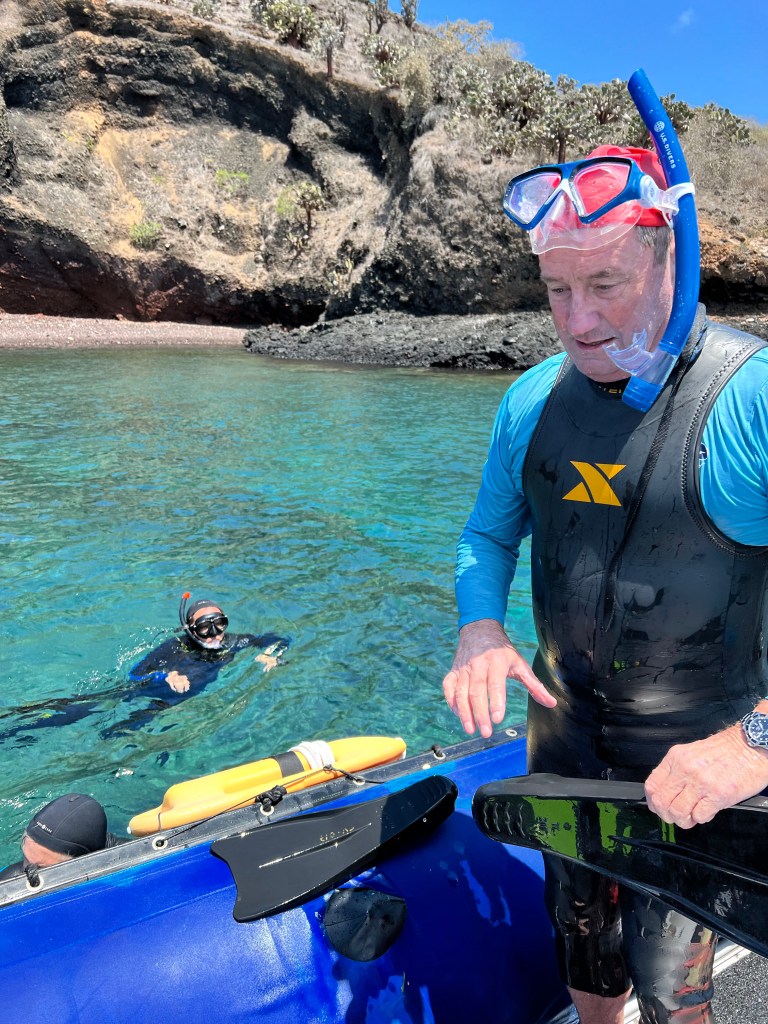
After our morning walk we once again squeezed into our wetsuits for a snorkel. The hope was to possibly see penguins in the water. Today’s snorkel was in cooler and choppier water. The water temp was 21 C, approximately 70 F. We saw more fish, but it felt colder. Thank goodness for the wetsuits. My wetsuit is 5 mm thick, and I haven’t felt much of the cold water. The wetsuits loaned out by Quasar are 3 mm, and some of the other guests felt the cold. One of the crew members helped me remove mine, he hefted it and said “you are a polar bear.” I’m good with that! We saw king angelfish, surgeonfish, another shark and so many colorfully designed Panamic cushion stars (starfish) it was impressive. The current picked up and we just floated along at a good clip.
Post snorkel.
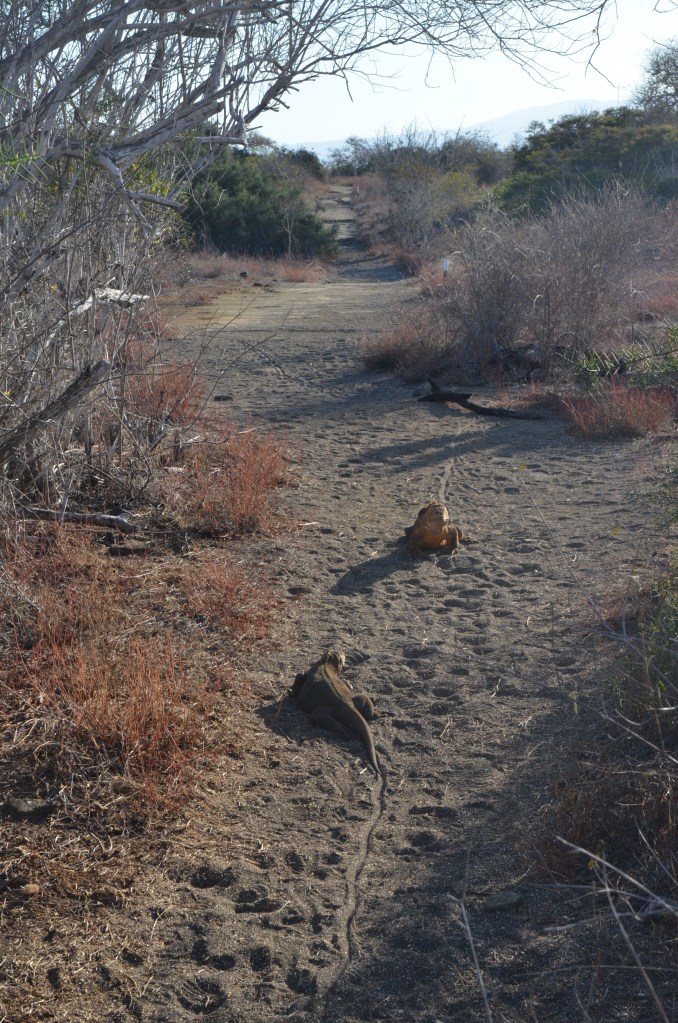
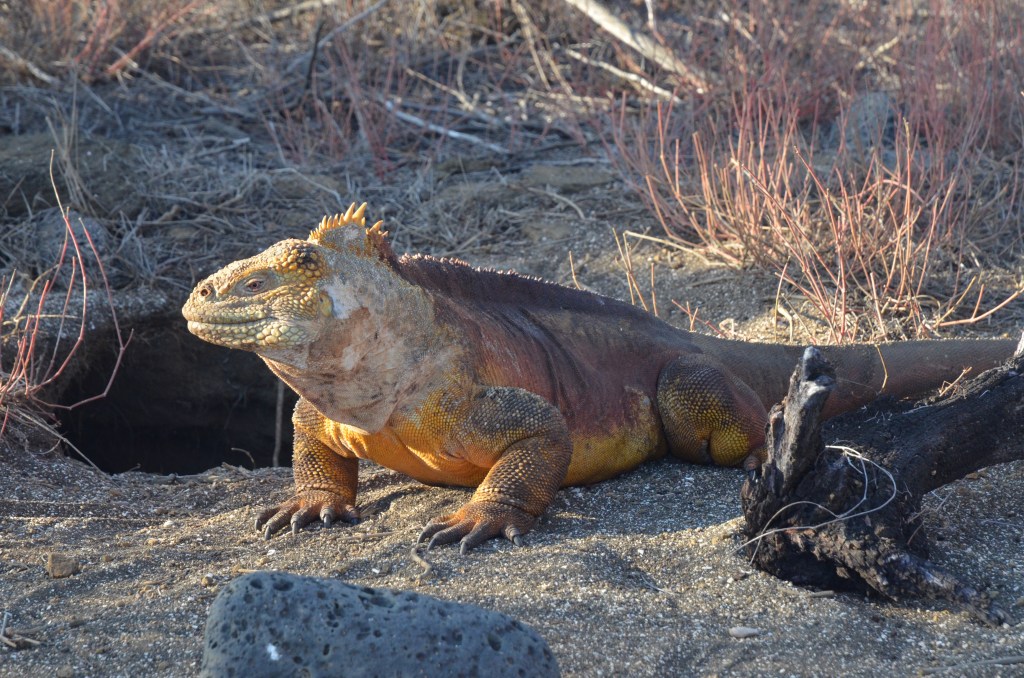
Back on board we ate lunch as the crew repositioned the boat to the west side of Santiago Island. At 3:30 we took a panga into shore, landing on a black sand beach in James Bay (Puerto Egas). During this walk Alex gave us a history lesson, including that Darwin spent more time on this island than any other. This island is home to many large land iguanas. We saw about 6 large ones.
Our guide Alex photographs a land iguana.
Land iguanas on the trail on Santiago, James Bay.
Land iguana.
We walked the trail, then the coastline and saw a large sea turtle and a fur seal in the crystal clear grottos formed of broken lava tubes. We also saw many more marine iguanas. As the sun was sinking and we were walking back to the beach for our pick up, we saw a mass of 17 marine iguanas settling in the the night.
The grotto where we saw the turtle.
Back on the Evolution we had our customary post walk snack and beverage. Tonight we watched the sunset over James Bay.
Sunset in James Bay.
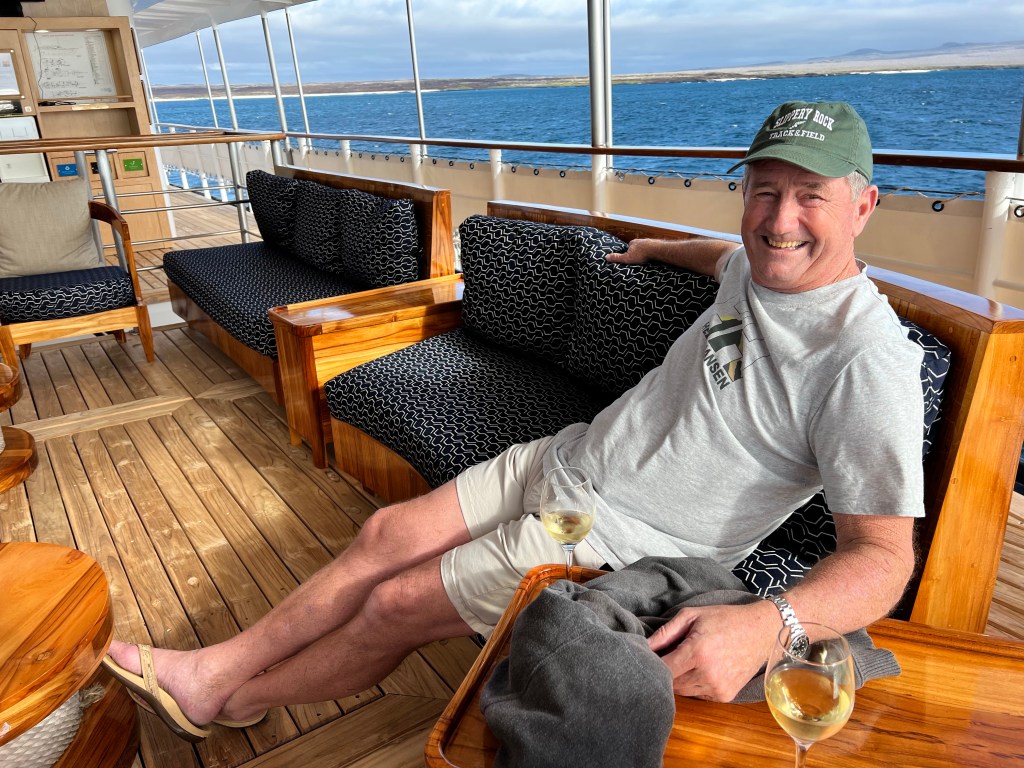
Post walk relaxation.
Cesar shows us an Ecuadorian rose. We liked it.
Every evening at 7 pm one of our two Naturalist Guides, Alex or Lenin, gives a lecture and then briefs us on the schedule for the next day. Then we have dinner. I owe our guide Lenin (Lennie) a huge debt of gratitude. I accidentally packed only one battery for my Nikon, and unfortunately I packed the bad battery. I was dead in the water. Lennie carries his Nikon on every walk. He loaned me one of his batteries so I could continue to take photos. If it were not for his generosity, I would be stuck with only iPhone pictures. He is an accomplished photographer and has worked for National Geographic, plus he’s funny.
Overnight we had our longest cruise, crossing the equator northbound. We cruised from Santiago Island to Genovesa Island, also known as Bird Island.
Darwin’s Bay
The next mornings nature walk along the shore of Darwin’s Bay we saw every stage of chick development, from newly hatched chicks with no fuzz at all, fuzz covered babies, to week old chicks and “teenagers” demanding to be fed. If yesterday was sea lion pup nursery, today was a bird hatchery.
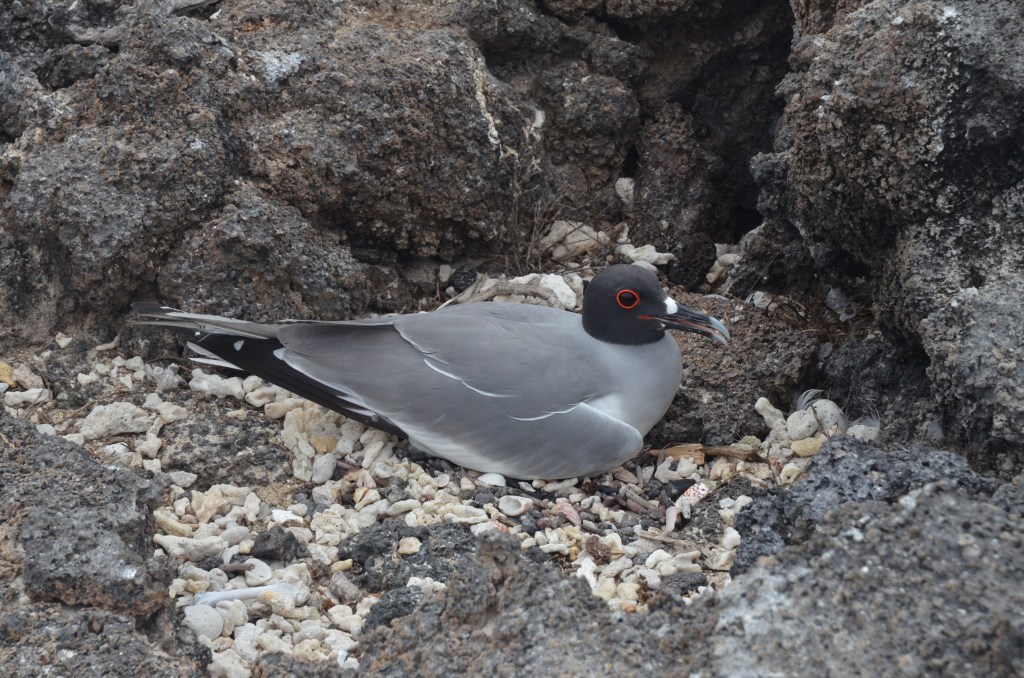
Swallow-tail gull on a nest.
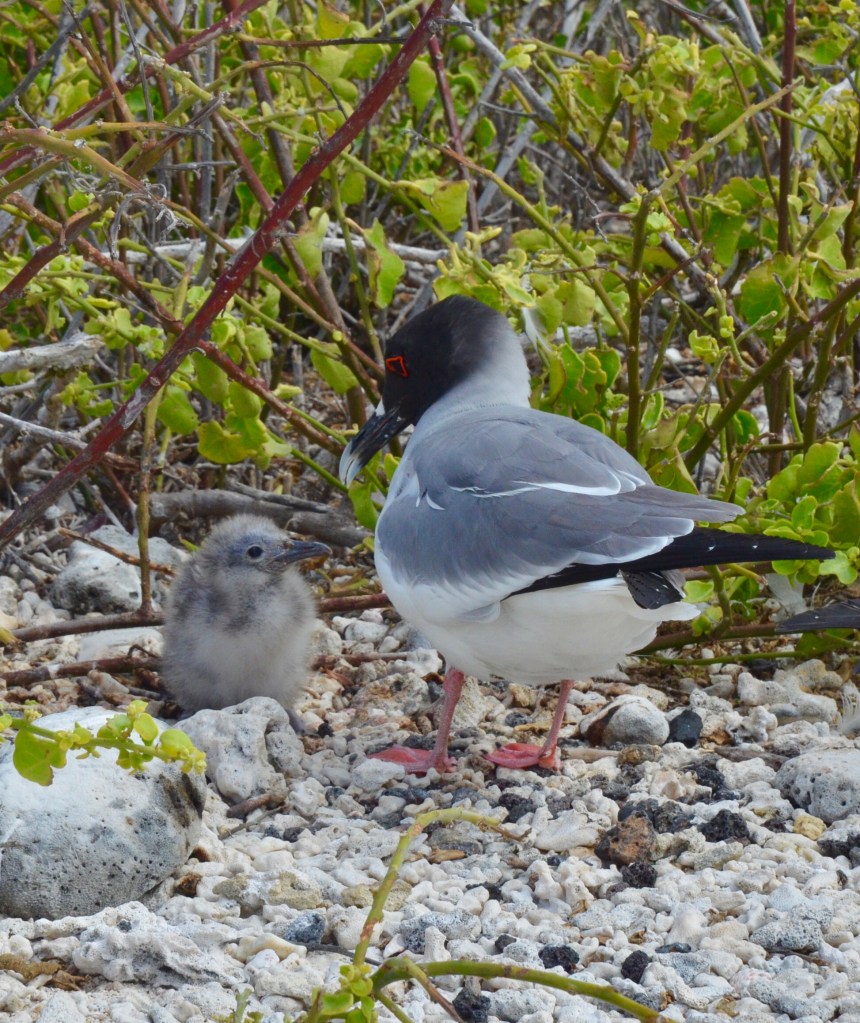
Swallow-tail chick.
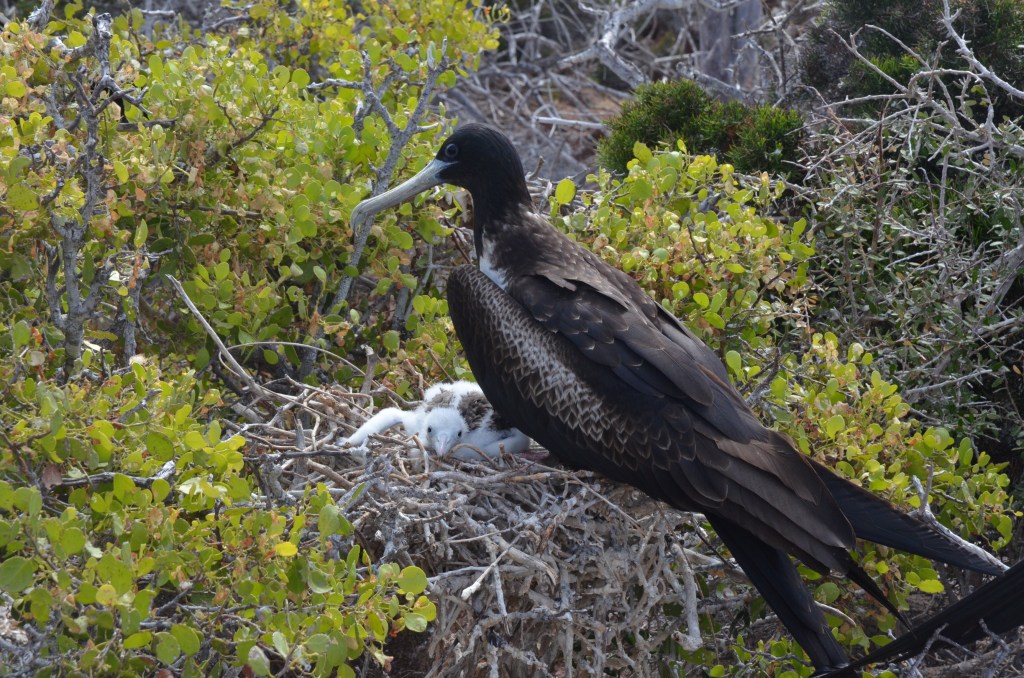
Frigate bird chick in a nest.
A red-footed boobie.
After the morning nature walk we participated in the mid morning snorkel, our third of the trip. For today’s snorkel we were on the western edge of the caldera, more open to the sea. This area is known for hammerhead sharks, and the guides gave us an 80% chance of seeing them. I really wasn’t thrilled about that but everyone else was. And sure enough, we saw quite a few hammerhead sharks, including a few large ones. At this point, a bit late actually, I asked Lennie about the dangers. He assured me, as the sharks cruised about twenty feet below us and I’m trying to talk between the swells, that there has never been a hammerhead shark attack on humans in the Galápagos. We survived the snorkeling expedition and returned to the boat for lunch.
After lunch and a rest, we again took the pangas to the island, but this time to the eastern side of the caldera. We climbed Prince Phillip’s Steps to the plateau about 80 feet above the waters surface.
On the plateau is another bird nursery. We passed many boobie nests with chicks as young as hatched that day to fledglings.
The trail through the “Palo Santo Forest”
The plateau on Genovesa.
Short-eared owl.
The goal on our walk this evening was to spot a short-eared owl. We had binoculars and scanned the lava field during our walk. We saw one from a distance. As the sun sank in the west and we made our way back along the trail we nearly stepped on an owl. It was the sighting of the day and we all got a good picture.
Descending the Prince Phillip Steps
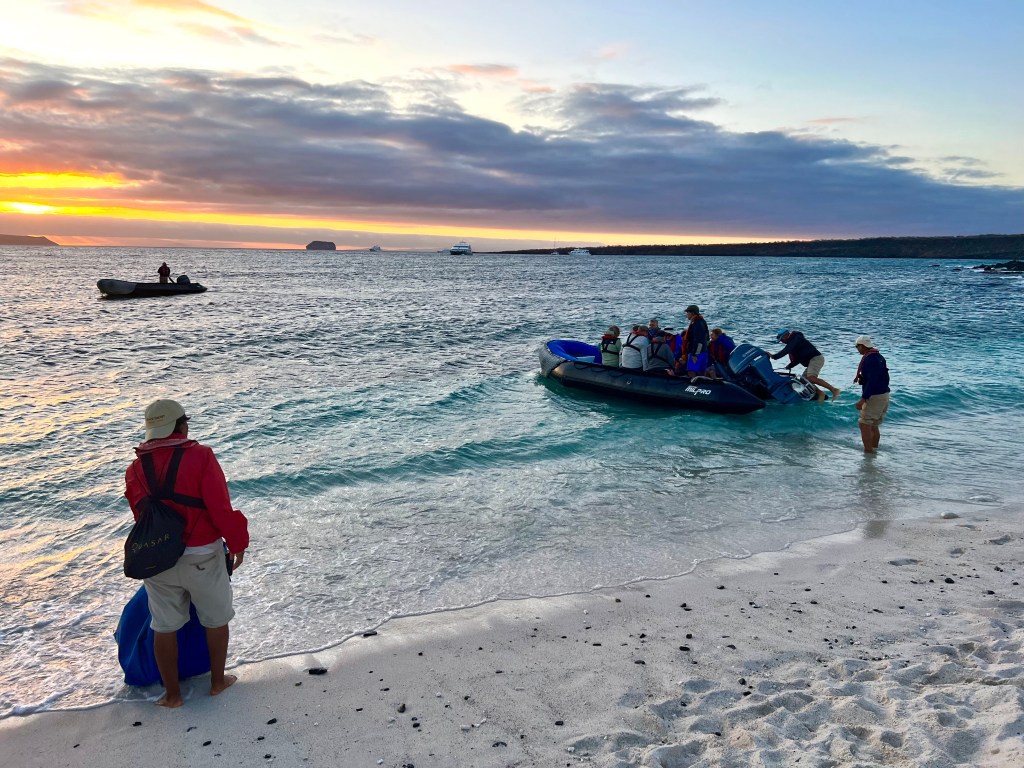
The panga ride back to the Evolution after sunset.
600 miles west of mainland Ecuador, The Galápagos Islands are home to many species of wildlife that never learned to fear humans.
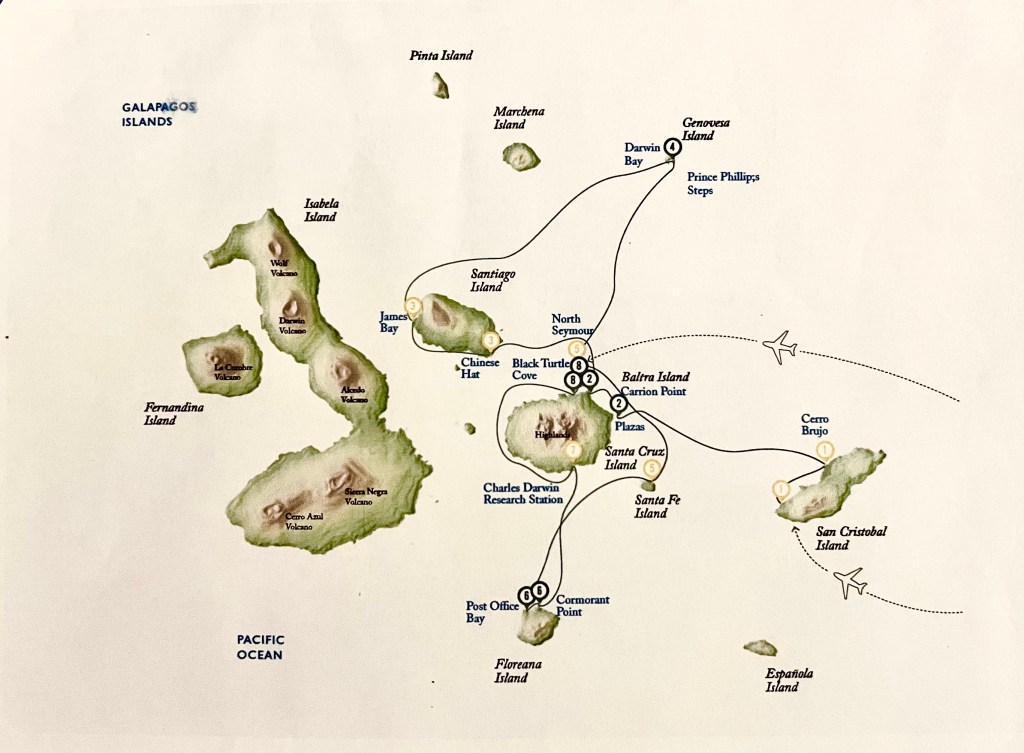
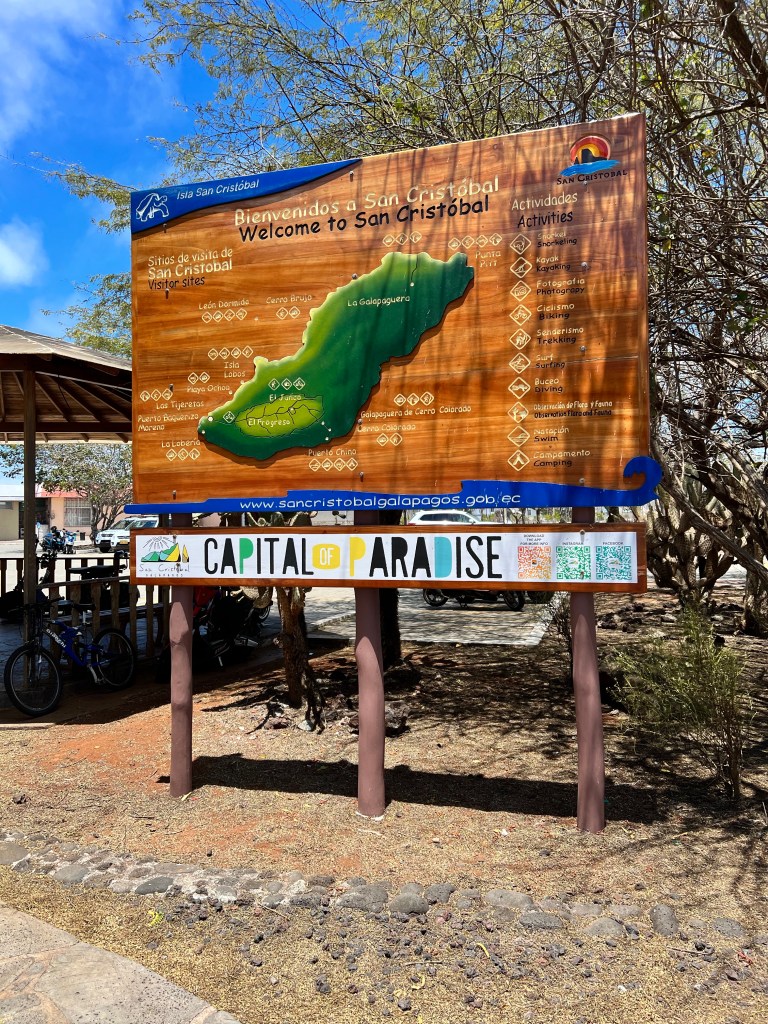
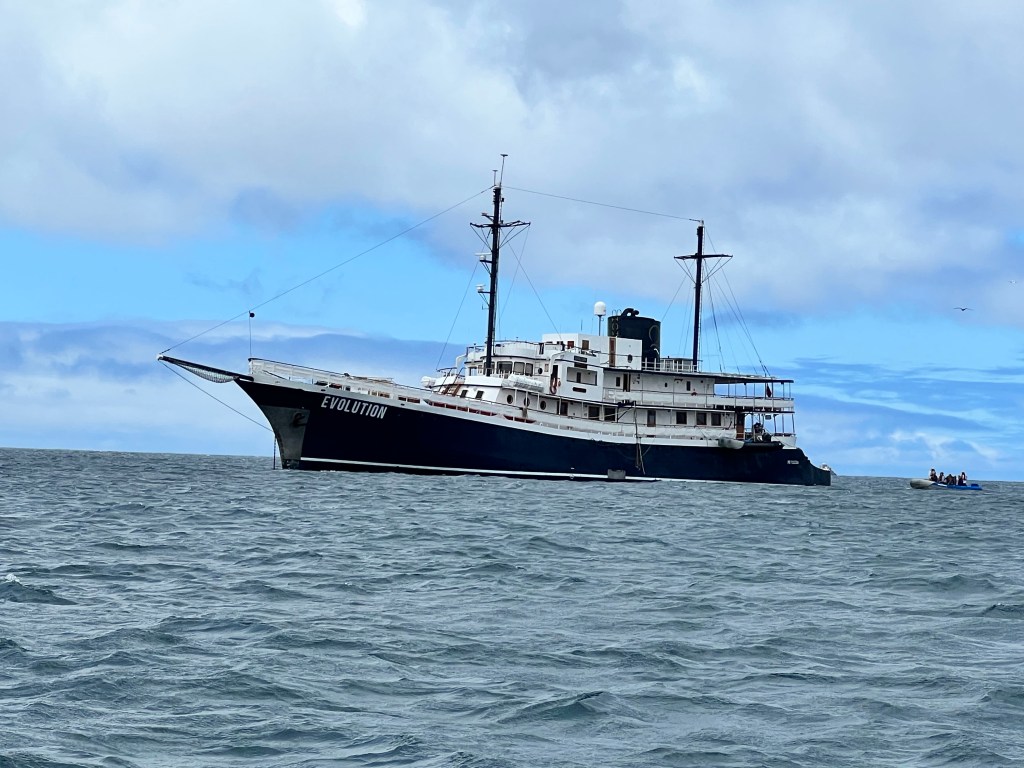
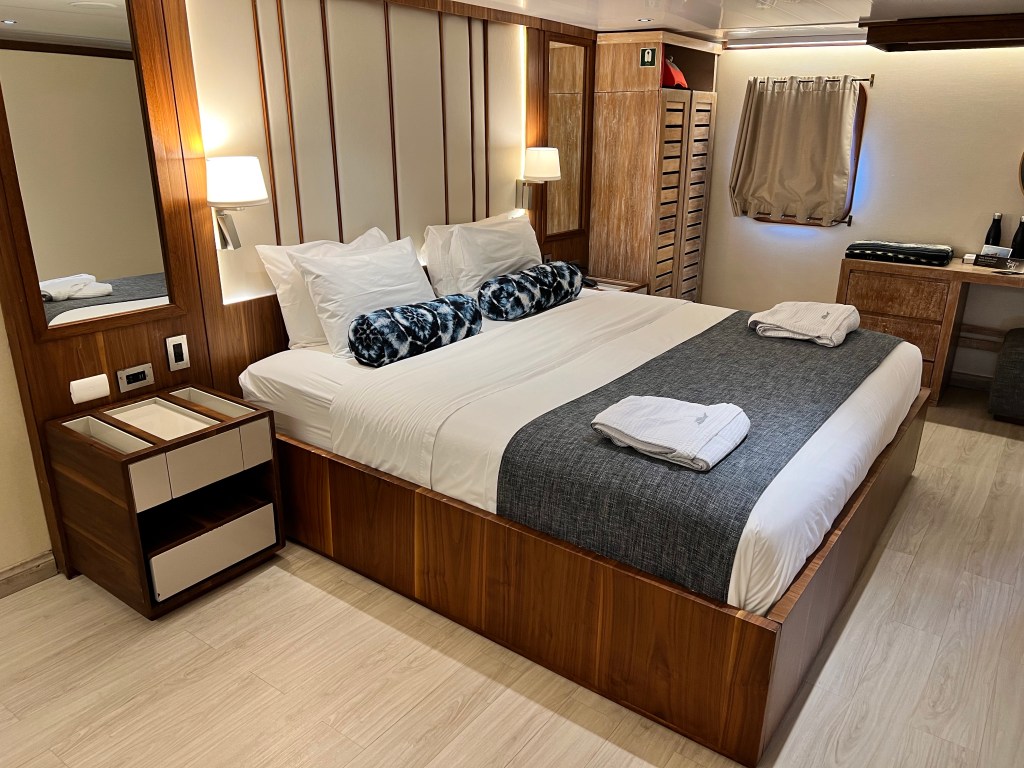
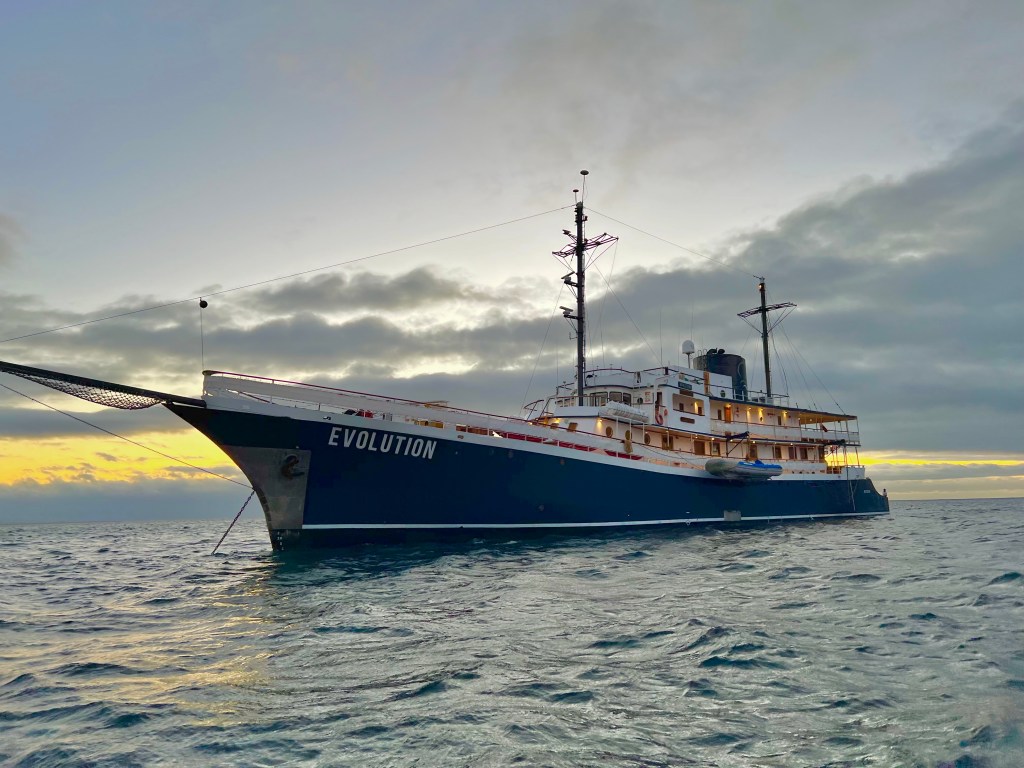
We landed on San Cristobal Island and were met by the crew of the M/V Evolution, operated by Quasar. We have a Saturday to Saturday cruise. Onboard we met more crew members, learned the rules of the Galápagos National Park, participated in a safety drill, found our cabin, and had lunch.
M/V Evolution
Our first cruise was to Cerro Brujo Beach on the island of San Cristóbal. After anchoring, we loaded into the pangas and headed towards the beach. The Evolution has accommodations for 32 guests, but this week they are hosting only 17. Two pangas can handle all guests. We have been divided into two groups; albatross and boobies. We are in the albatross group.
Our first nature walk in The Galápagos was not disappointing. We saw sea lions, blue footed boobies, marine iguanas, sea turtles, and many other bird species. We stayed on the beach to nearly sunset, then climbed back in the pangas for the short ride back to the Evolution.
Blue-footed boobie.
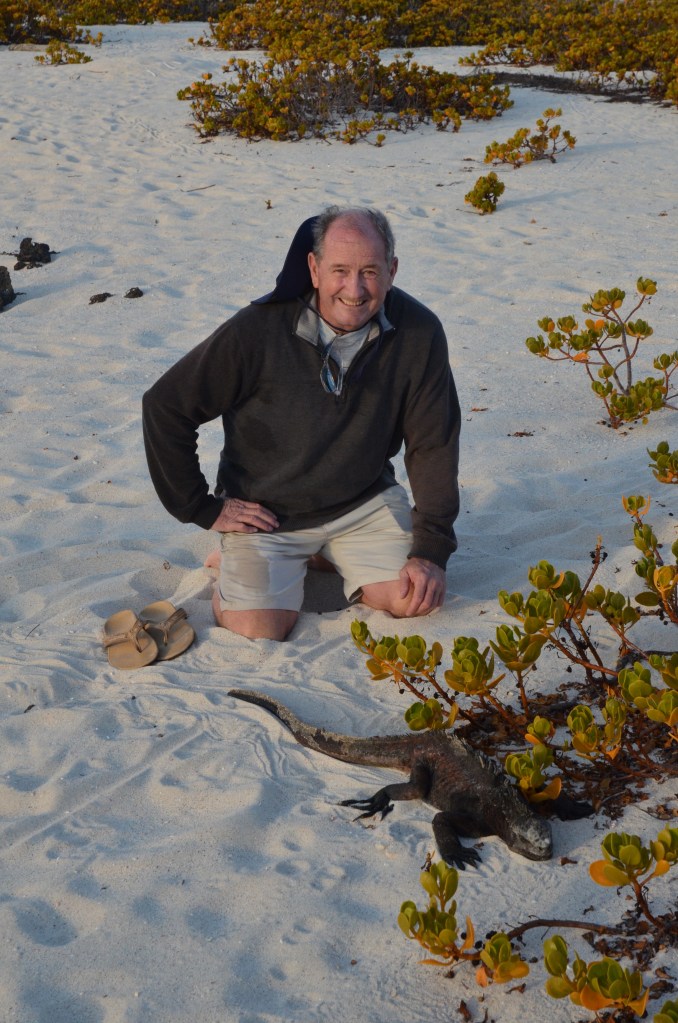
Tucker with a marine iguana.
We enjoyed a dinner of amberjack and met more of our fellow guests.
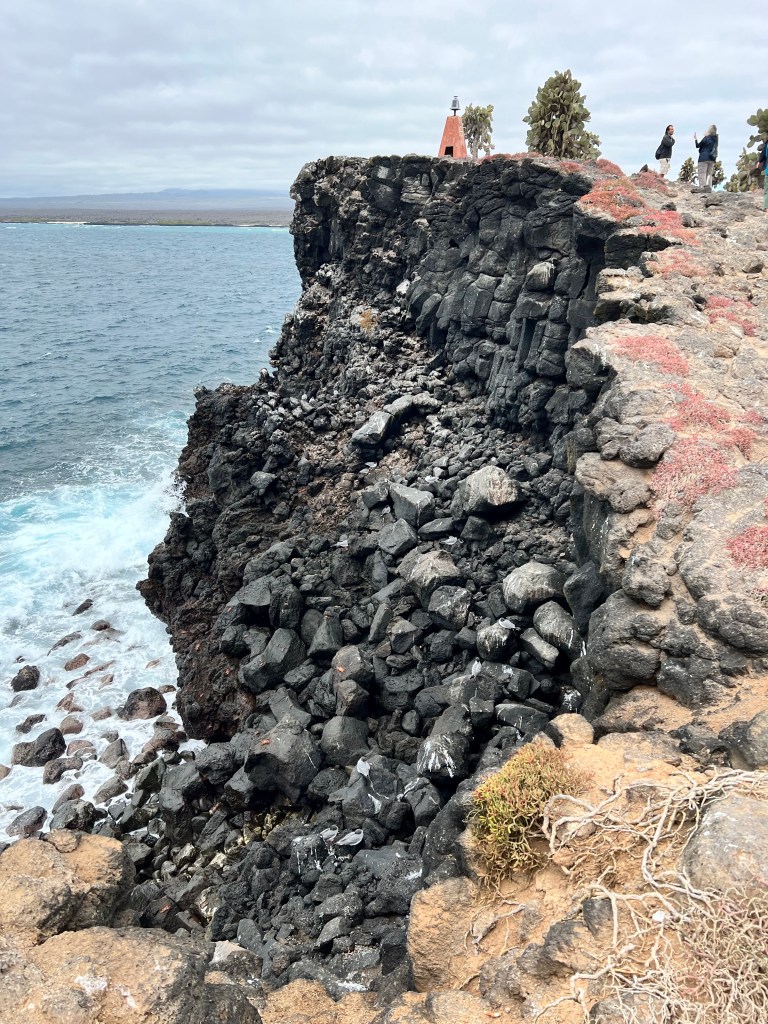
Overnight we motored from San Cristobol to South Plaza Island where we did a morning nature walk. South Plaza is a small island, 3/4 mile long, off the east coast of Santa Cruz. It was very windy, and cloudy, so at times it felt cool. The la nina is causing this year to be cooler than average.
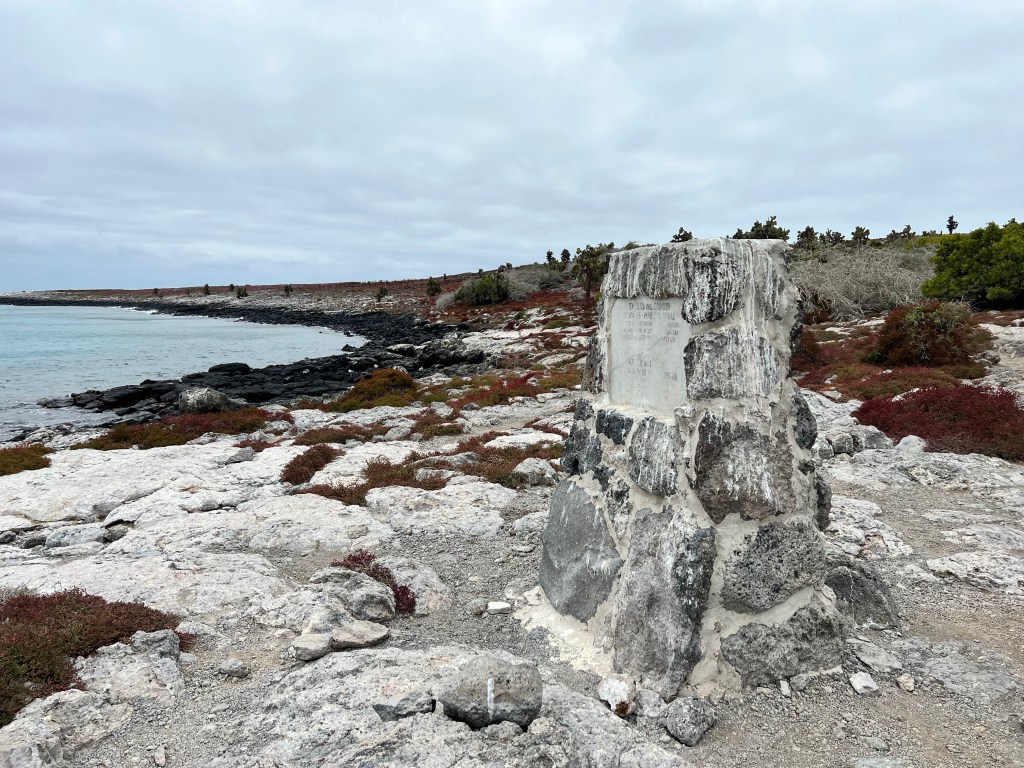
National Park Of The Galápagos marker.
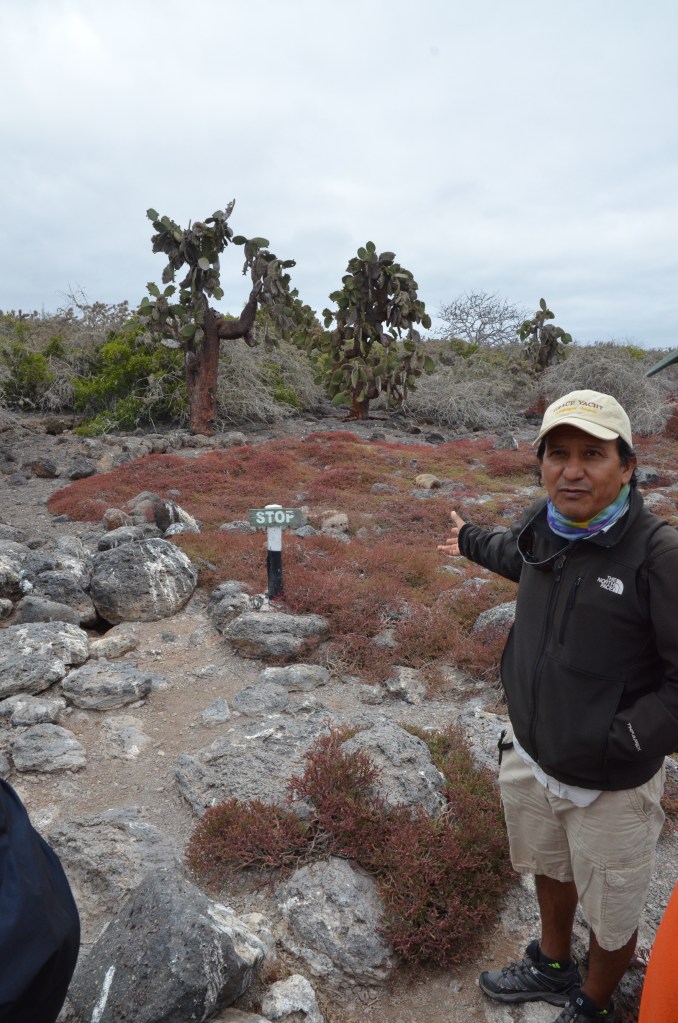
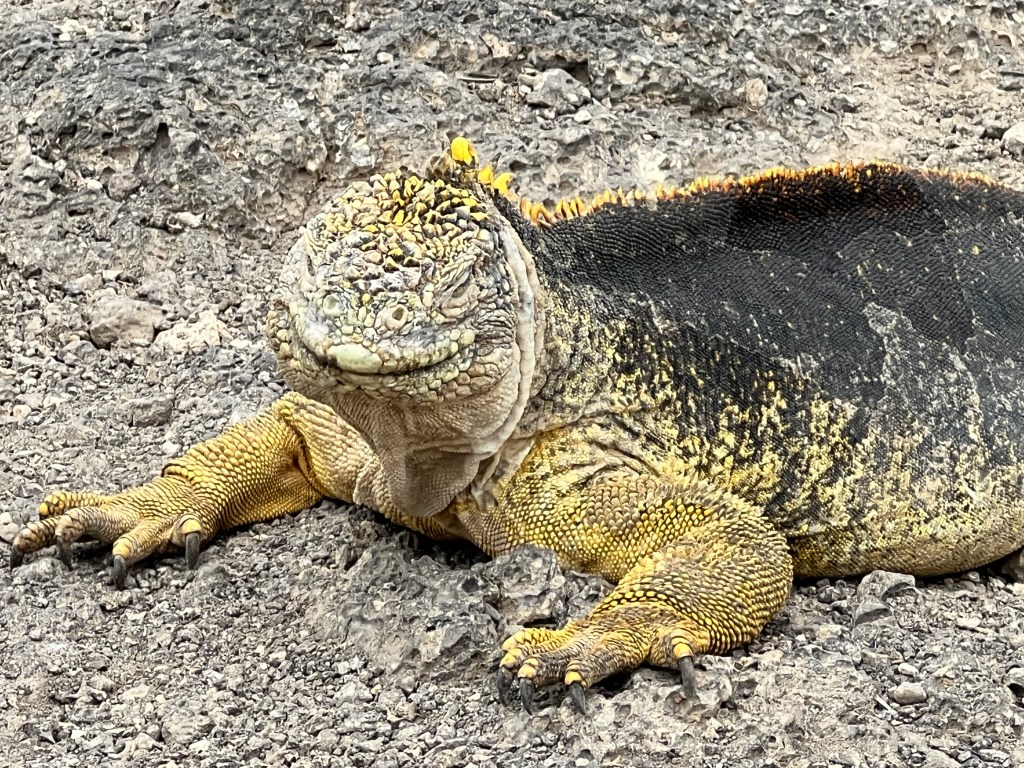
Seeing the colorful crabs, marine and land iguanas and watching very new baby sea lions nursing took our minds off the cool temps, plus I was wearing my tried and true Helly Hansen gear. The Galápagos Land Iguanas demonstrated their technique for eating prickly pear cactus fruit.
A female land iguana eats a prickly pear. She first rolled it around to remove the spines.The iguana carries off the prickly pear.Prickly pear cactus.
Juvenile swallow-tail gull.
Galápagos carpet weed.Land iguana on the trail.Land iguana in his mating colors.
Swallow-tail gull.
The nature walk got us warmed up, just in time to take our first plunge into the 68 F water, our next activity. There is an opportunity to snorkel every day and we plan to do just that. Today we snorkeled at Punta Carrion.
We brought our own wetsuits, but the Evolution also carries enough for everyone. This was my first experience at snorkeling with a wetsuit, having only snorkeled in warm tropical waters before. I was a bit apprehensive, but it went well. A shout out to my neighbor Janet who gave me her wetsuit, mask and snorkel. They were perfect, and I wasn’t cold at all. Our first day of snorkeling ended in a shallow sandy area where over a dozen white-tip reef sharks were loitering. It was great.
After lunch we motored to Santa Cruz Island for another beach walk on Mosquera Island Beach.
Sally light foot crab
Here we saw quite a few baby sea lions and dozens of Sally light foot crabs. Once again we stayed on the beach until almost sunset, then boarded our panga and returned to the Evolution.































































































 A Traveler's Photo Journal