Stanley’s Camp

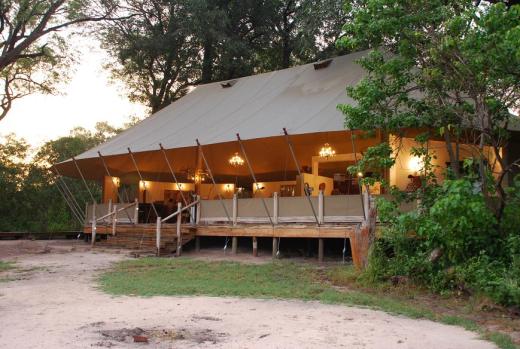
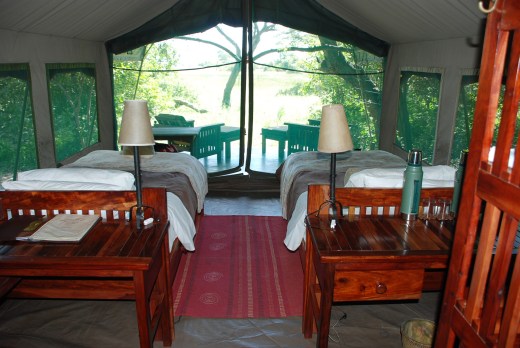
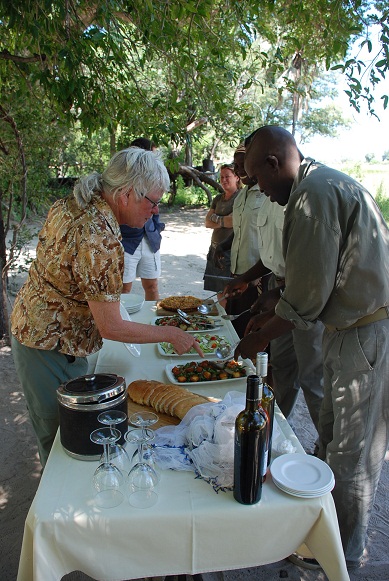
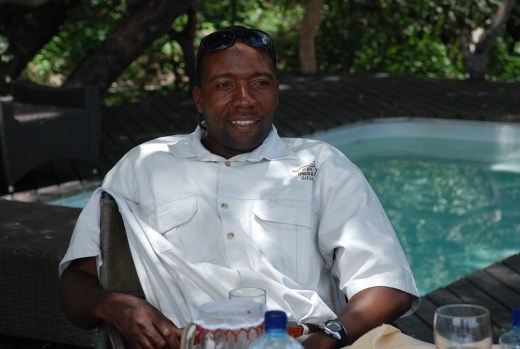
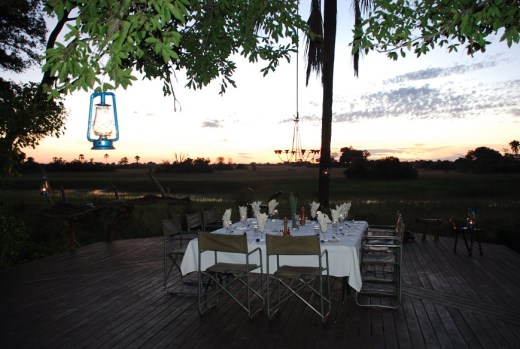
From the Chobe National Park and Sevute Under Canvas, I flew Safari Air to Stanley’s Camp, a permanent camp just outside of the Moremi Game Reserve in the Okavango Delta.  Stanley’s Camp is run by Sanctuary Retreats, and is a beautiful camp.  The tents have canvas sides, but the floors are hard wood and the bathrooms have running water.  The food here, created by Harry, the chef and camp manager, was very good.

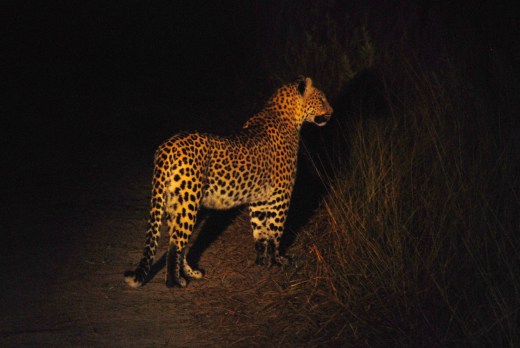
Because Stanley’s Camp is in a private concession, night game drives are allowed.  I arrived in the afternoon and got a night drive the first evening.  We drove out of camp at around 5 pm, slowly making our way through the bush.  Just before sunset we stopped, Sundowners were served, of course, and then we drove back to camp in the dark.   We had a lucky night, and saw some elusive carnivores; an African Wild Cat, a Genet (Viverridae family), and a Leopard.  It had rained in the evening and the trees and bushes were dripping.  We came upon the leopard in our headlights as it walked along the dirt road we were driving, trying to stay dry.  We stopped the vehicle as the leopard went into the bushes.  It passed us, and then popped back out onto the track, headed in the direction we had just left.  We used the spotlight to watch it as it walked away.  Cats, hyenas and predators are OK to spotlight.  Elephants, giraffe, zebra, impala and other prey are not, and we did not use the spotlight to see them.  The technique is to quickly scan the sides of the road with the light, looking for the reflection of eyes.   The color of the eyes will tell you what you have found.

Genets are nocturnal and very difficult to find.  On my night drives, I was lucky and had genet sightings three times.  They are smaller than I had realized, but with a long striped tail, and move very quickly.  We watched one in our spotlight as it hunted.

I chose Stanley’s Camp because of its association with the Living With Elephants Foundation (livingwithelephants.org).

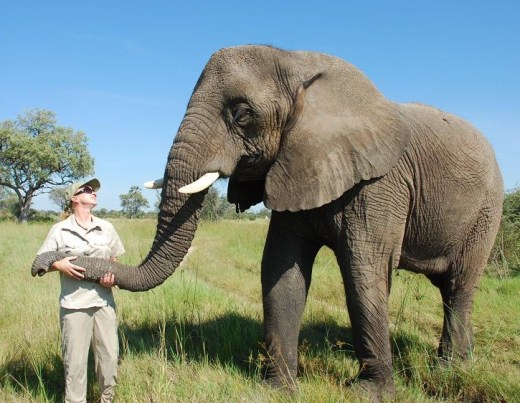
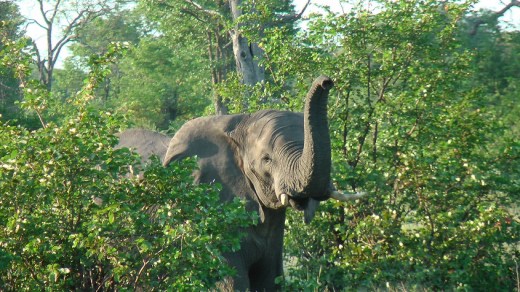
Living With Elephants is run by Doug and Sandi Groves, and supports their three rescued elephants, Jabu, Thembi and Morula.  Guests can join the elephants on their daily walk, and become personally acquainted with them.  Living With Elephants is involved with research and educational projects, and each year offers the residents of neighboring villages the opportunity to touch, feel and walk with Jabu, Thembi and Morula.  The Foundation has set up an explorative research project to understand more clearly how increasing human pressures alter elephant activity and vice versa.  The findings from the research have been passed on to Botswana’s Department of Wildlife and National Parks, to use towards developing effective mitigation strategies in dealing with negative encounters between elephants and humans.  I spent three hours with the elephants and their handlers and very much enjoyed the time.

Jabu and me.

Morula and me.

I had both day and night game drives at Stanley’s Camp.  The driving in this part of the Okavango is slow going, on bumpy dirt roads and some of it in areas of high water.  Here are photos from those drives.

A road in the Okavango Delta.

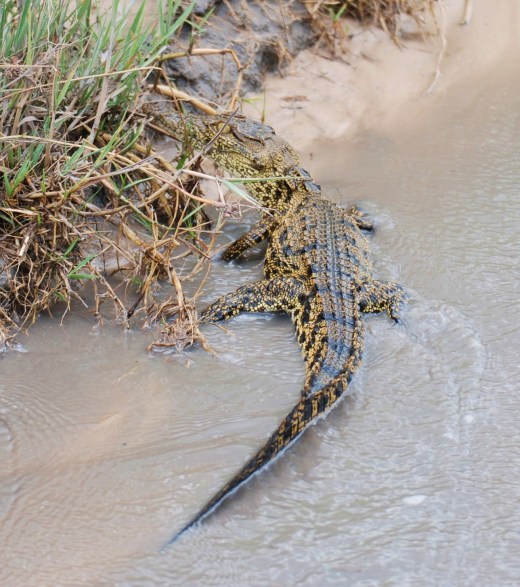
Baby crocodile.

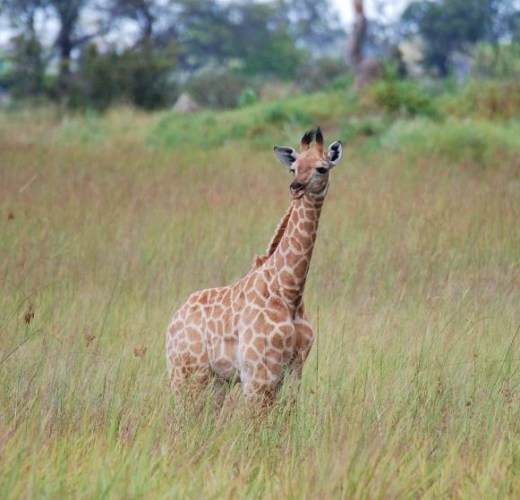
A family of giraffes. My guides estimated the baby to be about one week old.

Morning light.

A Steenbok.

Zebra.

Botswana's version of AAA.

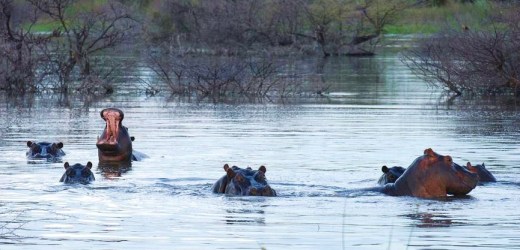
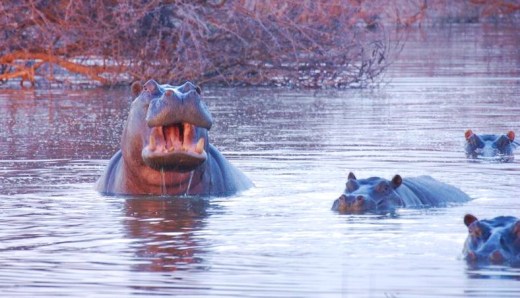
On my last evening game drive, I requested we drive out to the hippo pond, a drive time of about 1:30 to 1:45.  I had my Amarula sundowner out at the hippo pond and watched as the hippos became more active as the sun went down.

An angry hippo.


After the sunset, we headed back to camp in the dark.  At one point, my guides shut off the engine of the jeep and we listened, rewarded with hearing two lions roaring.  The two brothers lived in the area and were out and about after dark.  We found this one as we drove slowly back to camp in the dark, struggling to find the dirt track.

The lion we caught at night.

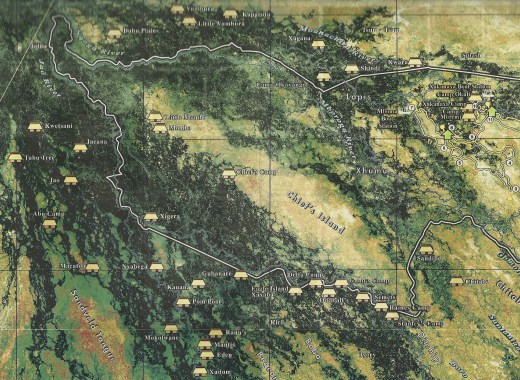
Map of the Moremi Game Reserve. The white line is the boundary of the reserve. Stanley's Camp, in the lower right hand corner, is just outside the reserve boundary. Macatoo Camp sits next to the sandveld Tongue, an area that does not flood. Chief's Island is in the middle of the reserve.

Posted in Botswana | Leave a comment

Sevute Under Canvas

After leaving the Macatoo camp I spent three days and nights in a mobile tent camp in the Chobe National Park.  All transfers between camps in the delta are done by small aircraft.  In a jeep, 5 km can take you an hour to drive.  The flight from Macatoo was on Safari Air, and we made several stops along the way to drop off and pick up other passengers at various camps. 
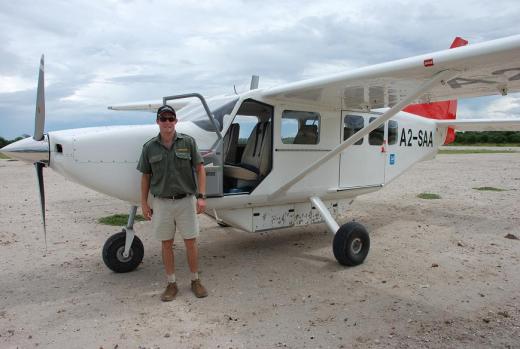
Scott of Safari Air.
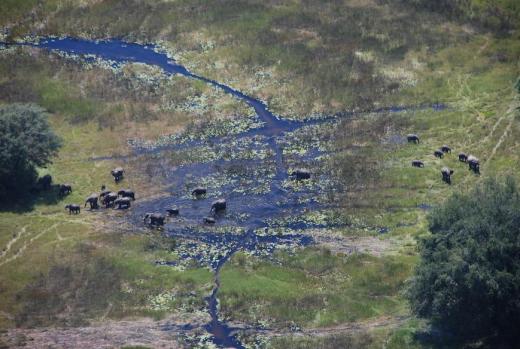
Elephants from the air.

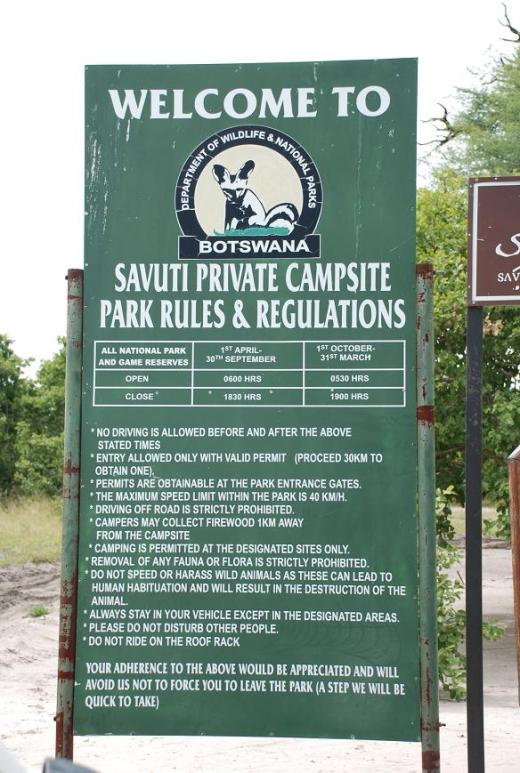
Sevute is within the Chobe National Park, and therefore visitors must abide by the park rules.  Night driving is prohibited (you must be back in camp by 7 pm), and you must stay on the tracks at all time.  March is the off-season, and I found out why.  The grass was tall and the trees were green with leaves, so the game was hard to spot.  I also discovered that the game doesn’t like the tall grass because they can’t see the predators, and with little game around, the predators are also scarce.  
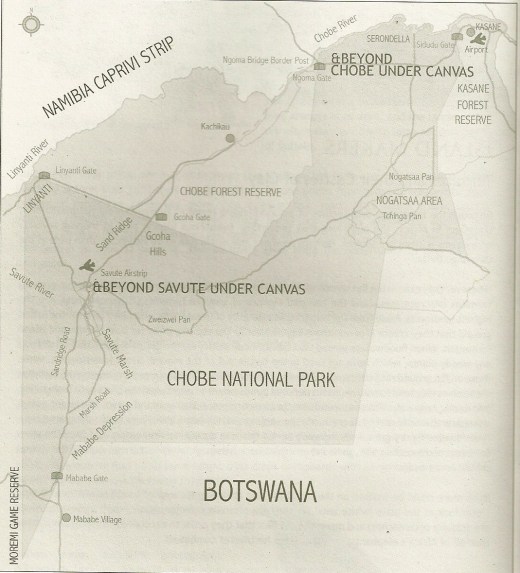
The Chobe National Park in northern Botswana. Savute is a famous battleground for lion and spotted hyena, captured in the National Geographic documentary film "Eternal Enemies."

The camp is moved every 3 or 4 days.  The tents are large, with comfortable beds, and 30 litre bucket showers.  The cooks, Ishmael and BK, did a wonderful job of creating tasty meals from a mobile tent kitchen, and all the guys working in the camp were wonderful.  They worked very hard, doing whatever needed to be done to make the stay a pleasant one.
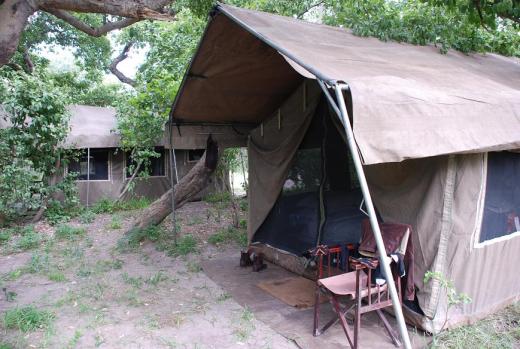
Sevute tent


Bucket shower.
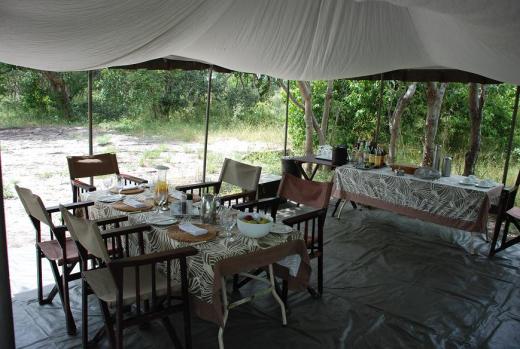
Sevute Under Canvas dining tent

The morning game drives started at 6:30 after a 5:30 wakeup and 6 am breakfast.  We saw mostly impala, some zebra, giraffe, and many, many birds.  I started to list the birds we saw and filled three pages.
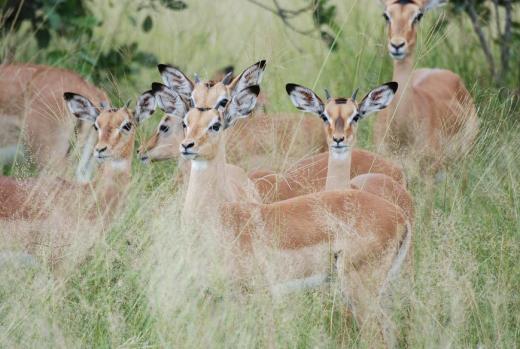
Impala.

Zebra.
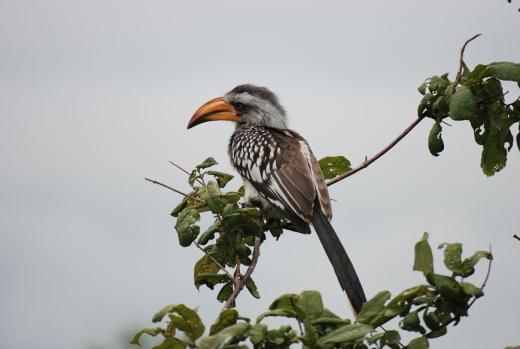
Southern Yellow-billed Hornbill

I arrived on a saturday, along with a few other guests.  On sunday, I was the only guest, so I was able to tailor my game drives as I liked.  At my request, we toured two other permanent lodges in the area in the early afternoon, Orient Express Sevute Elephant Camp, and the Desert and Delta Chobe Game Lodge.  Both were very nice lodges in good locations with elephants visiting the water holes daily. 
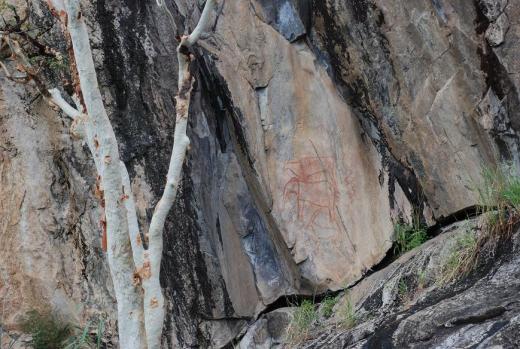
San rock paintings.
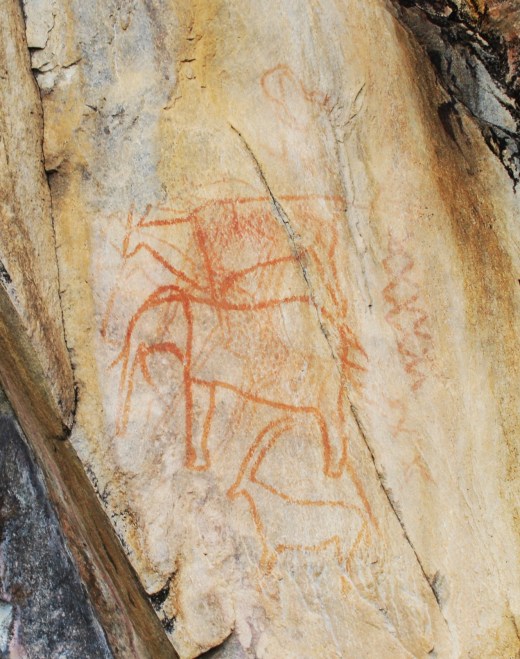
San rock paintings. The exact age of the paintings is unknown, but may be as much as 20,000 years old.

In the evening we went back out for our game drive, stopping to climb the rocks to see the San rock paintings and finished with sundowners.  (Tsodilo Hills, in northwest Botswana and west of Chobe National Park, is a Unesco World Heritage Site with over 4500 San rock paintings.)  Sundowners are an evening drive tradition.  I tried Amarula for the first time, which became my nightly sundowner preference.  Amarula is a cream liqueur made from the fruit of the African Marula tree (locally called the elephant tree.)  It is made in South Africa. 
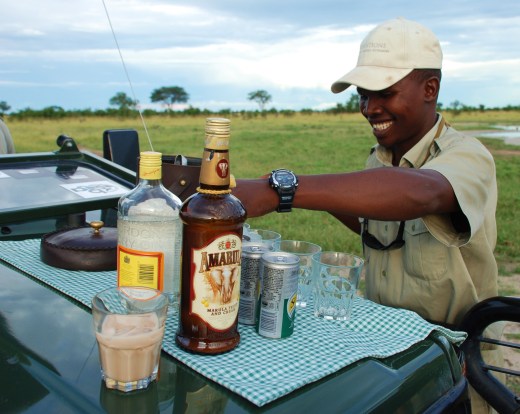
Pat, my guide, serving up my nightly sundowner of Amarula.
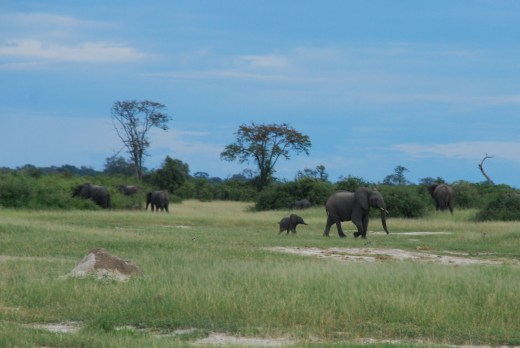
Breeding herd of elephants with quite a few babies.
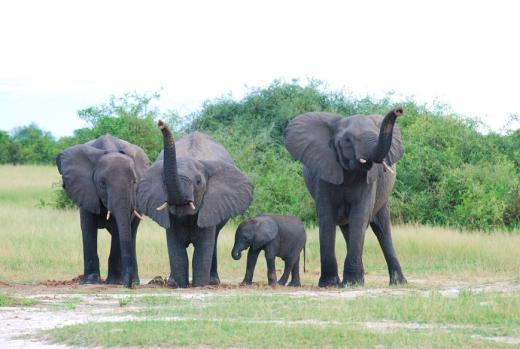
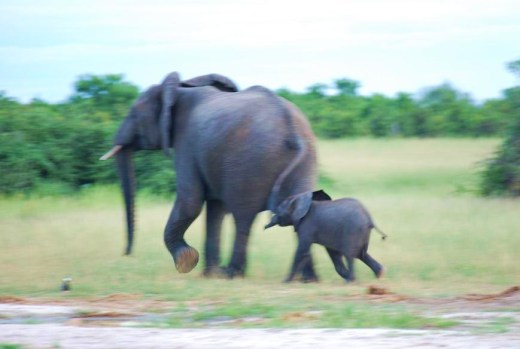
Baby elephant running to keep up with mama.
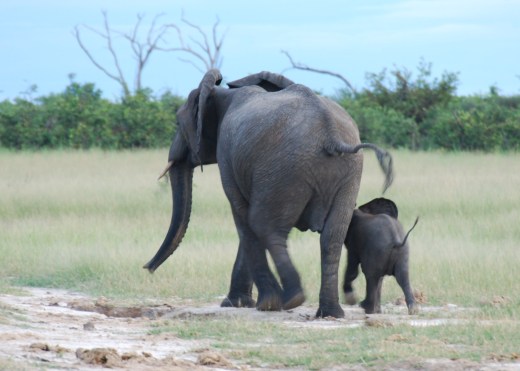
Sunday night our sundowner was held in the presence of a breeding herd of elephants.  It is fun to watch little elephants and their families.  My guides estimated this little elephant to be about 6 months old, and was still learning how to control his trunk.
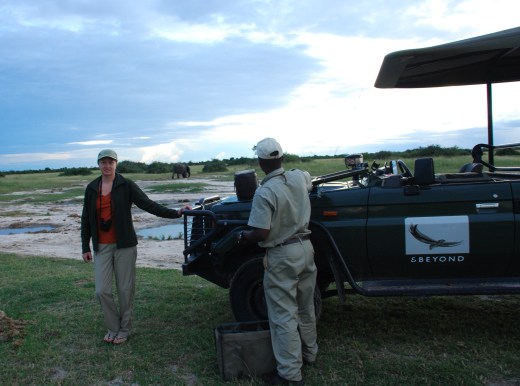
Sundowners with elephants.

Monday morning I was once again the only guest, so I requested we skip breakfast in camp and instead pack a picnic and have breakfast out on our drive.  We had seen mostly impalas and a large kudu when we got a radio call from the guide on the Orient Express vehicle.  
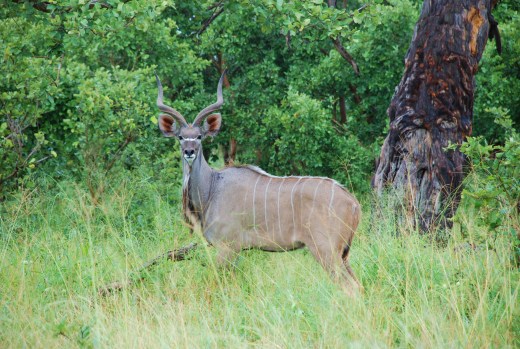
Kudu buck.

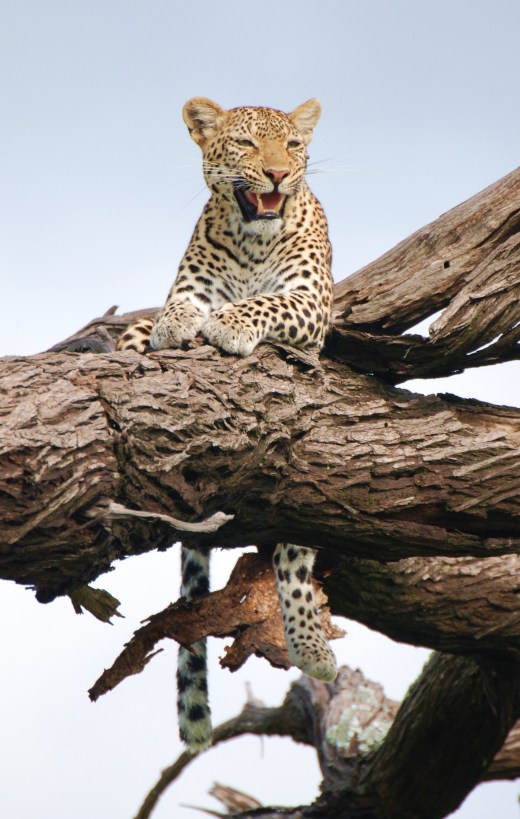
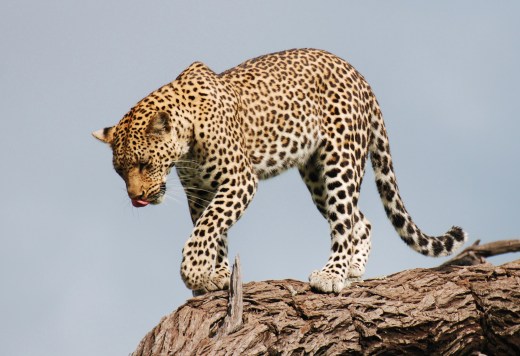
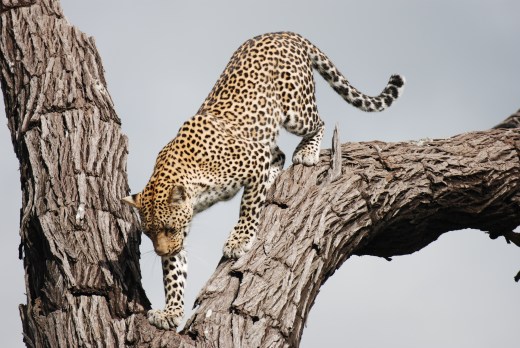
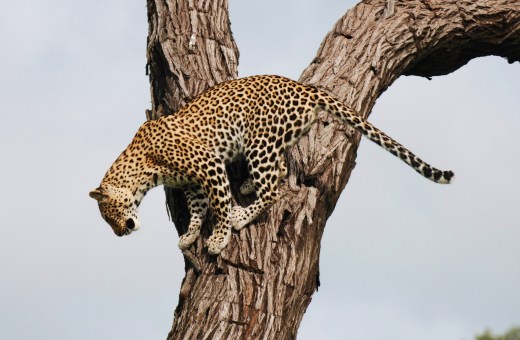
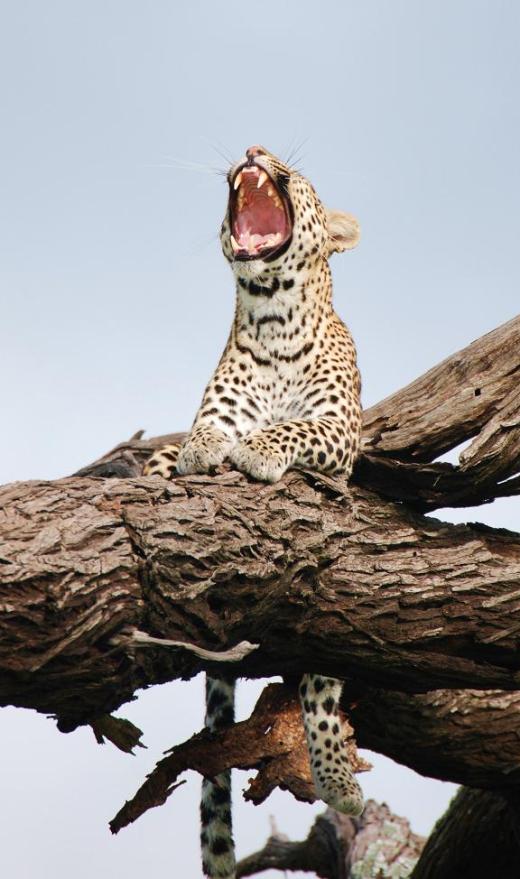
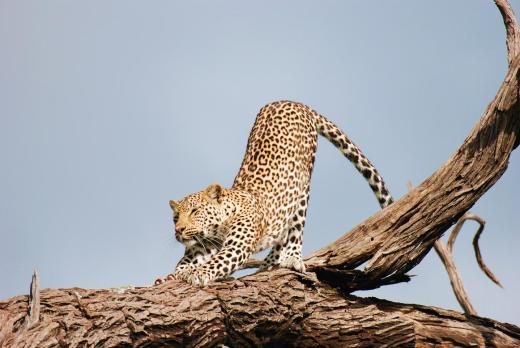
He had spotted a leopard in a tree, and was giving my guide Pat the location.  It is common for guides from all of the lodges to share sighting information.  We hustled over to the sight, near Leopard Rock as it turns out, about a 30 minute drive on the bumpy dirt roads.  The other vehicle had left, but the leopard was still there.  The leopard in the tree was the mother of a cub born last year and about 8 months old.  She was watching her cub practice stalking in the tall grass.  She was quite relaxed, but when an impala settled down and her cub was sneaking through the grass, she sat up and paid close attention.  The cub did not catch the impala, but I think he was just getting some practice in.  I could have sworn she was posing for me as she shifted positions and yawned and stretched.  A super model indeed.  We watched the two for about 45 minutes, until mama leopard called to her cub, climbed down from the tree and settled into the long grass, a cooler option once the temperatures started to rise.
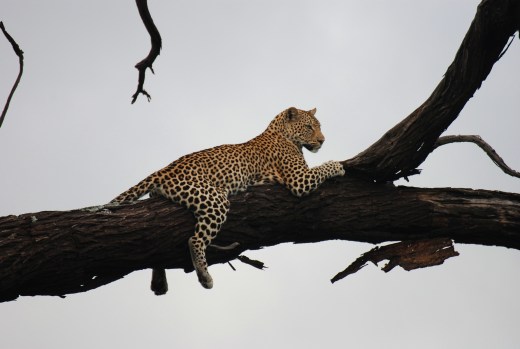
Mother leopard in the tree Monday morning, March 7th, watching her cub in the grass.
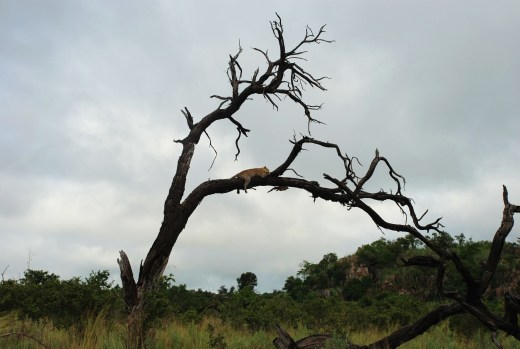
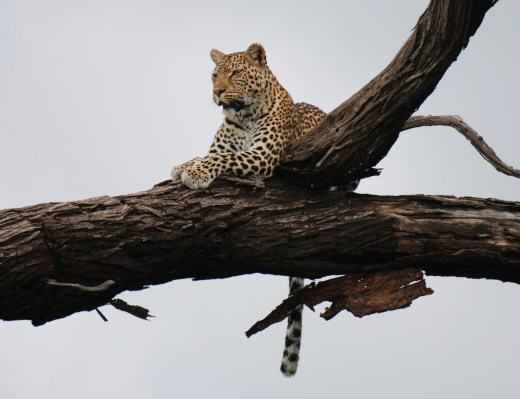
In this photo she is calling her cub.
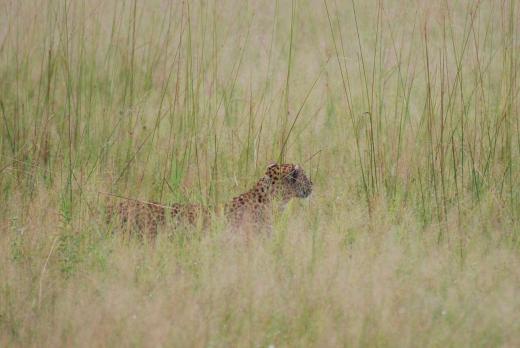
Leopard cub in the grass stalking an impala.
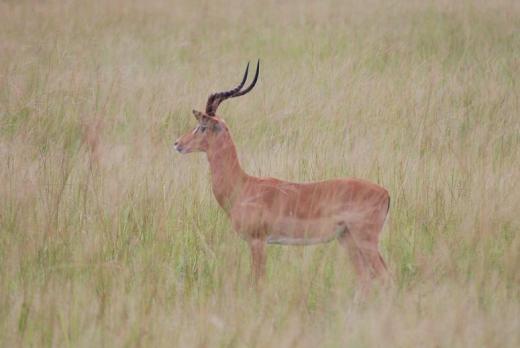
The impala being stalked. It saw the leopard cub and ran.
After the incredible leopard sighting, we drove a short distance away and had our breakfast outside on the hood of the Toyota.  Most of the game vehicles were Toyota Land Cruisers.
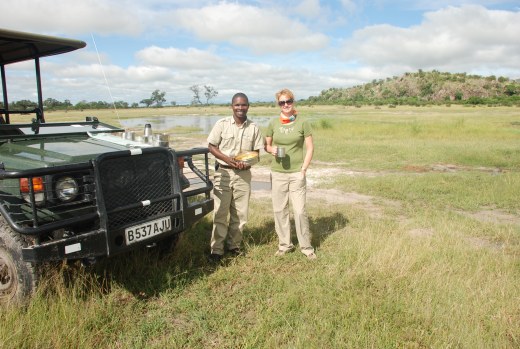
Breakfast on the game drive. Leopard Rock is in the background.

After breakfast we continued our drive.  We saw a group of Ground Hornbills and watched them fly from the tree to the ground.  Eddie, guide in training, told me of a Bantu belief involving the Ground Hornbill.  If a man was irresponsible and did not care for his family, the heart of a Ground Hornbill would be mixed with other ingredients and fed to the man.  The man would then become responsible and caring towards his family, as the Ground Hornbill is.  Not so good for the Ground Hornbill.
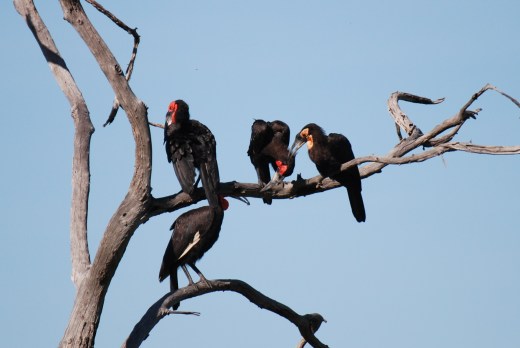
Four Ground Hornbills in a tree.
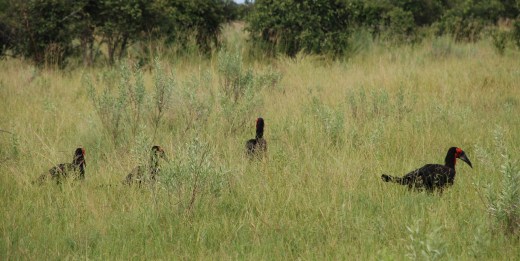
Monday evening I was joined on the game drive by two more guests.  We crossed the Savute Marsh, saw a rainbow, watched fabulous cloud formations, saw many more birds and enjoyed sundowners by Leopard Rock.  The Lilac Breasted Roller, of which we saw hundreds, is Botswana’s national bird.  It is most colorful in flight.
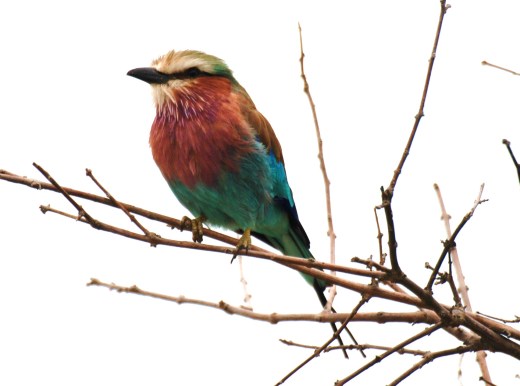
Lilacbreasted Roller, Botswana's national bird.
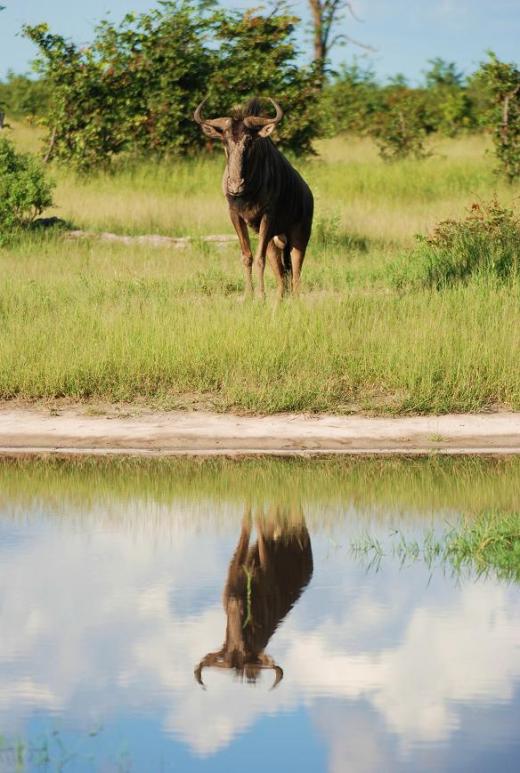
A wildebeest posing. Everyone was posing for me that monday.
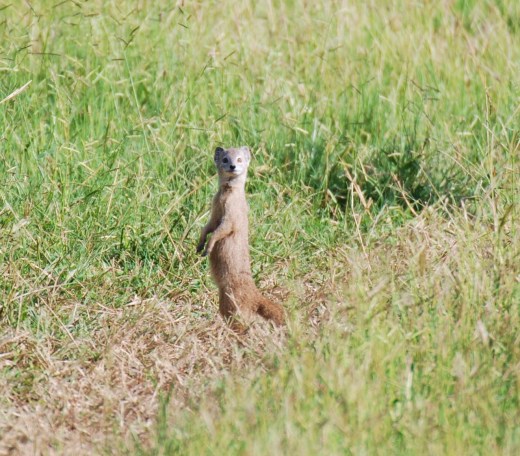
A yellow mongoose. We saw a business of mongooses all running together. It was quite a sight.
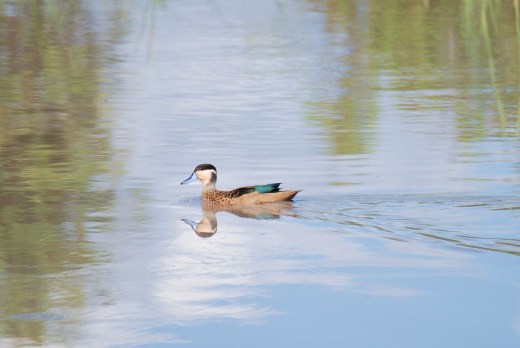
Hottentot Teal
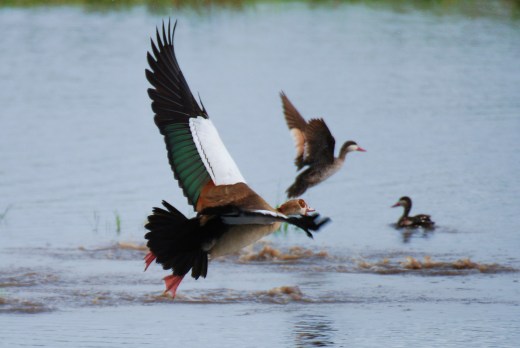
 

Egyptian goose.
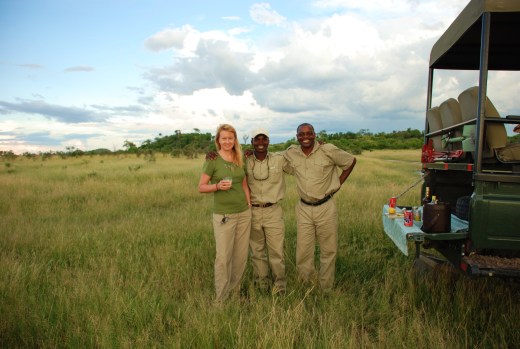
Sundowners Monday night with Pat and Eddie.

At 7 pm when we returned from the evening game drives, the bucket showers would be filled with hot water.  The water smelled slightly of campfire smoke, but was welcome.  It is possible to shower in 30 litres and it got so that I didn’t even use all the water.  7:30 to 8 pm was spent at the “bush tv” as the camp workers called the fire.  The pre-dinner gathering around the campfire is another tradition at all of the camps I have visited.
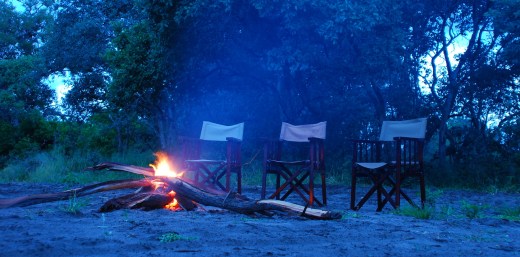
Bush tv

 Tuesday morning was my last game drive in Chobe.  I was hoping to see Wild Dogs, as they had been spotted near our camp, but they are elusive and did not show that morning.   We did see vervet monkeys, impalas and giraffes, and I got a lesson in the names of groupings of animals.  Here is part of what I learned;  a journey/tower of giraffes, a business of mongoose (mongooses?), a herd/parade of elephants, a dazzle of zebras, a shrewdness of monkeys, an obstinacy of buffalos, a pride of lions, a crash of rhinos, a raft/pod of hippos,  a leap of leopards, a coalition of cheetahs, a skulk of jackals, a pack of wild dogs, a dray of squirrels, and a parliament of owls.  At 11:30 we were back out at the dirt airstrip for another Safari Air transfer to the next camp.  On takeoff, I quickly snapped this photo of an elephant just off to the side of the departure end of the runway.  (The camera I use is a Nikon D80.  All of the leopard and bird shots were taken with the Tamron SP70-300mm F/4-5.6 Di VC USD lens.  It was my first experience with this lens and I was very happy with it.  The other lens I traveled with was the Nikon 18-135mm).
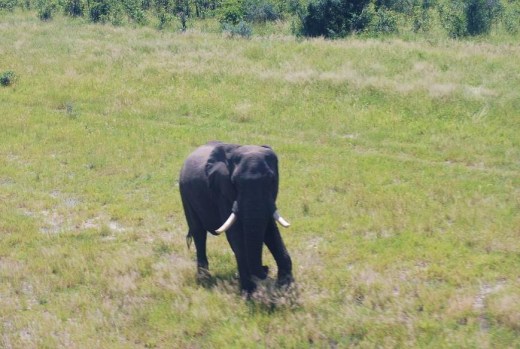
Posted in Botswana | 1 Comment

Macatoo

elephants from the air, near Macatoo

The Macatoo horseback safari camp is just outside of the Moremi Game Reserve in the Okavango Delta.  The flight from Maun (where I landed on Air Botswana coming from Johannesburg, S. Africa) to the Macatoo camp airstrip was about 35 minutes in a small single engine plane.  We were low enough to spot animals along the way.  Once on the ground, the drive to camp was another 30 minutes.

On the road to the Macatoo camp


The Macatoo camp, run by African Horseback Safaris was exactly what I had hoped it would be; pure fun, wonderful rides, and great dinners.  The tents were comfortable, each with a propane water heater and a flushing toilet, not exactly roughing it. 

Macatoo tent

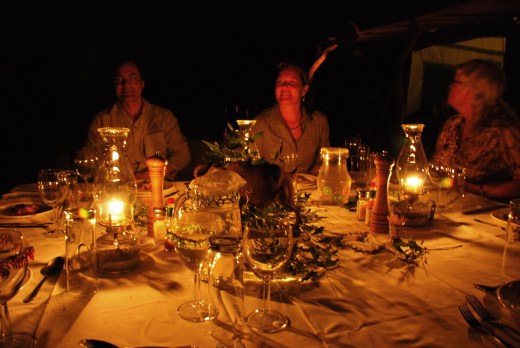
The rides were like nothing I have done before, through deep water, cantering across flood plains, and mingling with game.  There is no better way to get close to the animals than on horseback.  You can quietly observe the animals without the annoying jeep.  The rides in the morning lasted about 4 hours, then a break for lunch, then an evening ride from 5 pm to 7 pm, and dinner at 8 pm.  The dinners were parties every night, all of us gathered around a large table. 

Breakfast.

In the evenings, it was a dinner party every night.

Every ride took is in a different direction, from plains, to marshes to forests.  One day we came upon a journey (or tower) of giraffes and walked along with them.  We stopped for a break of apples under a large baobab tree.  Elephants were everywhere, and see saw them on horseback every day. 

Me on Kwai, with giraffe in the background.

Taking a break under the baobab


Macatoo will take guests out in a game viewing vehicle, and we did that to watch the lions, and on the evening of my birthday.  Because the camp is not within the game reserve, night driving is allowed.  The evening of my birthday, we drove to a tree platform for a champagne toast.  As we climbed the ladder we heard a leopard call, and it sounded very close.  I was hoping to see a leopard in the trees that evening, but instead we watched a herd of elephants emerge from the trees across the water, and followed their splashing as they crossed, passing nearly underneath us.

Game drives in the delta can be difficult, and very wet.

The tree stand.


Bongwe prepares the champagne for my birthday toast.

"Pula!"

Birthday celebration at Macatoo camp.

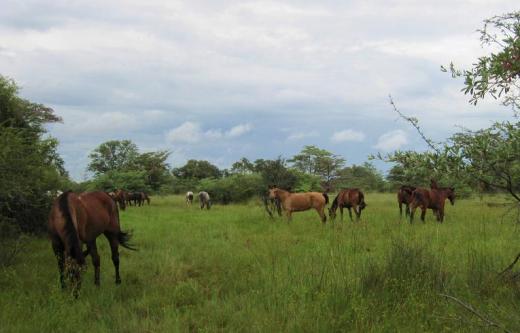
On my last day at the camp and during the morning ride, we passed the enclosure where the horses spend their days.  At night they are all in the barn, but during the day they are allowed into a pasture accompanied by armed guards.   Only once did a lion attempt to crash the horse pasture.  That last morning Bongwe showed us where an elephant had died the previous year.  Other elephants came and scattered the bones around.  The tusks are still there.

The horses out at pasture during the day.


The last morning ride.

 The website for Macatoo camp is http://www.africanhorseback.com/

Posted in Botswana | 1 Comment

Thrills, Chills, and Mortal Danger: Just Another Day on Horseback in the Okavango Delta

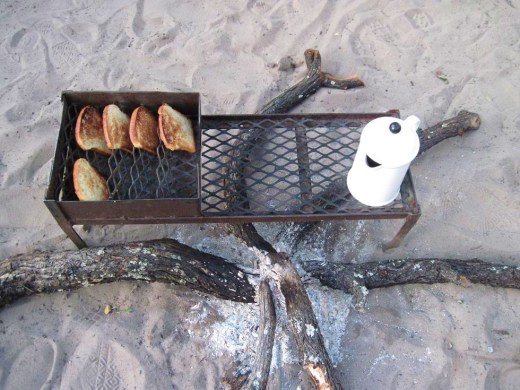
At the African Horseback Safari camp, the day begins at 6 am with coffee and biscuits in your tent. At 630 we all meet at the main camp circle for breakfast, toast and coffee warmed over the open fire. At 7 am we move to the barn and mount up for the morning ride. On today’s ride there are a total of 6 horses, four guests, Jose and Nuria (from Spain), Doug (from Canada), myself and our lead guide Bongwe and our follow up guide Bernard.

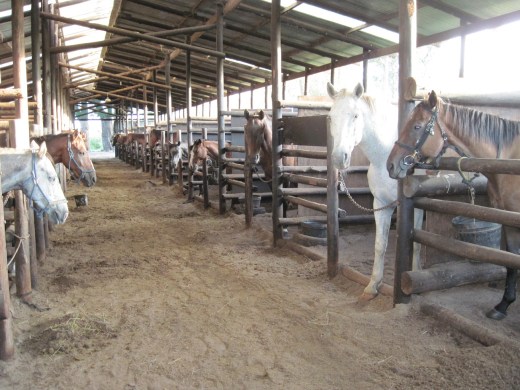
The Macatoo camp has 40 horses in their stable.

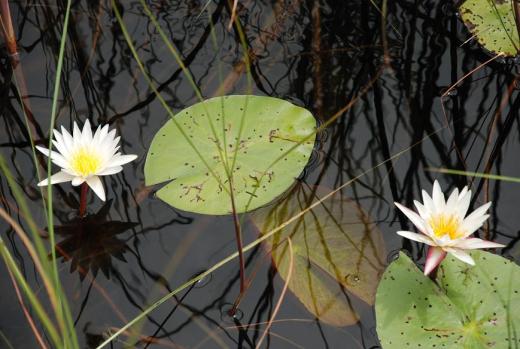
 We ride out of camp and almost immediately are wading through water chest deep on the horses, lily pads gently bobbing in our wake. The water rises and falls, sometimes dry land, sometimes wading through more lily pads.

Our first canter is over a marshy area, but not deep water. The first two hours of the ride are fairly quiet. The highlights are the canter, a leopard kill in a tree and four wildebeests. We ride past the airport, and have another canter alongside the runway. Eventually Bongwe stops and says “The rainy season starts now. Put your cameras away.” He isn’t kidding. We canter along a road that is under at least one foot of water. Lesson learned here is, don’t follow too closely. At times it feels as if a garden hose is being sprayed in my face and I can barely see. It is fun and exhilarating. The horses seem to really enjoy the run and are not anxious to stop. After our water canter we slow down to a walk and wind our way through marshy areas, past termite mounds and again to dry land. We stop for a break of apples, shared with the horses. Back on horseback and we still have not seen an abundance of game. We see Impala now and then and a Reedbuck, but not a lot. Finally our luck seems to be changing as we spot some giraffe. We follow them casually for a bit and then we open up onto a marshy plain and see some zebra. Walking a bit further, Bongwe’s horse begins to act up, unwilling to continue ahead. Then the smell hits us, the scent of something dead. Bongwe looks down and finds lion tracks and says “These are fresh.” He looks intently around. There is evidence of a kill, but nothing on the ground. He thinks it was a small meal and suggests that maybe the lions are still in the area and still hungry. Then the giraffe and zebra stand at attention, looking in the same direction. Suddenly they turn tail and run. Bongwe looks closely in the direction of where the giraffe and zebra were looking and spots the lion. We are being watched. We all see it, in full view, and very interested in the six antelope like creatures standing less than 50 meters away. Bongwe says he sees four lions, but I only see two. Bongwe very calmly and quietly starts giving us instructions, “Do not let the horses run”, he motions to his left, “keep moving and keep me between you and the lions.” As we start to move slowly in the direction Bongwe has indicated, the lion crouches and takes two steps towards us. I’ve seen enough nature programs to know we are being stalked. Within seconds, several intense emotions surge through me; elation at having seen the lions from horseback, and fear when I realize just how close we are and that we look like prey. Bongwe urges his horse forward directly towards the lion, waves his arms, and yells “Hey! Hey!” The lion hesitates. We continue our slow and controlled walk away from the lion as Bongwe and Bernard stand their ground. Bongwe carries a rifle, and has on each ride. We wonder if he would use it. The lion stays transfixed on the horses as we slowly increase the distance between us. As we make our way to safety, we turn and see the lion still very intently watching our progress. We eventually feel the distance safe enough to breathe a sigh of relief. In our minds, Bongwe is a hero. To Bongwe, it is just another day at work. He tells us if he had not advanced on the lion yelling, it would have charged. We ride back to the barn, hoping to avoid any more lions.

The lion we encountered on horseback. This photo was taken from a jeep after we had returned safely to the barn.

At lunch it is all we can talk about. Janet, one of the guests and rider Doug’s sister, had been out on a game drive that morning and had seen that pride. There were seven lions in the pride. Jose asks Bongwe “What would we have done if the lion had not stopped?” It is a very good question. Bongwe says we would have stood our ground. “If you run, you are prey.” Jose asks if he would have used the rifle and Bongwe tells us that the rifle probably would not have stopped the lion. The rifle, I think, gives a false sense of security.

Back in camp we gather in the common area before lunch.

Lunch at Macatoo.

 We have lunch and then I ask if we can drive out and see where the lions are now. A new guest, Marcello, rides with us. The lions have not moved, and we find the pride relaxing in the same shady spot. We see where we were on horseback as we sit in the jeep very near the lions. It is much closer even than it seemed earlier, definitely less than 50 meters. The afternoon rides go out at 5 pm, and last for two hours. There is no cantering on the afternoon rides, just a relaxed walk and trots. In addition to the morning riders, we also have Janet and Marcello. Off in a different direction from the morning, we are now in a more wooded area.

It is scenic and relaxing. We see impala and a Fish Eagle. Thunderheads are off in the distance, and I mention to Jose that I hear distant thunder. A short while later Bongwe gives the sign for elephant and we grow silent and stop. There is a large elephant feeding off to our right in the trees. Bongwe takes out his wind tester and puffs a bit of ash into the air. We hear trumpeting, but not in the direction of the elephant we see. We are upwind of the trumpeting, and have walked into the middle of a herd, unseen amongst the trees. We slowly retreat and look for the source of the trumpeting. It is not hard to find it; the large matriarch of the herd has spotted us and wants us to leave. Many elephants emerge from the short trees, waving their trunks as they smell us and try to identify what we are. The matriarch keeps pace with us as we back away. We continue the retreat and she advances, trumpeting and flapping her ears. Bongwe says “She is not a happy girl.” She keeps her eyes on us as we turn and backtrack out of the herd.

This elephant was "...not a happy girl."

 When safely away, I think to myself that this elephant encounter was a very good reminder that this is not a ride in the park. Even though the evening ride is the “easy and relaxed ride”, you never know what you will run into. We head back to camp and a wonderful dinner. Every day here at Macatoo is a new adventure, and every night is a dinner party.

Bongwe, our incredible guide.

The Okavango Horseback Safaris was featured in Peolwane,  The Inflight Magazine of Air Botswana in July 2010.

Posted in Botswana | 1 Comment

On the Road Again

I will be traveling again this upcoming Sunday.  A dream trip of mine is about to come about, a combination of my favorite activities;  horseback riding and African safari.  The Okavango Delta in Botswana is my travel destination.  I hope to be able to post photos from Botswana, but will probably have to do so upon my return.

African Horseback Safaris

Sunday I will be flying out on South African Airways from Washington DC to Johannesburg, South Africa, with a fuel stop in Dakar, Senegal.  I’ll be staying and riding at the Macatoo camp, http://www.africanhorseback.com/ for the first four days.   Two more camps follow, Sevute Under Canvas and Stanley’s Camp.

http://www.andbeyondafrica.com/luxury_safari/botswana/savute/and_beyond_savute

http://www.eyesonafrica.net/african-safari-botswana/stanleys-camp.htm

African Horseback Safaris

African Horseback Safaris

accommodation, africa, african, botswana, bush, bushman, camp, camping, chobe, delta, elephant, explore, falls, family, fishing, gaborone, game, golf, guide, holiday, holidays, hunting, kalahari, kasane, kgalagadi, lion, lodge, lodges, makgadikgadi, map, maun, moremi, okavango, operators, packages, park, reserve, safari, safaris, savute, southern, tour, tours, travel, vacation, wildlife

Posted in Botswana | 1 Comment

Groundhog Day Blizzard

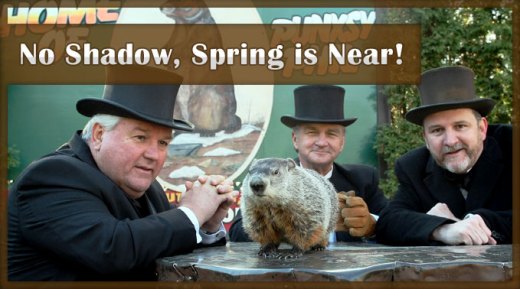
It seems that Phil in Punxsutawney, PA did not see his shadow either.

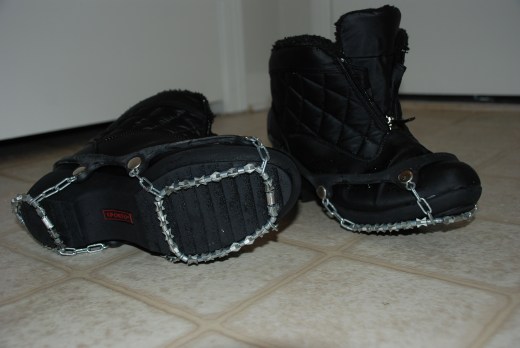
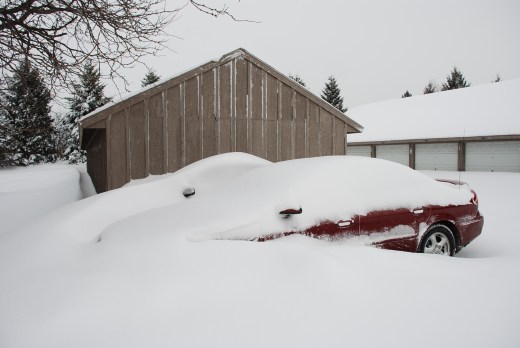
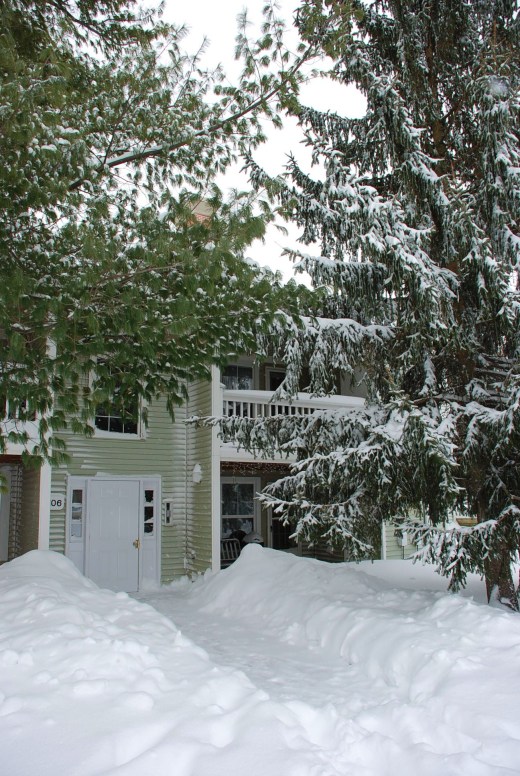
Any groundhog leaving its burrow in Michigan this morning would not have seen its shadow.  If winter ends early, as predicted by the groundhog, it would be good news to all of us now digging out from under at least a foot of new snow.  My 5 am “don’t come to work” phone call let me sleep a few extra hours.  When I did finally crawl out of bed, I put on my Ice Trekkers and braved the heavy snow.

Ice Trekkers, snow treads for your shoes. A Christmas gift from my brother.

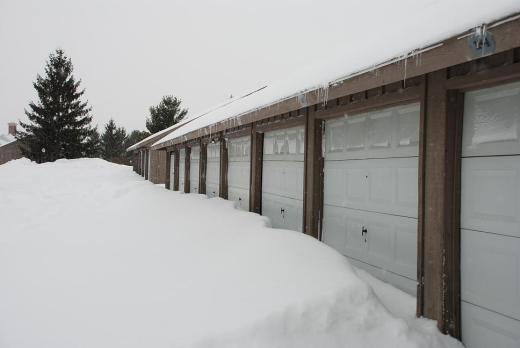
No one is going anywhere for a while.

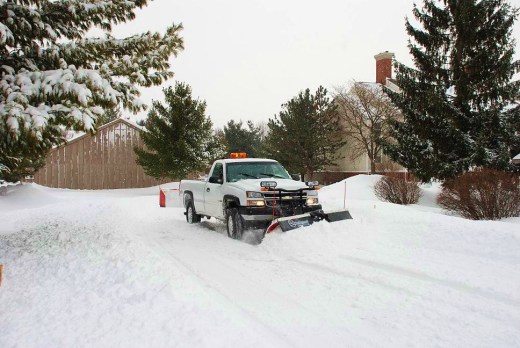
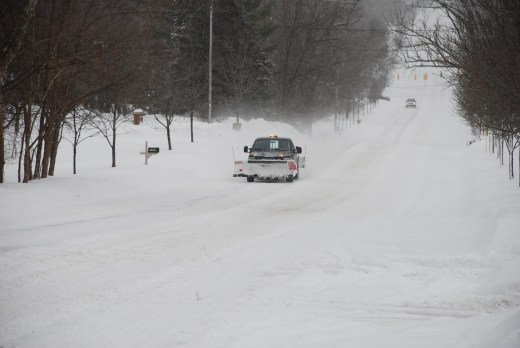
Snow plow trying to clear the local road.

The main road.

Our forecast here in Michigan is for the snow to pass and the clouds to start clearing later tonight.  We are supposed to have partly cloudy skies tomorrow.  Thank goodness the groundhog said winter is ending soon.  I’m not sure how much more of this I can take.

Posted in Seasons & Holidays | Leave a comment

Essentials

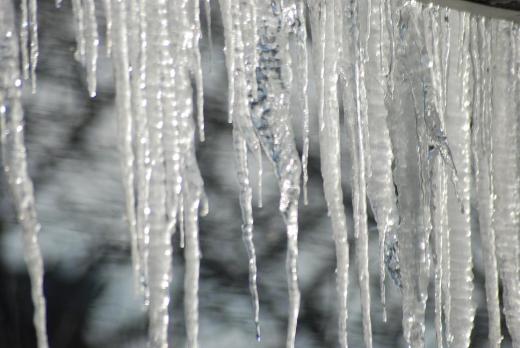
Icicles hanging from the roof.


Snow

When icicles are hanging from the roof and the temperature dips below the zero mark on the Fahrenheit scale, I turn to comfort food and wool clothing.  Having been raised by parents who were either from  the old country, or whose grandparents were, some of my comfort food is from scandinavia.  We grew up with certain foods and traditions, and now I find I can’t live without them.  Here are the best of Norway and Sweden that I can’t live without:

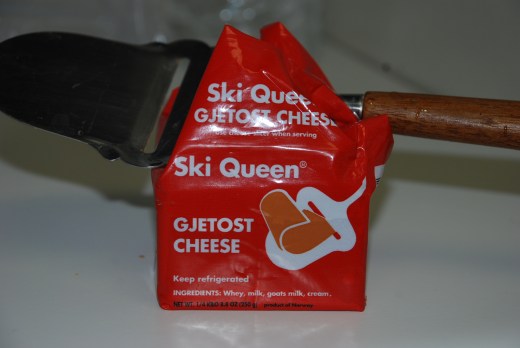
Norwegian Goat Cheese, Gjetost

Gjetost, Norwegian Goat Cheese

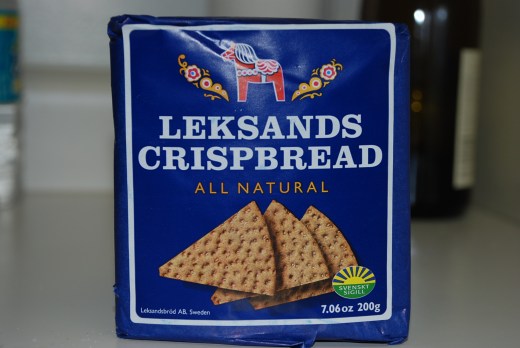
Swedish Flat Bread

Swedish Crispbread

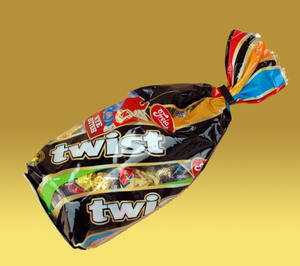
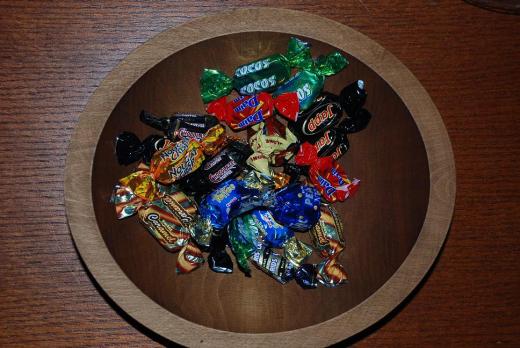
Norwegian Twist candies by Freia

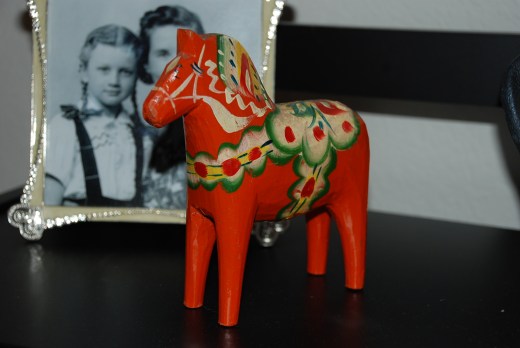
Swedish Dalecarlian horse, Dalahäst

Dalahäst

Norwegian woolens; sweater, scarves and mittens

Norwegian sweater, by Dale of Norway

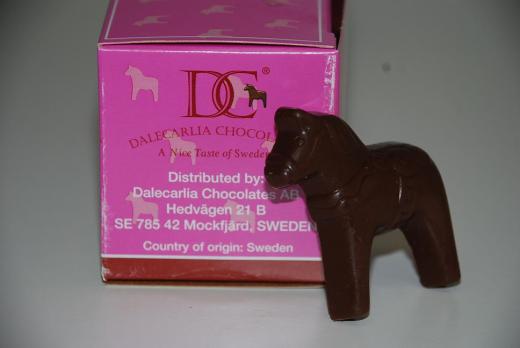
Swedish Dalecarlia chocolates

Dalecarlian chocolates

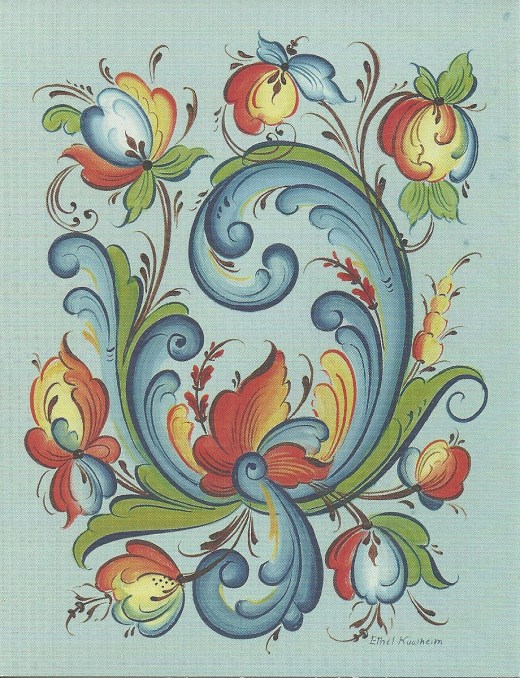
Norwegian Rosemaling painting

Telemark style Rosemaling, by Ethel Kvalheim

Posted in Family | Leave a comment

Diana, A Celebration

Diana, A Celebration exhibit handout

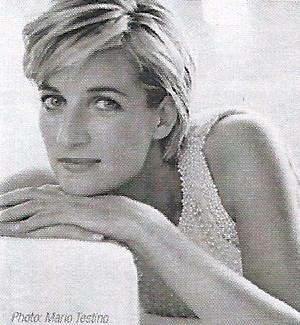
When it is 15 degrees outside, I tend to look for indoor activities.  Luckily for me, the Grand Rapids Art Museum is hosting the Diana, A Celebration exhibit.  So I spent Thursday Jan. 20th at GRAM.  The exhibit is nine galleries of Spencer family jewels, childhood memorabilia, photo albums, film clips, Spencer family tree information, Diana’s dresses and of course, Diana’s wedding dress. 

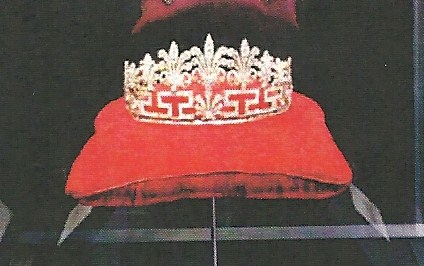
The exhibit starts out with the Spencer family’s stunning diamond tiara.  The next room is filled with Spencer family jewels, paintings of the Spencer women, photos of the Anthorp estate and one wall with the Spencer family tree.  (http://www.althorp.com/)

Spencer family diamond tiara.

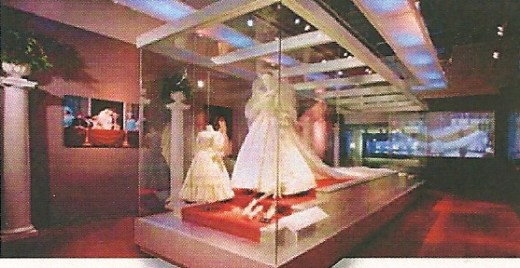
The exhibit takes you through Diana’s childhood with film clips of her first birthday and other childhood activities, all taken by her father.  You are able to view her childhood passport and school report card among other personal items.  These rooms educate the visitors with her background in preparation for the grandest room of all, the wedding dress room.  The exhibit claimed that Diana said it was one of the best days of her life, no big surprise here.  She was only 20 when she married Prince Charles and became Her Royal Highness.  A film loop of the wedding day plays on the wall while her wedding dress, with the train fully extended, takes center stage.  Included in the glass enclosure are the tiara she wore at the wedding, her shoes, and the bride’s maids dress.

The room with Diana’s wedding dress on display

One room of the exhibit is dedicated entirely to Diana’s charity work, including hand-written letters and many photographs.   The next room in the exhibit is dedicated to her death.  A large screen plays film clips of her funeral while Elton John sings his modified “Candle in the Wind” for Diana.  The text of her brother’s eulogy is displayed on the wall.  You can’t be in this room without getting choked up.  Near the end of the exhibit is the room of Diana’s dresses.  There are dress suits, short dresses and evening gowns from her early days through 1997, the year of her death.  Many of the gowns are accompanied by photos of Diana in the dress.  The dresses looked much better, more stylish, actually on Diana, than on the mannequins, but it was wonderful to see the actual dresses.  One orange dress suit looked rather garish on the mannequin, but in the photo of Diana wearing the dress, it looked beautiful.  This room was very crowded as the visitors took their time gazing at the dresses.  I heard many conversations of which dress was a favorite, and other such comments.  The day of my visit, I saw only two men in the crowd.  The Today Show had been filming earlier in the day, for a Today Show segment to run today, Friday Jan. 21st.

The exhibit ends in a gift shop, naturally.  I had no plans to purchase anything, but the little heart-shaped earrings whose “design is inspired by the tiara Diana, Princess of Wales wore on her wedding day 29th July 1981” were very nice and sparkly, so I ended up taking them home.

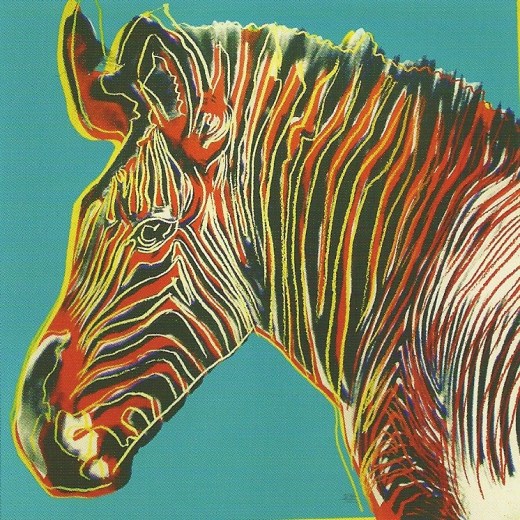
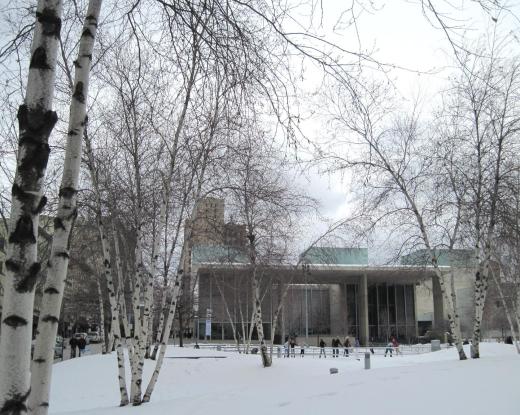
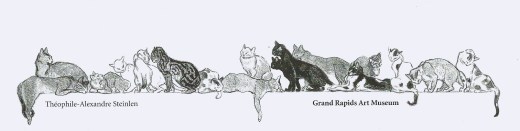
The Grand Rapids museum also houses a collection of Andy Warhol works called “Endangered Species” and an exhibition called “100 years – 100 Works of Art”  (http://www.artmuseumgr.org/).

  Masselink-copy

From the 100 years / 100 Works of Art exhibit

Andy Warhol’s “Endangered Species: Grevy’s Zebra”, 1983


Andy Warhol's "Endangered Species: Africa Elephant". 1983


The exterior of the Grand Rapids Art Museum.

This post is dedicated to my dear friend Joanie, who is planning on taking April 29th off from work so she can watch the wedding of Prince William and Kate Middleton.

Posted in Uncategorized | 2 Comments

A Lion in Winter

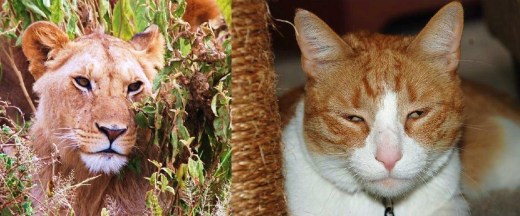
A lion at Grumeti camp, Tanzania; Barcley

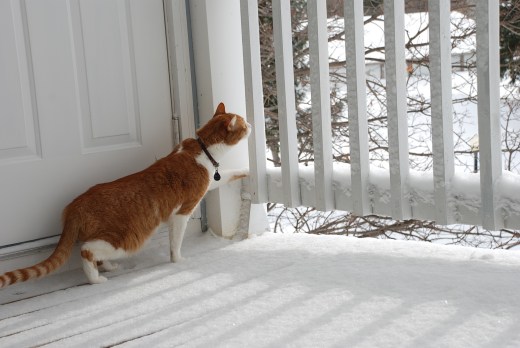
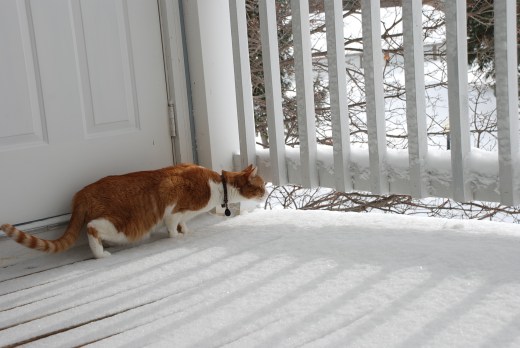
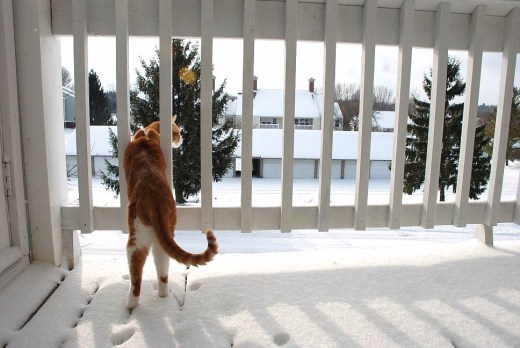
During my recent move from Florida to Michigan, I wasn’t alone.  My two cats were forced to make the move as well.  They weren’t happy about it and made their feelings known.  In Florida they were inside/outside cats with their own kitty doors, spending most of their time outside.  They loved lounging in the sun and hunting for mice, lizards and snakes.  Barcley is the closest thing you can find to a lion that weighs less than 20 pounds.  He walks like a lion, loves to stalk prey and is very aggressive.  The transition from outside Florida cat to inside Michigan cat has been rough.  Our first location in Holland did not have any outside access for the cats.  Our new place in Grand Rapids has a deck.  After a night of continuous snow, the deck had a nice covering, so Barcley got his first real taste of Michigan winter.  

The King of Beasts, surveying his domain.

Posted in Family, Seasons & Holidays | 1 Comment

A Heritage of Snow and Transportation

By all accounts, I should be comfortable in the snow.  Although I have lived in Florida for the past 24 years, my roots are definitely deep in the snow zone.  My father was born and raised in Norway, and my parents met at Timberline Lodge on Mount Hood in Oregon.  I learned to ski on Mt. Hood, and enjoy visiting the mountain and Timberline Lodge when I travel home to Oregon. 

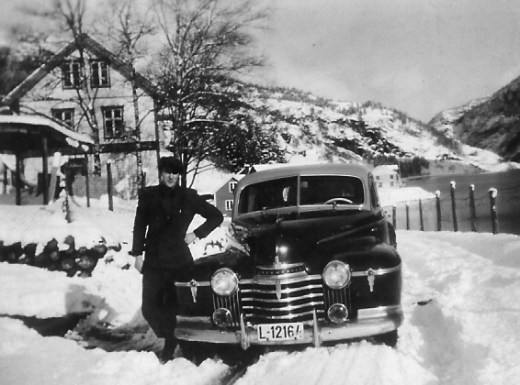
My dad in his hometown in Norway in 1948. My dad used this 1941 Oldsmobile as a taxi and put 300,000 miles on it.

Timberline Lodge postcard

My parents were both working on the mountain in the 1950s when they met.  My father drove a sno-cat, taking skiers to the summit and running rescue missions.  My mother worked selling lift tickets and as a waitress in the dining room.  My father was awarded a special “Over-The-Snow” plaque for his record-breaking 69,000 miles driven in a sno-cat.  All his life my father has nurtured a passion for motor vehicles, and has racked up the miles in either taxis, sno-cats or trucks.  My sister and I have followed in those transportation footsteps and continue the family tradition and love of moving vehicles; she in trucks and me in airplanes, and both of us on motorcycles.

My dad accepts his "Over-The-Snow" plaque.

My dad told us stories of the skiers and climbers he had rescued over the years.  Timberline Lodge is a classic ski lodge, whose exterior was featured in the movie “The Shining.”  The original old lodge has a huge fireplace and wood carvings throughout, and boasts the only year round glacier skiing in the US. 

A photo from the book "Timberline and a Century of Skiing on Mount Hood" by Jean Arthur

A snocat on Mount Hood.

My dad and skiers at 10,000 feet, taken Christmas 1956.


My mom and her dog Kushki on a chair-lift at Timberline.

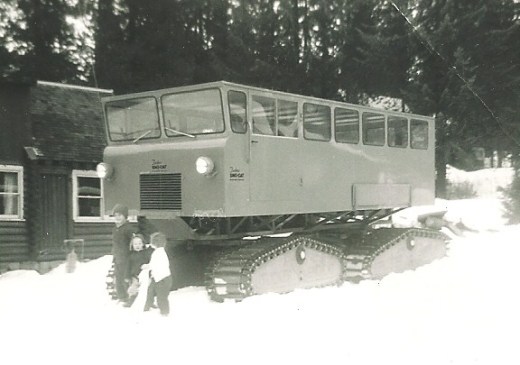
This sno-cat is parked in front of my parent's log cabin in Government Camp, Oregon, Jan. 1961. My sister, three years old in this photo, is standing in front of the sno-cat.

I love to ski and vacation in the snow, and am enjoying the snow this winter.  However, after many months of having to drive to work in the snow, the fun factor may change, and I am still looking forward to heading southbound and back to Florida.  (Special thanks to my mom, who not only saved all the old black and white photos and newspaper articles, but who also dug through many boxes to find the ones I wanted and then sent them to me.)

Snowcat postcard.

Posted in Family | 2 Comments